Living in central Córdoba, Argentina: the old city
Living in central Córdoba: 27 de Abril, Obispo Trejo and Vélez Sarsfield; pedestrian streets lead to the markets, the bus terminal and Nueva Córdoba.
Score your own address
Everything this article covers, you can check on your own address: free, in a minute.
Free. The score at once, the full report after an e-mail sign-in.
Contents 15 sections
The oldest part of the city
The centre is the oldest part of Córdoba, built around Plaza San Martín and the cathedral. Next to it are the Jesuit Block, a World Heritage site, and the building of the old university.
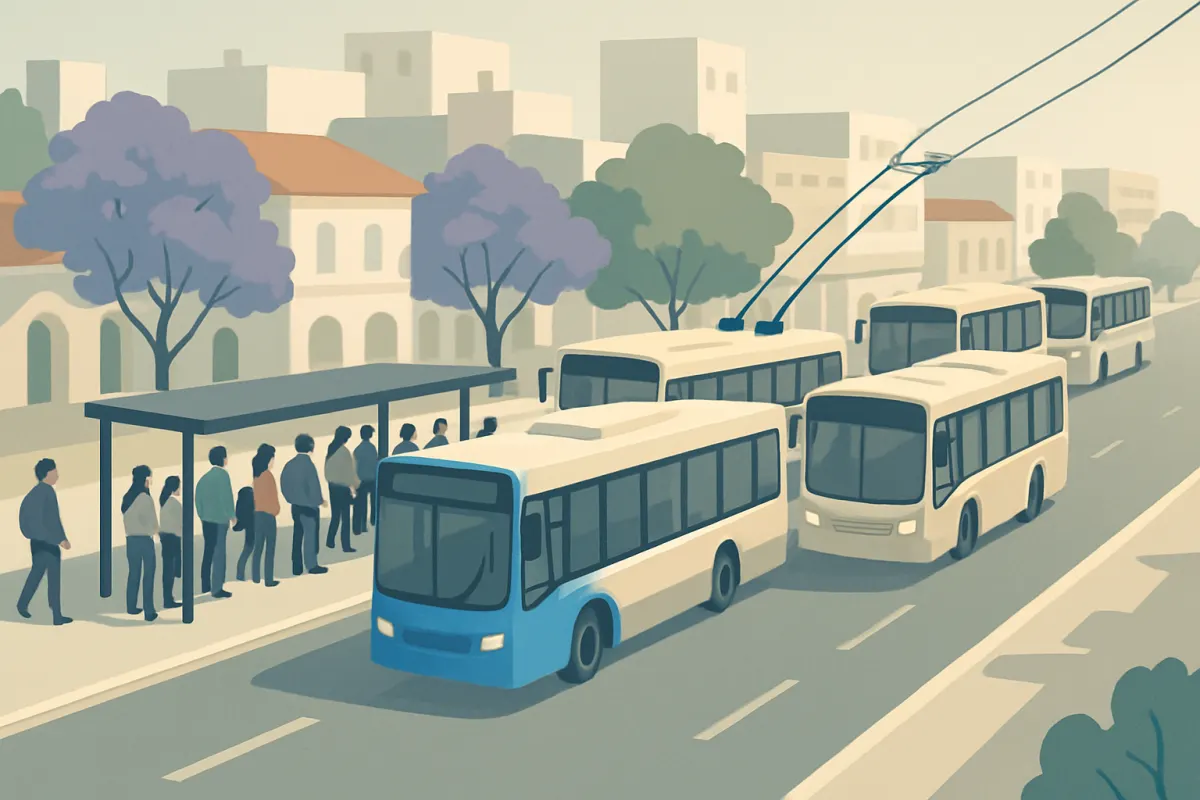
By day it is loud: offices, banks, shops, students. In the evening some streets empty out, while those towards Nueva Córdoba fill up with bars.
On foot
Supermarkets, pharmacies, banks, hospitals and markets are all close. Along the pedestrian streets you can get every errand done without public transport.
Buses from all over the city converge on the centre, and the bus terminal and Nueva Córdoba are within walking distance.
What we measured
We scored addresses on 27 de Abril by the cathedral, on Obispo Trejo and on Avenida Vélez Sarsfield. For the last two, the map only knows the street.
| Address | Score | Groceries | Station or stop | School | Park | Noise and air |
|---|---|---|---|---|---|---|
| 27 de Abril, 350, Córdoba | 85.7 | 2 min | 2 minBelgrano 65 | 2 min | 1 min | −5.5 |
| Obispo Trejo y Sanabria, Córdoba | 82.2 | 2 min | 2 minBulevar San Juan 125 | 6 min | 6 min | −5.8 |
| Avenida Vélez Sarsfield, Córdoba | 79.1 | 3 min | 1 minAv Velez Sarsfield 620 | 7 min | 6 min | −8.2 |
A point and its table row carry one number. Press plus for a closer look.
The page How the score works walks through the score.
Who it is for
- University students.
- People who work downtown.
- Retirees who need everything close at hand.
The downsides
Days are loud and crowded. At night some blocks go empty and feel uneasy on foot. Old buildings need repair, and parks are scarce.
Housing
Mid-century high-rises, old houses with tall ceilings and small new buildings. Flats are often compact.
Rent is lower than in Nueva Córdoba and the choice wider; many flats are let to students.
What to check
Ask whether the building has security or a doorman and what the monthly expensas come to. Walk down the street in the evening.
Children
There are schools, but few playgrounds and little green. Families go to Parque Sarmiento, which is not far.
Summer and winter
In summer the centre bakes as the stone heats up. Winter is dry and sunny, with cool nights.
Getting to work
Most people work right here or close by, and buses reach every part of the city.
Without a car
Life without a car is easy, while parking downtown is hard to find and costly.
The centre and the northern barrios
Córdoba is Argentina’s second-largest city and a major university town. Many families have moved to the northern barrios, but business, study and transport still meet here. Those who choose to live in the centre want everything nearby.
If you buy
Investors often buy flats here to rent to students, so there is plenty on the market. Deals are done in dollars through a notary. Find out the monthly cost of running the building, and check that it owes nothing to its suppliers.
Weekends
At weekends the centre empties: offices are shut and many residents drive out to the Sierras de Córdoba, an hour away. Those who stay stroll the pedestrian streets and visit the museums of the Jesuit Block.
Neighbouring barrios
Around the centre lie Nueva Córdoba, General Paz, Güemes and Alta Córdoba, each covered on a separate page.
Questions
Is the centre of Córdoba a good place to live?
It suits people who want everything close at hand: universities, work, banks, hospitals and markets. Every errand can be done on foot, with no car. In return, days are loud and crowded, some blocks empty out at night, parks are few and the old buildings need repair.
Do you need a car if you live in central Córdoba?
No. Buses from the whole city converge on the centre, and along the pedestrian streets you can get everything done on foot. People walk to the bus terminal and to Nueva Córdoba too. A car is more of a burden here, as parking is hard to find and expensive.
What flats are for rent in central Córdoba?
Flats in mid-century high-rises, in old houses with tall ceilings and in small new buildings. Most are small, and many are let to students. Rent is lower than in Nueva Córdoba and the choice is wider. Before you sign, ask about the building’s running costs and security.
Is central Córdoba a good place for children?
There are schools, but few playgrounds and little green space. Parents take children to Parque Sarmiento, which is close by. Families who want a yard and quiet usually feel more at home in the northern barrios, where many of them have already moved.