

How to read an address report: step by step in Madrid
How to read an address report: score, confidence, categories, penalties and What is missing, step by step, on Gran Vía 28 in Madrid, 87.6 out of 100.
How to read an address, district by district: walking minutes, noise, air, cycling and the cost of living, on real addresses in ten countries.
How to read an address report: score, confidence, categories, penalties and What is missing, step by step, on Gran Vía 28 in Madrid, 87.6 out of 100.

Choosing a flat with a dog: the park, the dog run and the vet in minutes from home. Four Madrid addresses and the Pet owner profile.
A flat for a year: school, doctor, noise every night, air and your own places. What to add to the checks for a monthly let, on six Barcelona addresses.

The first week after a move, without a car: groceries, pharmacy, bank, SIM card, metro and a doctor. What should be close, shown on Madrid addresses.

Valencia for two without a car: El Carmen up to 95.4, Ruzafa up to 91.7, the centre 95.5 with no-car, no-kids weights. Minutes to market, metro, park.
Eixample or Gràcia: where is it quieter to live in Barcelona? At six addresses noise costs 0 to 4.52 points, and the street decides, not the district.

Can a bike replace a car? Bike share 2 minutes away, parking, lanes within a kilometre and the ride to the centre, checked on addresses in Seville.
Where to live in Madrid as a remote worker: coworking 8–9 min from Gran Vía and Plaza de Olavide, work scores 36.2 to 94.5. What to check in a report.
On the sea or ten minutes from it: in Málaga beach addresses score 77.5 to 80.6, the historic centre up to 94.4. What the front line gives and takes away.
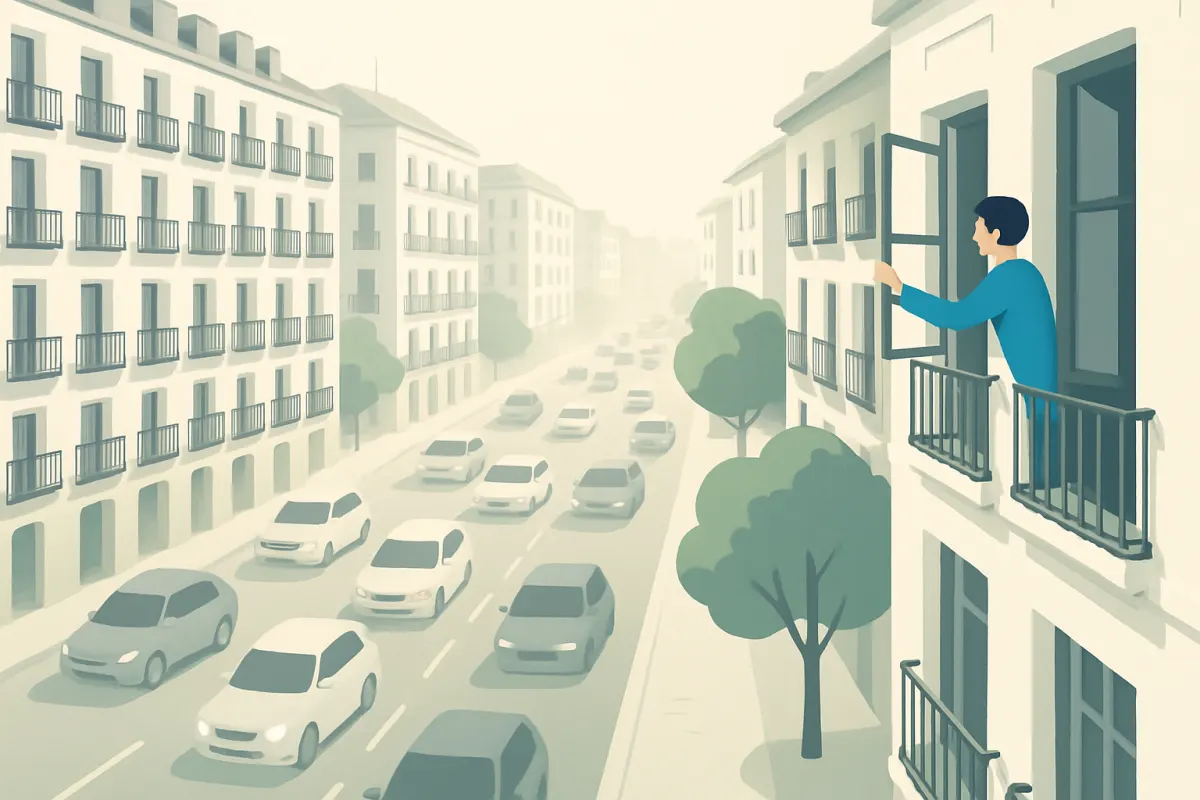
How a busy street affects the air and noise at home: in Madrid the noise penalty runs from 0 to 5.64 points on nearby streets. What to read in a report.
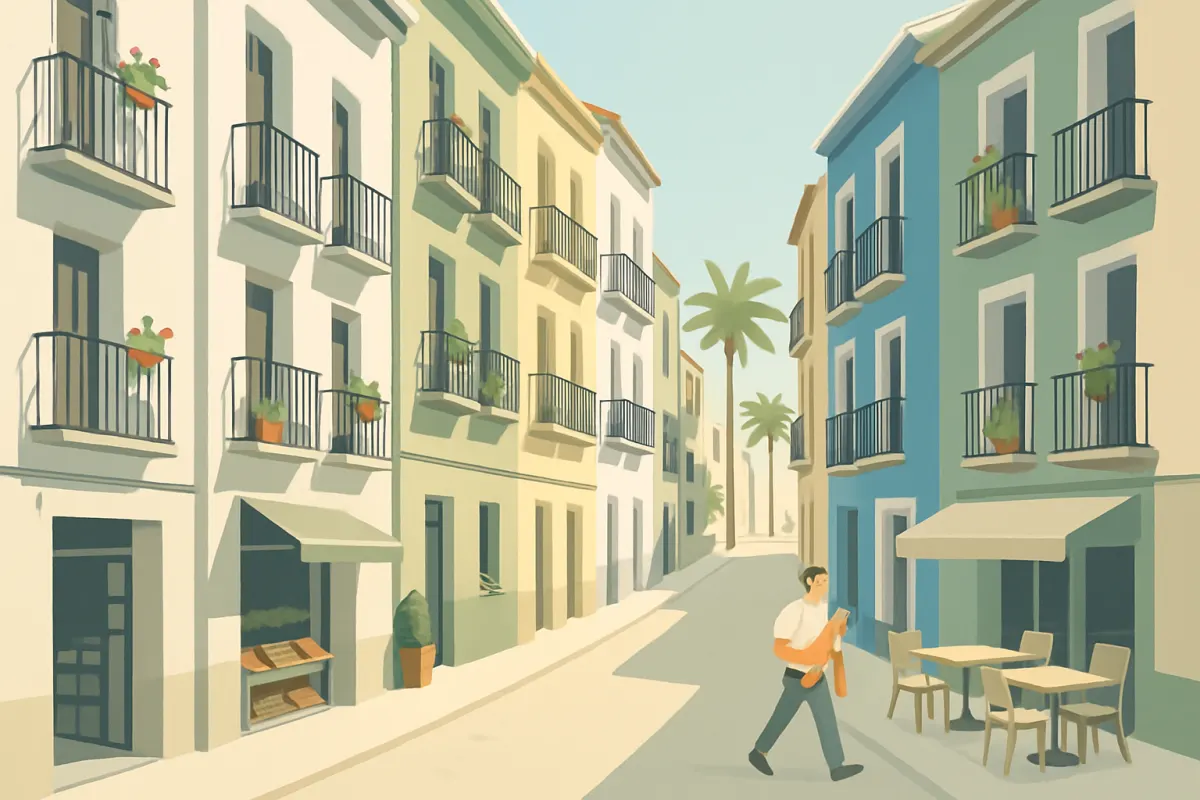
Central Alicante scores 88.5–91.9, Playa de San Juan 65.4–70.1. Six addresses in minutes: where the beach is closer, where the school, shop and tram.

Triana or Nervión: six Seville addresses by minutes on foot. Nervión: nearer the metro, quieter. Triana: shop and school close, noise up to 8.68.

30 addresses in 10 Alicante districts: average score, noise and minutes to a stop in one table. The centre 90.7, San Blas and La Albufereta the loudest.
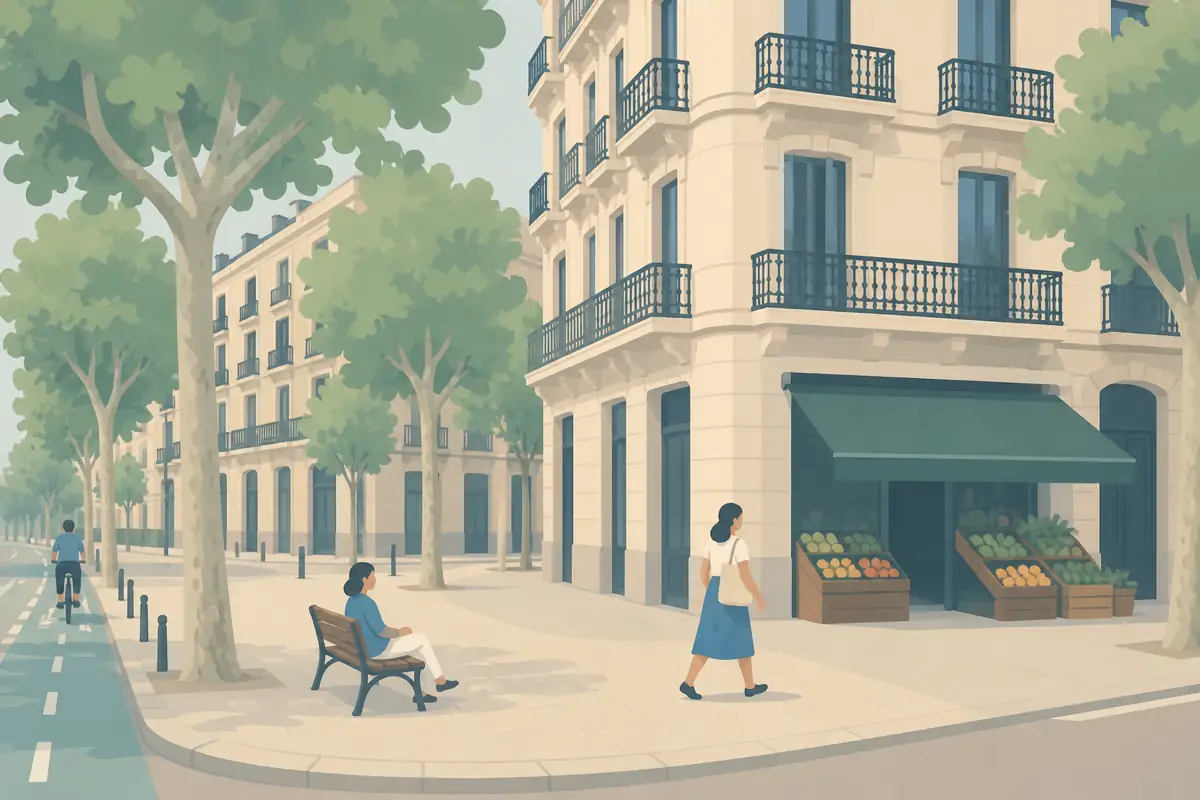
42 addresses in 14 Barcelona districts: average score, noise and minutes to a station in one table. El Born 94.2 with no noise, Sants the loudest.
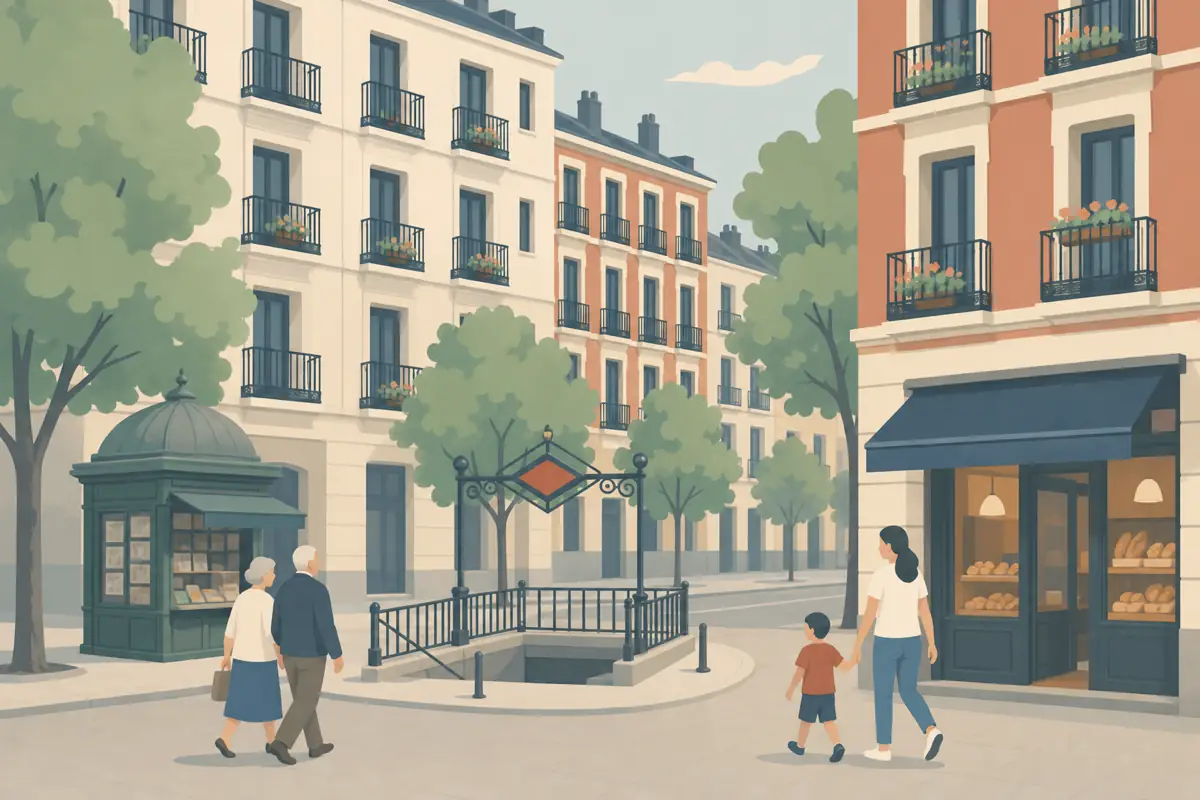
Fifteen Madrid neighbourhoods, three addresses each: Malasaña averages 95.1, Valdebebas 67.0. Where the metro is near, which avenues are loud.
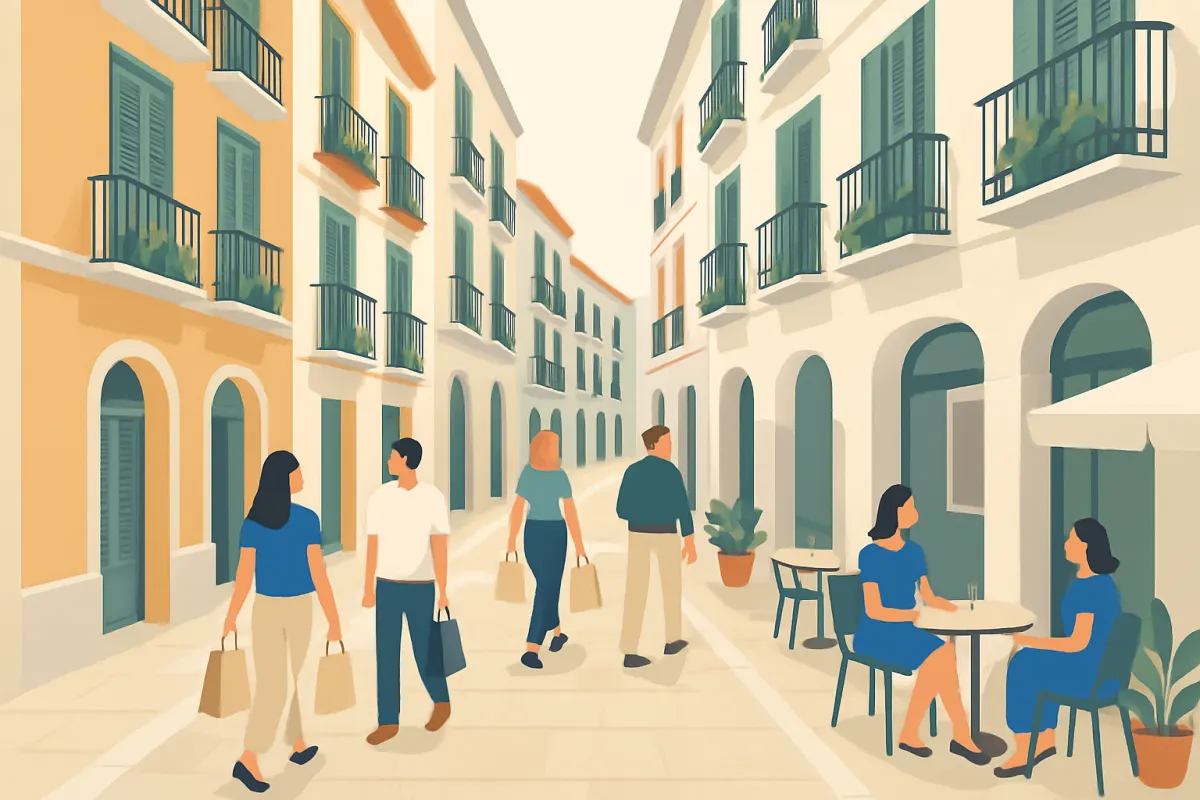
Central Málaga or La Malagueta by the beach: six addresses by minutes on foot. Average scores 93.0 and 79.2. Why a school is 18–20 minutes from the sea.

36 addresses in 12 Málaga neighbourhoods: average score, noise and minutes to a station in one table. Soho leads on 93.4, El Palo is the loudest.

36 addresses in Seville and nearby towns: average score, noise and minutes to a station in one table. San Bernardo 86.2, Sevilla Este the loudest.
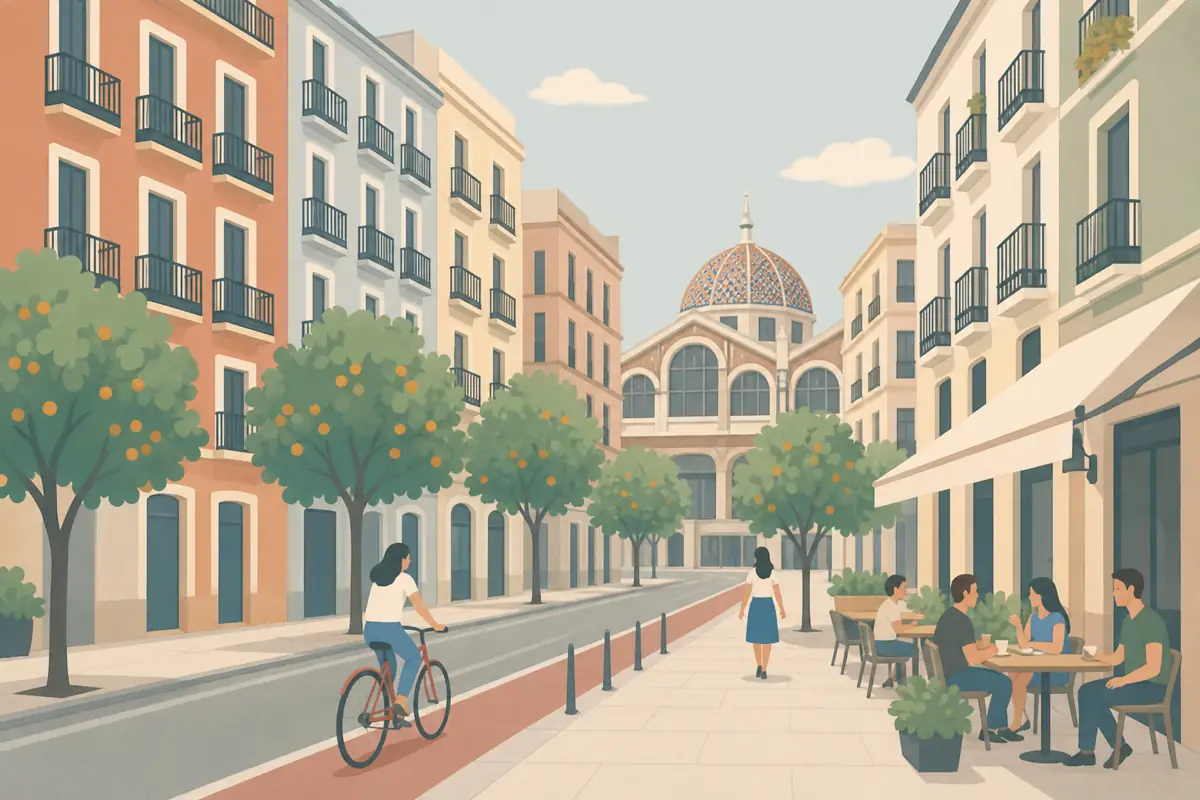
42 addresses in 14 Valencia districts: average score, noise and minutes to the metro in one table. El Carmen 95.2 and quiet, Patraix the loudest.

18 addresses in 6 A Coruña districts: average score, noise and minutes to a stop in one table. Monte Alto 90.8, Oleiros 46.3.
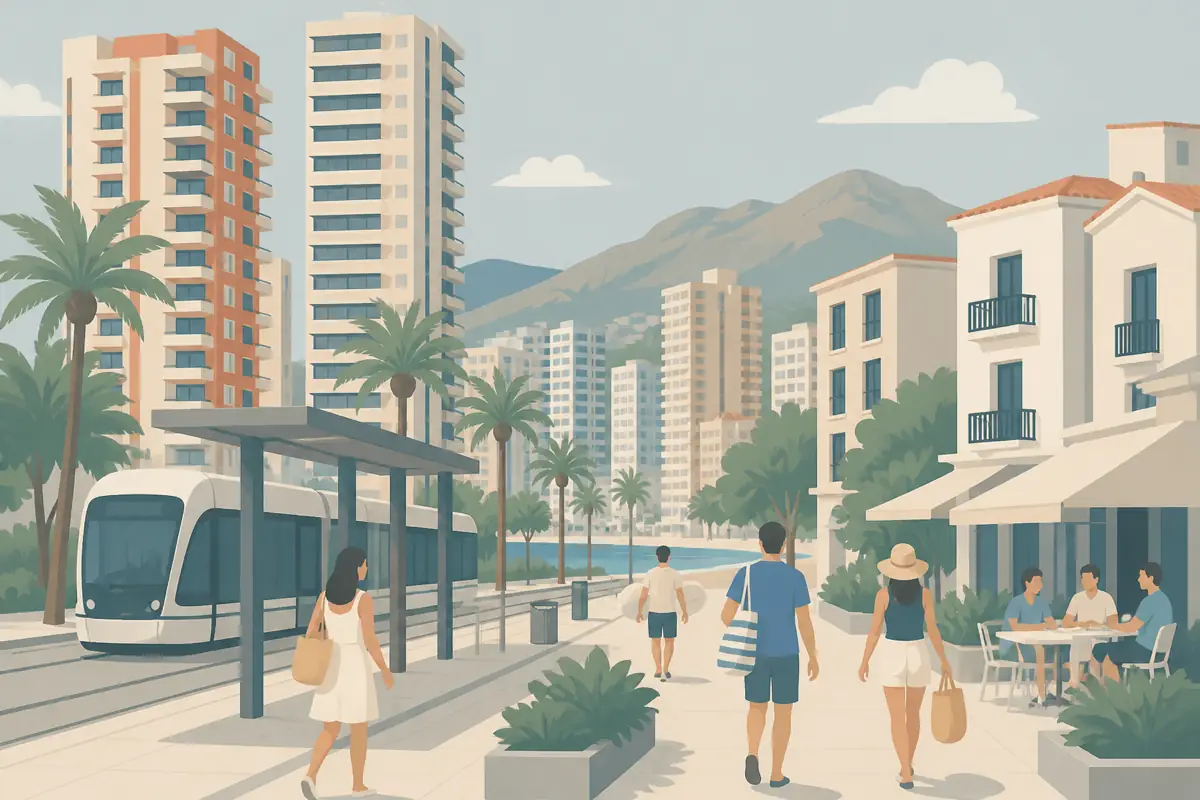
18 addresses in 6 Benidorm districts: average score, noise and minutes to the tram in one table. Foietes 91.8, Poniente 58.4.

Six Bilbao neighbourhoods, three addresses each: Indautxu averages 96.5, Getxo 88.0. Where the metro is close, which streets are loud, what to pick.
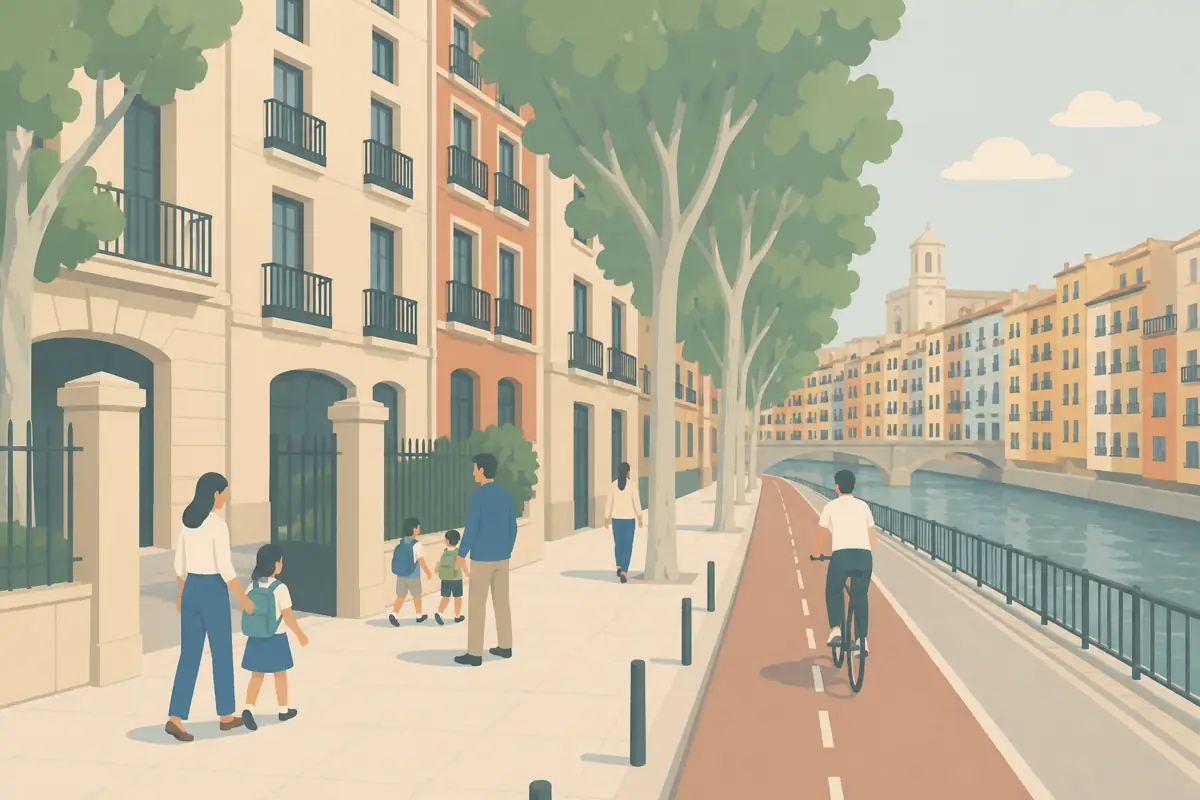
18 addresses in 6 Girona districts: average score, noise and minutes to a stop in one table. Eixample 91.6, Salt 69.5. You can see where it is quieter.

18 addresses in 6 Granada districts: average score, noise and minutes to the metro in one table. City Centre 87.6, Realejo 81.8.
15 addresses in 5 Las Palmas districts: average score, noise and minutes to a stop in one table. Alcaravaneras 91.3, Vegueta 84.6.

Four Marbella neighbourhoods, 12 addresses: the centre scores 78.3, Nueva Andalucía 32.9. Where life is on foot, where it is loud, where you need a car.
18 addresses in 6 Murcia districts: average score, noise and minutes to a stop in one table. Centre 91.0, Zarandona 48.1.

Six Palma neighbourhoods, 18 addresses: from 95.4 in the old town to 46.3 in Cala Major. Where it is quiet, where schools are close, which area suits you.
El Antiguo, Gros, the centre, Amara, Egia and Zarautz, three addresses each. City areas sit within 3.6 points; Zarautz trails by 12.4.

Centre, El Toscal, La Laguna and San Andrés: twelve addresses by minutes on foot. The centre averages 90.0, San Andrés 57.7. Where it is quiet.

Six Torrevieja neighbourhoods, 18 addresses: the centre scores 82.3, Aguas Nuevas 45.2. Where shops and schools are close and where you need a car.
El Carmen or Ruzafa: six Valencia addresses by minutes on foot. Average scores 95.2 and 90.1. Which has the metro closer, the Turia park, quieter streets.
15 addresses in 5 Valladolid districts: average score, noise and minutes to a stop in one table. Centre 91.1, Parque Alameda 61.6.
18 addresses in 6 Zaragoza districts: average score, noise and minutes to the tram in one table. Centre 93.7, Valdespartera 68.5.
Eixample or Gràcia: six Barcelona addresses in minutes on foot. Average scores of 90.0 and 90.4. How the metro, parks and Passeig de Gràcia noise differ.
Chamberí or Salamanca: six Madrid addresses by minutes on foot. Calle Ponzano, 30 scores 92.3, Serrano, 47 87.9. Quiet streets, metro and schools.

Three Valencia addresses: 6 minutes by bike from Ruzafa, 12 from Benimaclet, 24 from El Cabanyal. How the ride to the centre is timed and scored.
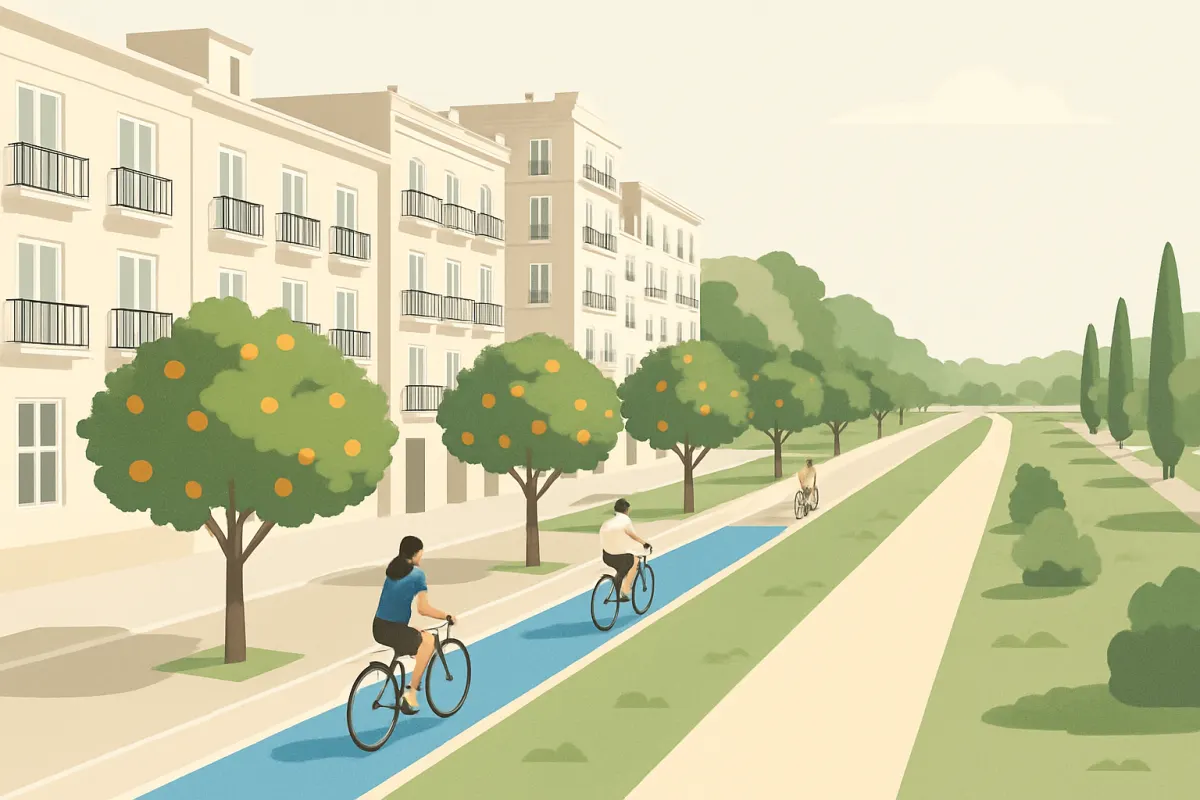
Twelve addresses in three Spanish cities: Benimaclet in Valencia scores 94.1, central Malaga 90, central Alicante 89.1. Where a wrong pick costs most.
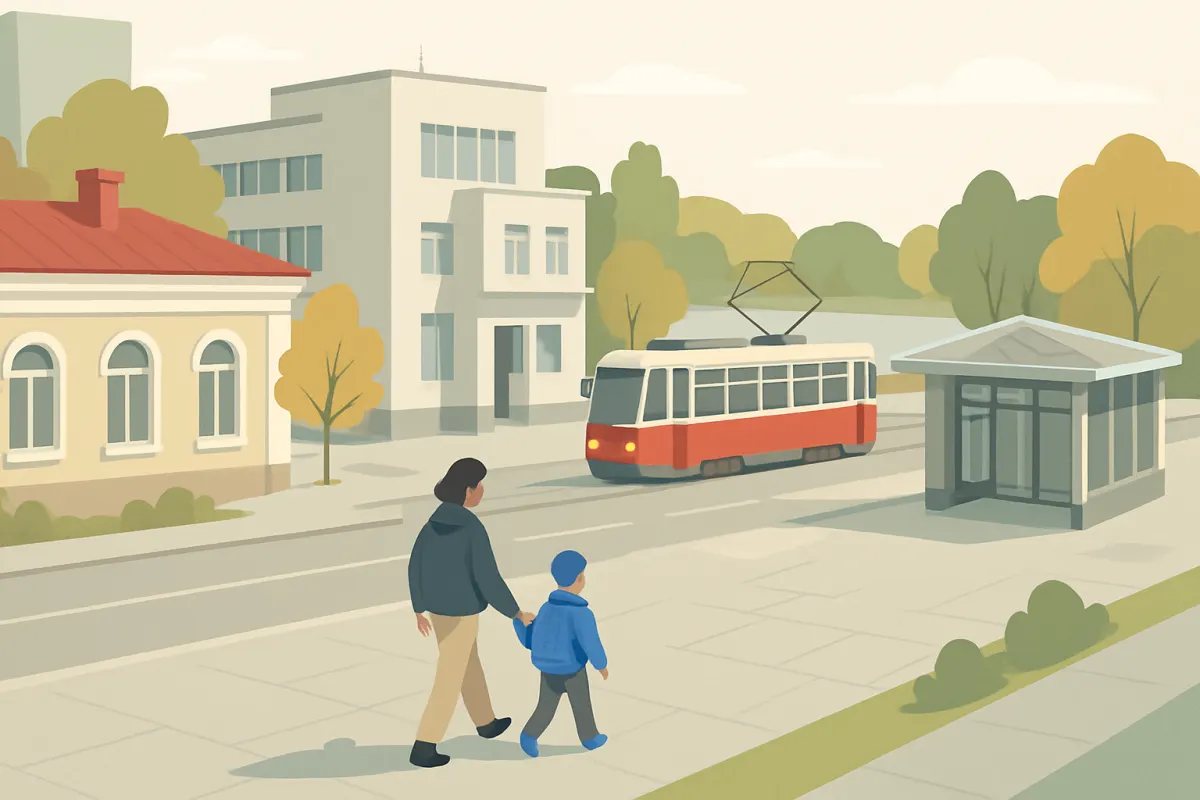
Centre or suburb for a family with a child: central Yekaterinburg and Akademichesky in minutes and with family weights, which erase the 8.4-point gap.
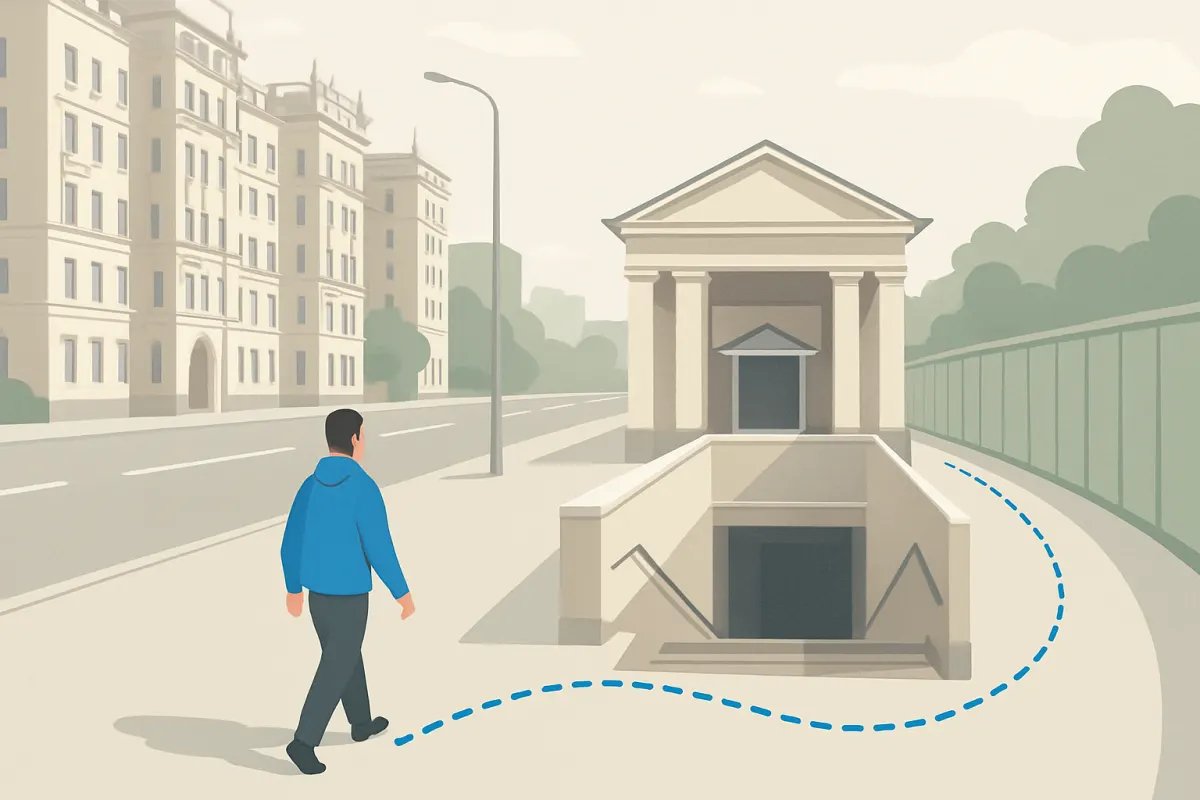
How long the walk to the metro really is when a listing says 600 or 900 metres, and how the score counts the way to a station. Moscow examples.
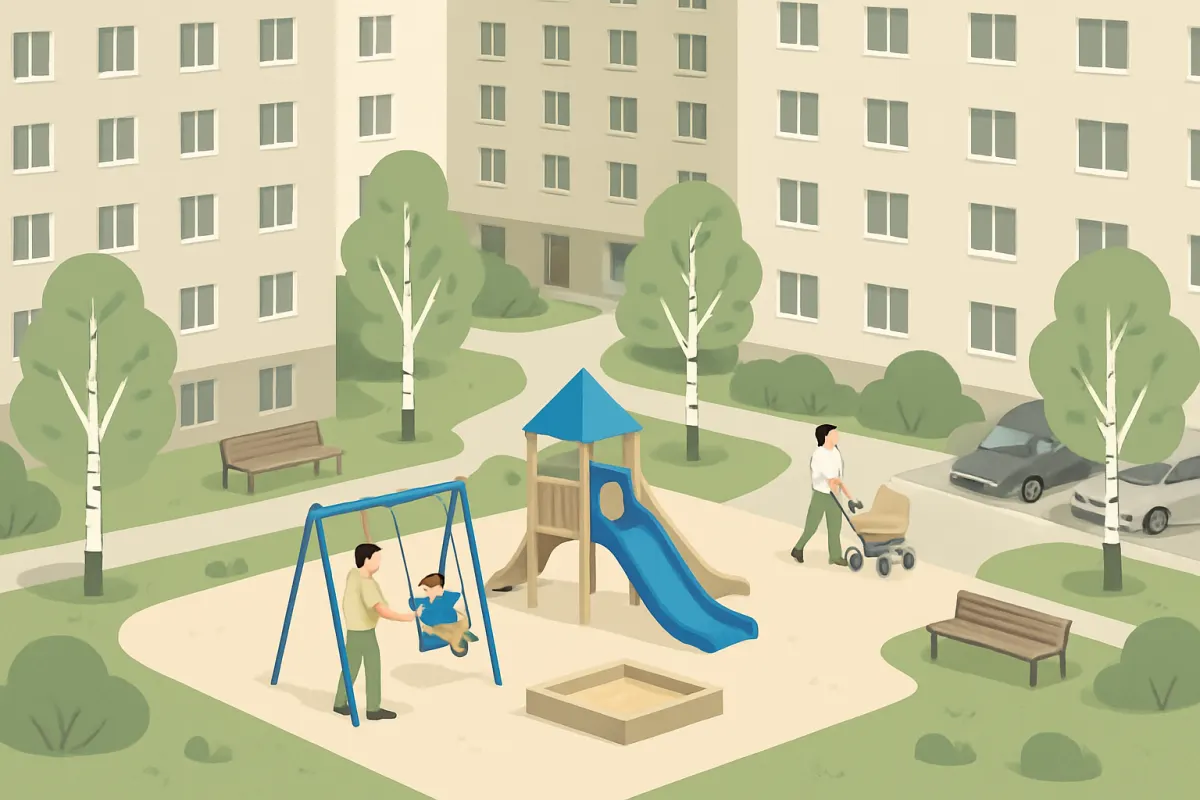
Kindergarten or playground near home with a toddler? Minutes with a child at six Russian addresses, and why the score wants the playground closer.

A lively neighbourhood in numbers, in Kazan: cafes are almost everywhere, but a theatre, cinema and library decide whether culture scores 100 or 44.
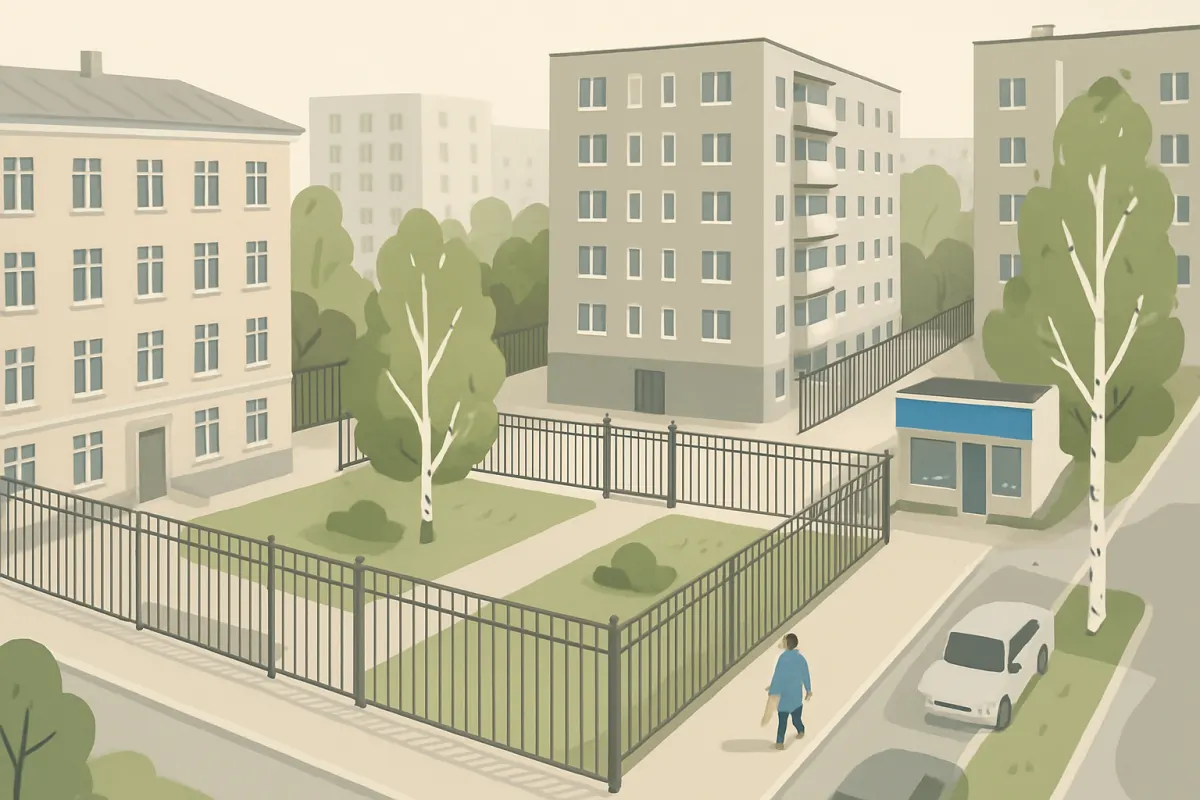
The shop across the courtyard looks close, but the courtyard is locked. How fences, gates and private drives lengthen a walk, and how the report shows it.

7 Universitetskaya Embankment scores 60.4; the 7th Line inland, 86.9. Why St Petersburg's grand centre can be awkward to live in.
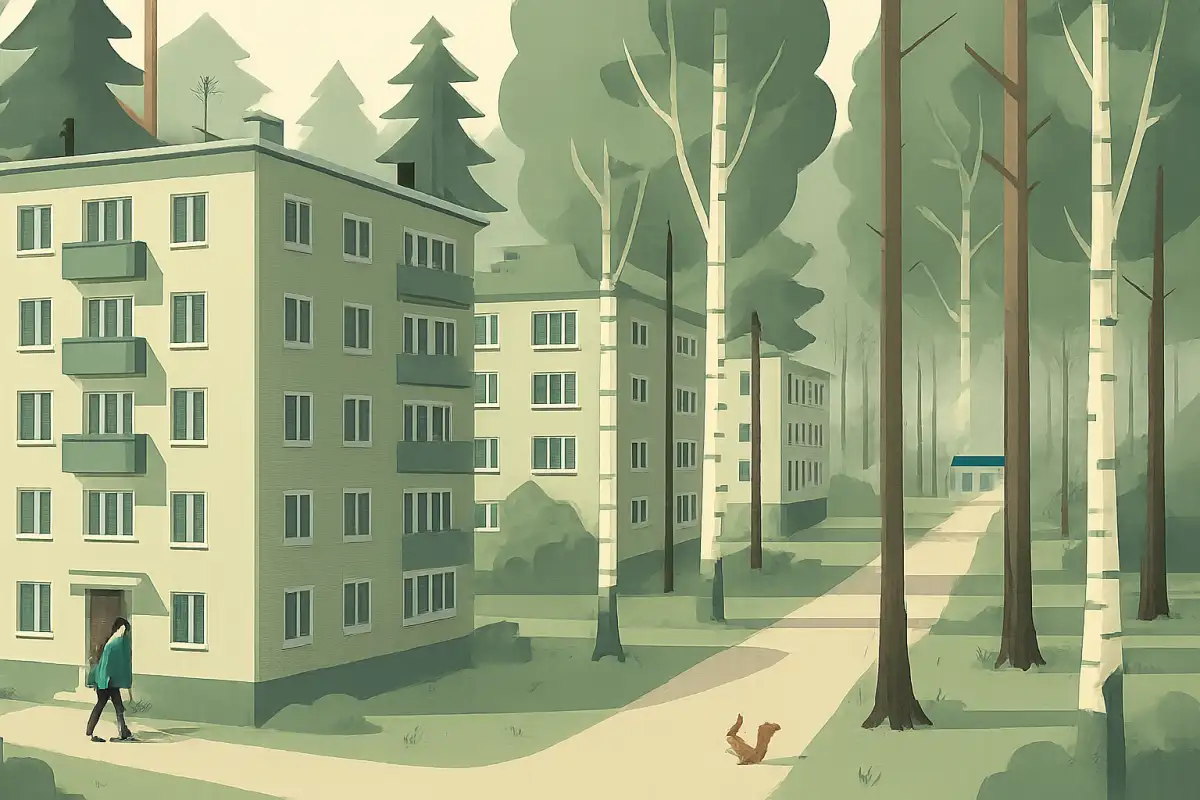
A forest by the door does not make a district convenient. Akademgorodok and central Novosibirsk: a park a minute away, the shop and school much less so.

Akademgorodok or central Novosibirsk over six addresses: a park 1–2 minutes away or the metro in five. Which is quieter, which is closer, scores 70–87.

Lunch when you work remotely: cook, go to a cafe or grab a pastry. Minutes to food at Moscow addresses, and why a cafe 15+ minutes away does not count.
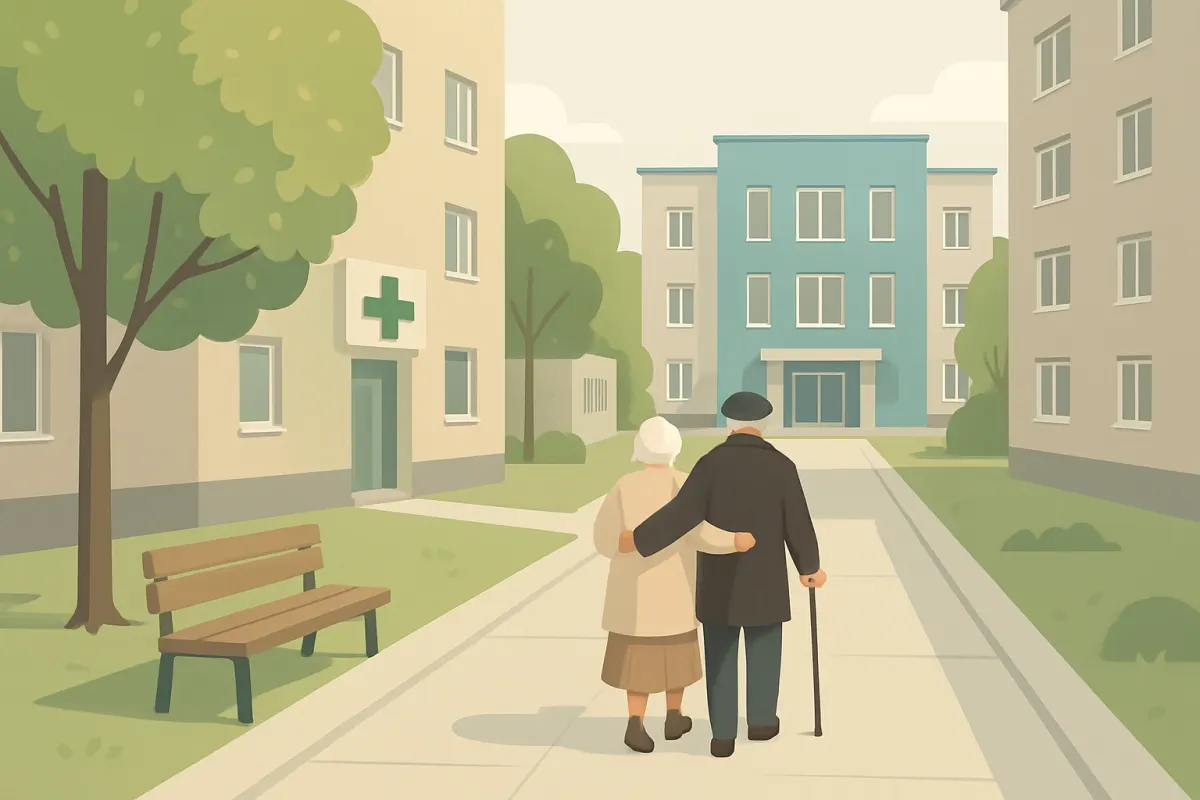
A Yekaterinburg district for elderly parents: nine addresses at 60 metres a minute. Where a pharmacy, doctor and park are close, and where noise intrudes.

Where to rent as a student in Kazan: two minutes from Kremlyovskaya Street to the university, metro two minutes from Peterburgskaya 1, 22–37 on the edges.
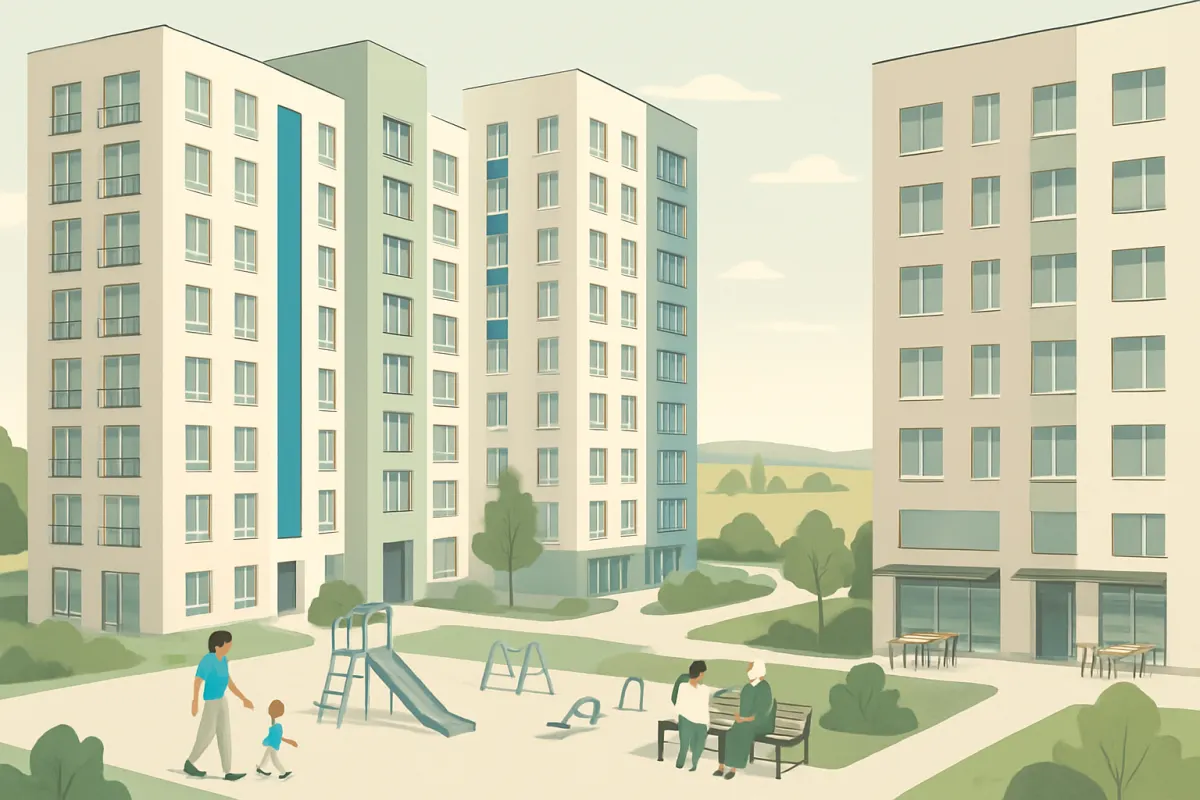
Outskirts or central Yekaterinburg: in Akademichesky groceries are 2–3 minutes away, the metro 34. Who in the family pays for cheap rent with their time.

Nine Sochi addresses by minutes on foot: 7 Navaginskaya Street in the centre scores 88.1, Adler loses up to 10 points to noise, Sirius gets 48.4 to 55.8.
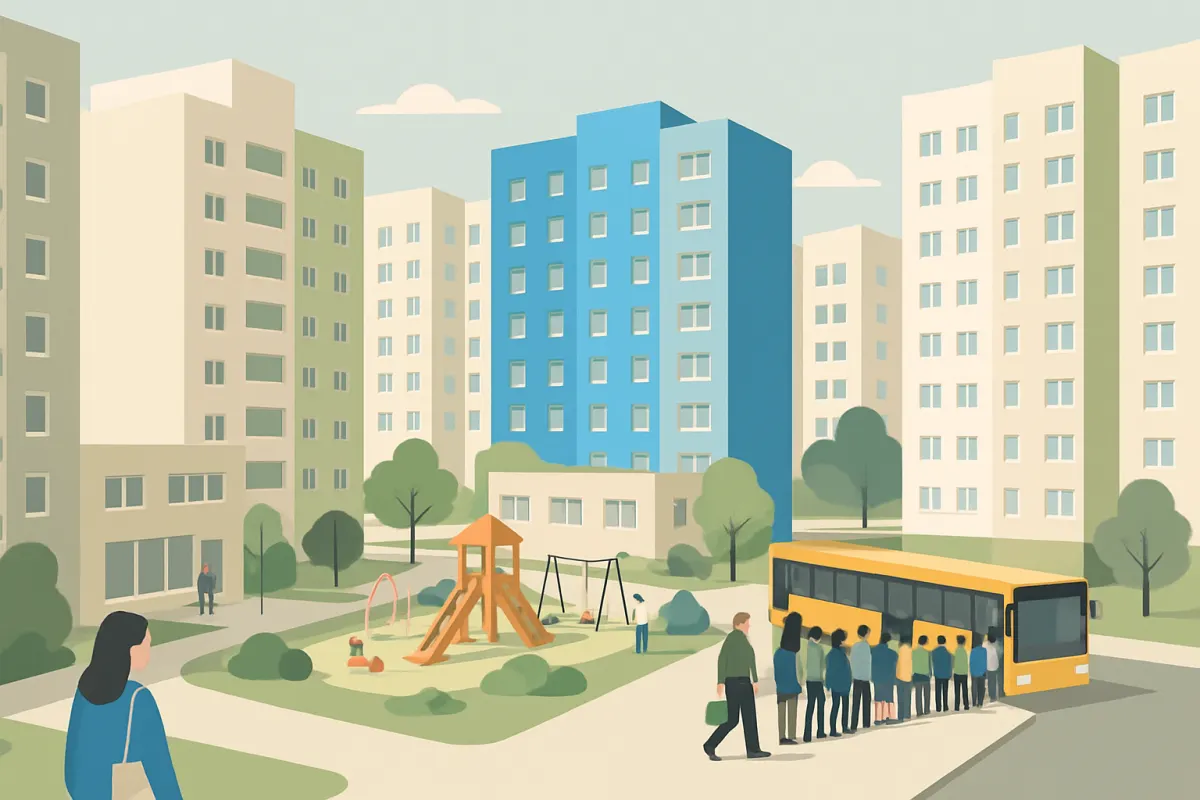
What living without a car saves: we count trips and hours at Yekaterinburg addresses, from the centre to Akademichesky. How to plug in your own prices.

How far the metro is in Saint Petersburg: from 1 minute on Nevsky to 11 on Universitetskaya Embankment. Nine addresses and what the minutes do to a score.

Moscow districts for living with children, at nine addresses: 4 to 13 minutes to school, 1 to 10 to a park. Khamovniki, Presnya and Ramenki by the minute.
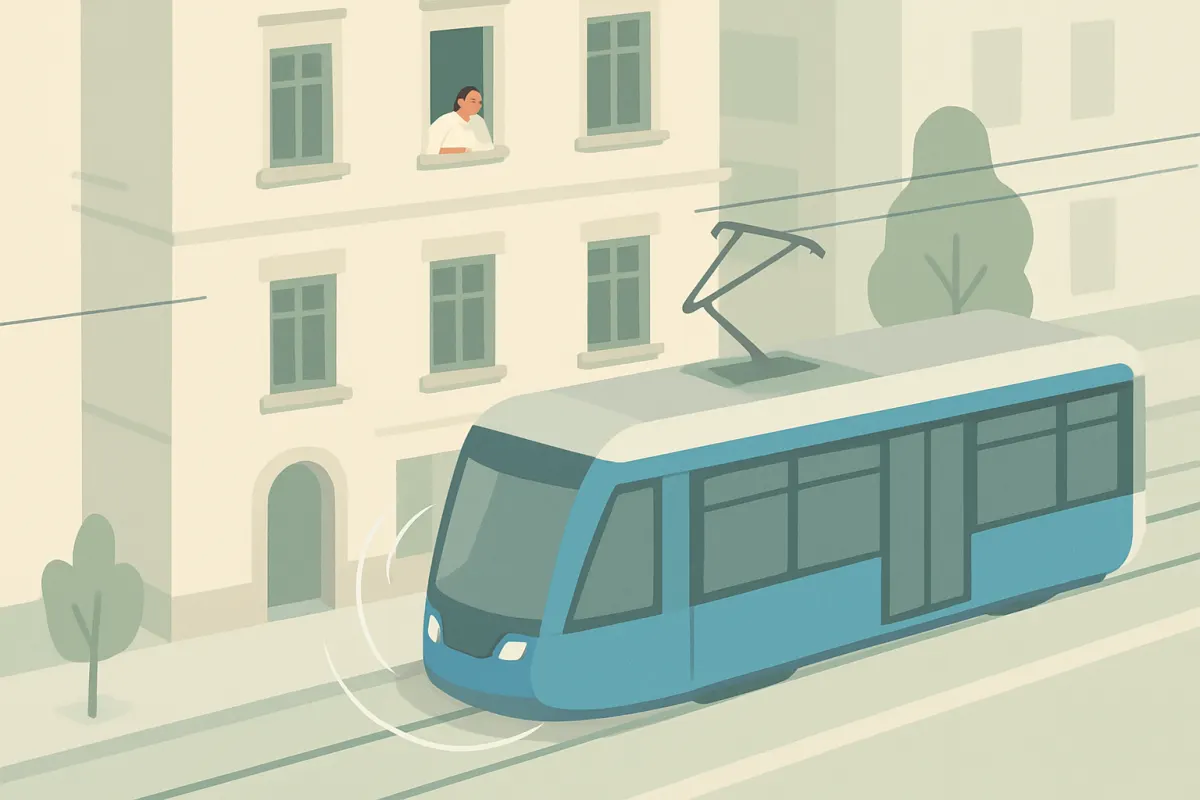
Which noise near home is worst: a tram, a highway, a railway or a bar. How many points each source takes off and at what distance the penalty disappears.
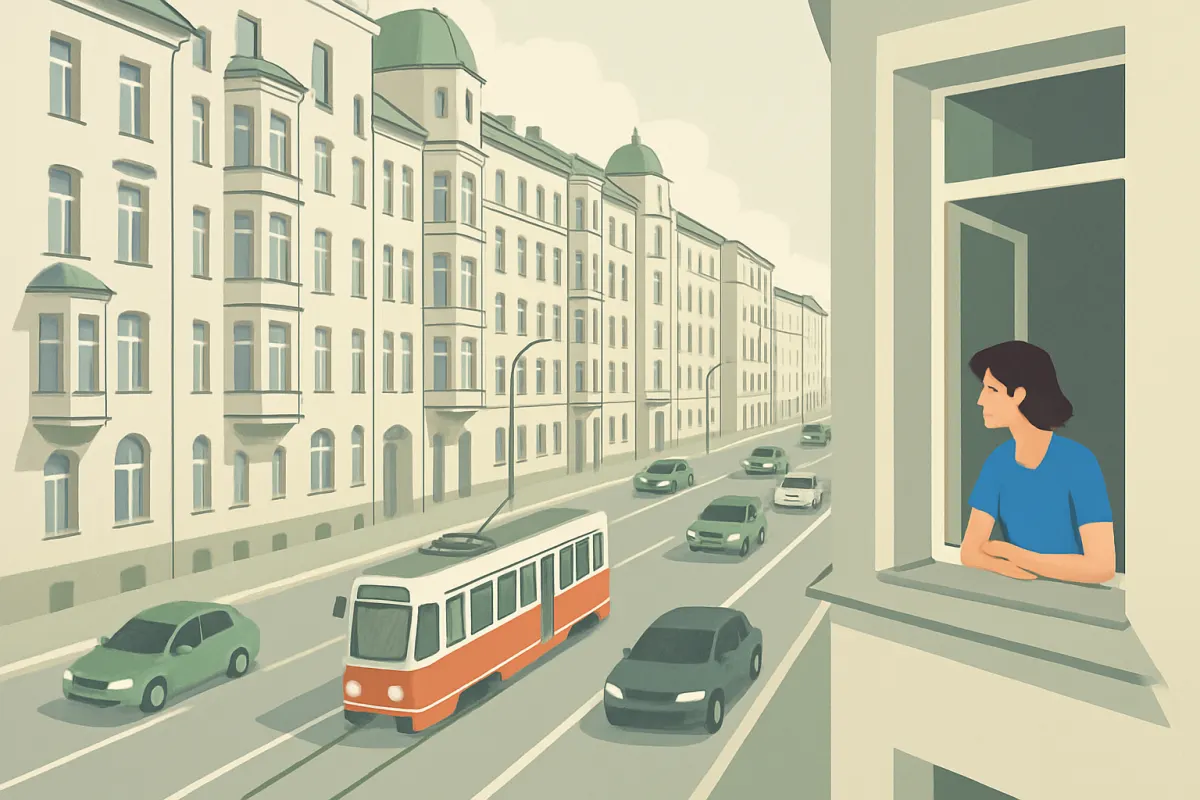
Courtyard or avenue: how much quieter a courtyard flat is by the noise formula, and why a building gets one figure. Six St Petersburg addresses.

An easy neighbourhood has groceries, a pharmacy, a bank, a post office and a bakery five minutes away. How to check an address, using Yekaterinburg.

Whether a child can walk to school alone depends on more than minutes: crossings, big roads, dark mornings. How to check the way, in Yekaterinburg.
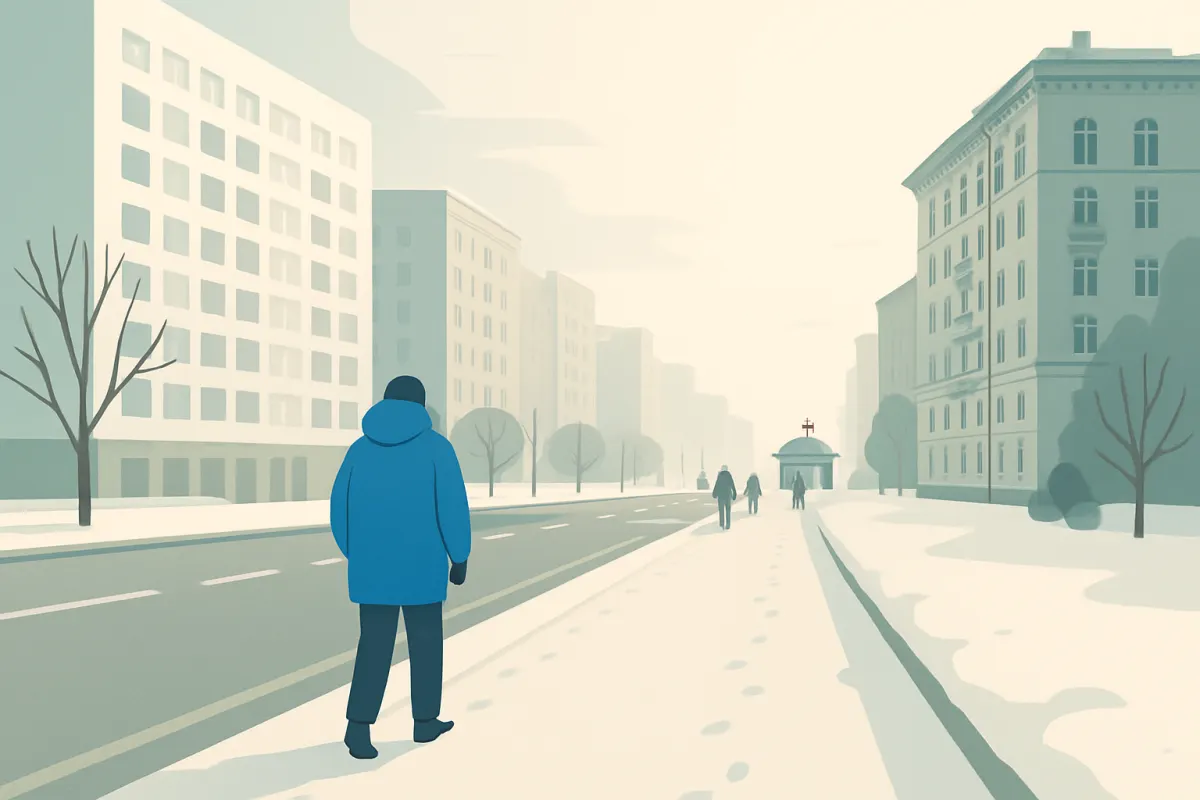
24 minutes to the metro is almost 17 hours a month just to the station and back. We count on Moscow addresses and see what it does to the score.
21 addresses in 7 Kazan districts: average score, noise and minutes to a station in one table. Gorki leads on 85.7, Sovetsky is the loudest.
78 addresses in 26 districts of Moscow and its region: average score, noise and minutes to a station in one table. Mitino 85.1, Salaryevo the loudest.

18 addresses in 6 Novosibirsk districts: average score, noise and minutes to a station in one table. Tsentralny 86.4, Oktyabrsky the loudest.
36 addresses in 12 Saint Petersburg districts: average score, noise and minutes to a station in one table. Tsentralny 87.0, Pushkin the loudest.
Nine districts of Greater Sochi, three addresses each: Khosta averages 82.9, Sirius 52.7. Where shops are close, where the highway and airport are loud.
27 addresses in 9 Yekaterinburg districts: average score, noise and minutes to a station in one table. The centre 88.4, Elmash the loudest.

Compare two flats by their routes: minutes to the shop, school and station times trips a week. A Novosibirsk example: 136 minutes against 336.

What to check before viewing a rental flat: street noise, the metro, a shop, industrial land. Six checks on St Petersburg addresses.
Buying in a new build: how to check the area first. Akademichesky, Yekaterinburg: schools 99 of 100, transport 35.9, the metro a 34-minute walk.

Choosing a flat as a student: the way to university, a library, the metro and groceries on foot. Three Kazan addresses, from Kremlyovskaya to Pobedy.

Choosing a flat for older parents: a pharmacy, a shop, a clinic and a square within five minutes of their pace. Why it is 300 metres, not 400, in Moscow.

Where to live in Sochi without a car: nine addresses in the centre, Adler and Sirius. 7 Navaginskaya Street: 88.1; Adler loses up to 10 points to noise.

Novosibirsk districts over nine addresses: the centre 85.8 to 87.1, Zaeltsovsky 73.6 to 84.4, Akademgorodok 70.1 to 81.7. Metro, noise and forest.
A flat by the park: what matters is not the view but the minutes to the entrance. How the score counts parks, squares and big parks, with Moscow examples.

Yekaterinburg districts by nine addresses: the centre 84.3 to 90.7, Botanika 64.6 to 85.6, Akademichesky 75.5 to 78. Metro, school, park, noise.

Where to live in Kazan: Vakhitovsky scores 81.9 to 87.6, Novo-Savinovsky 71.6 to 82.8. Metro, school, park and penalties across six addresses.
A stop "right across the road" can be a 440-metre walk if the crossing is far away. How the score counts crossings and what to check before a viewing.

Saint Petersburg districts by nine addresses: centre 86.4 to 88.2, Petrograd Side 81.3 to 89.5, Vasilyevsky 60.4 to 86.9. Where the points are lost.

Moscow districts to live in, by nine addresses: Khamovniki about 80, Presnya 76.4 to 86.6, Ramenki 60 to 80.5. Metro, school, park and air.
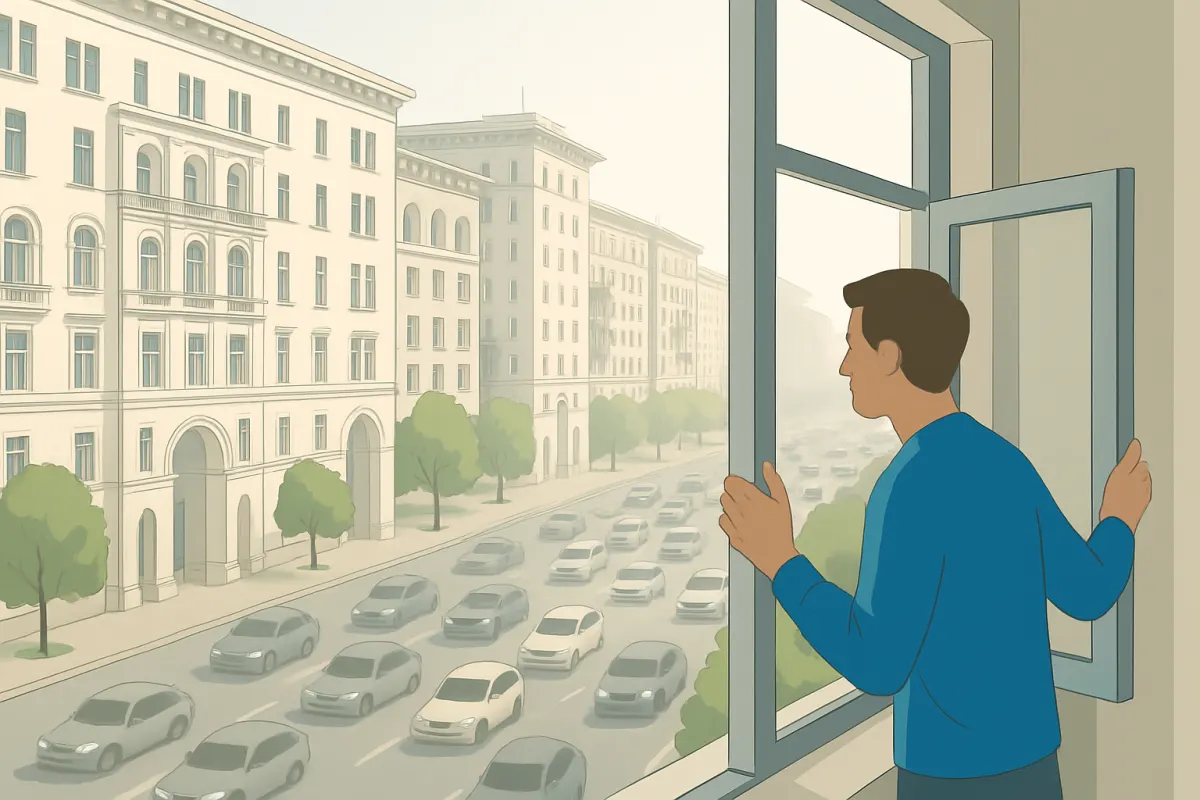
Air quality by address, with Moscow as the example: four addresses lose 5.5 to 7.5 points. Where the figures come from and how to read them in a report.

Central Moscow or a quiet residential district: three addresses before and after penalties. Pokrovka loses 8.2 points, Ramenki 6. Street and air.
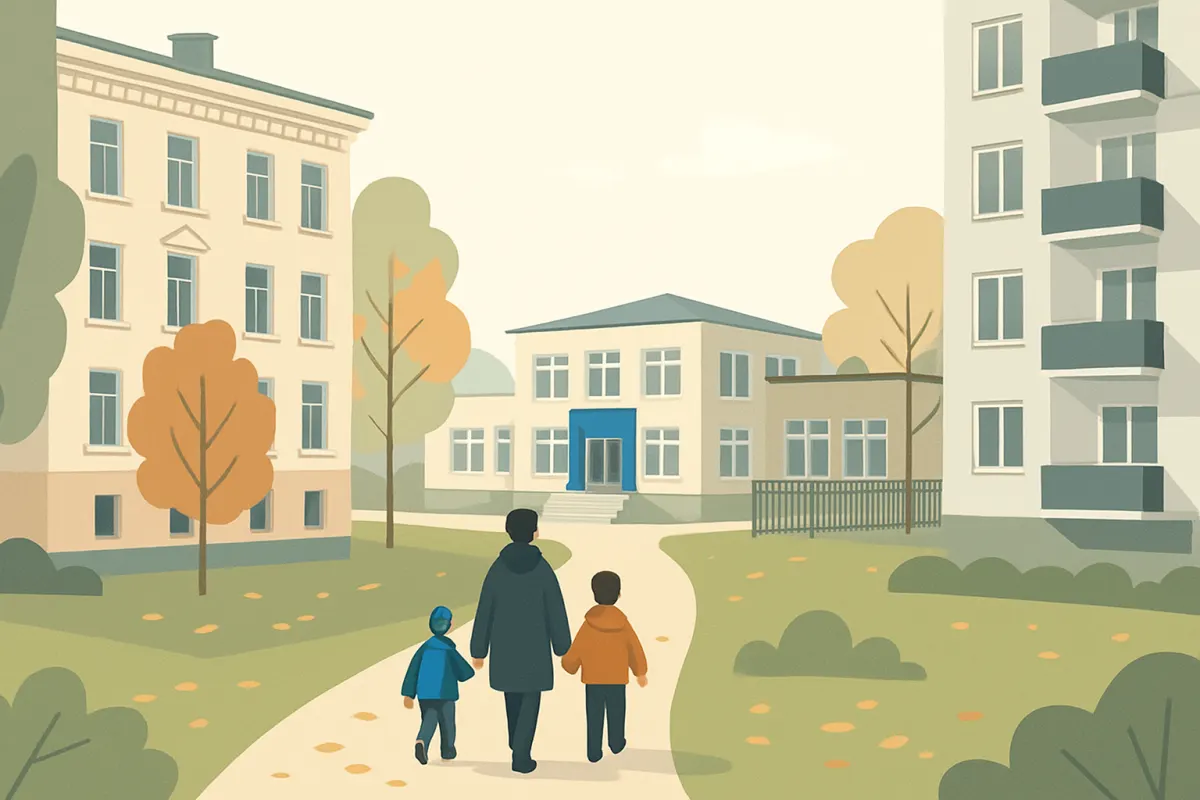
A family neighbourhood by the minutes at 13 Tverskaya Street, Moscow: kindergarten 4.5, school 6.1, playground 3.3. What the family profile changes.

A neighbourhood for remote work, shown on Moscow: Pokrovka scores 99 out of 100 in the work category, Ramenki 30. What should be within ten minutes.
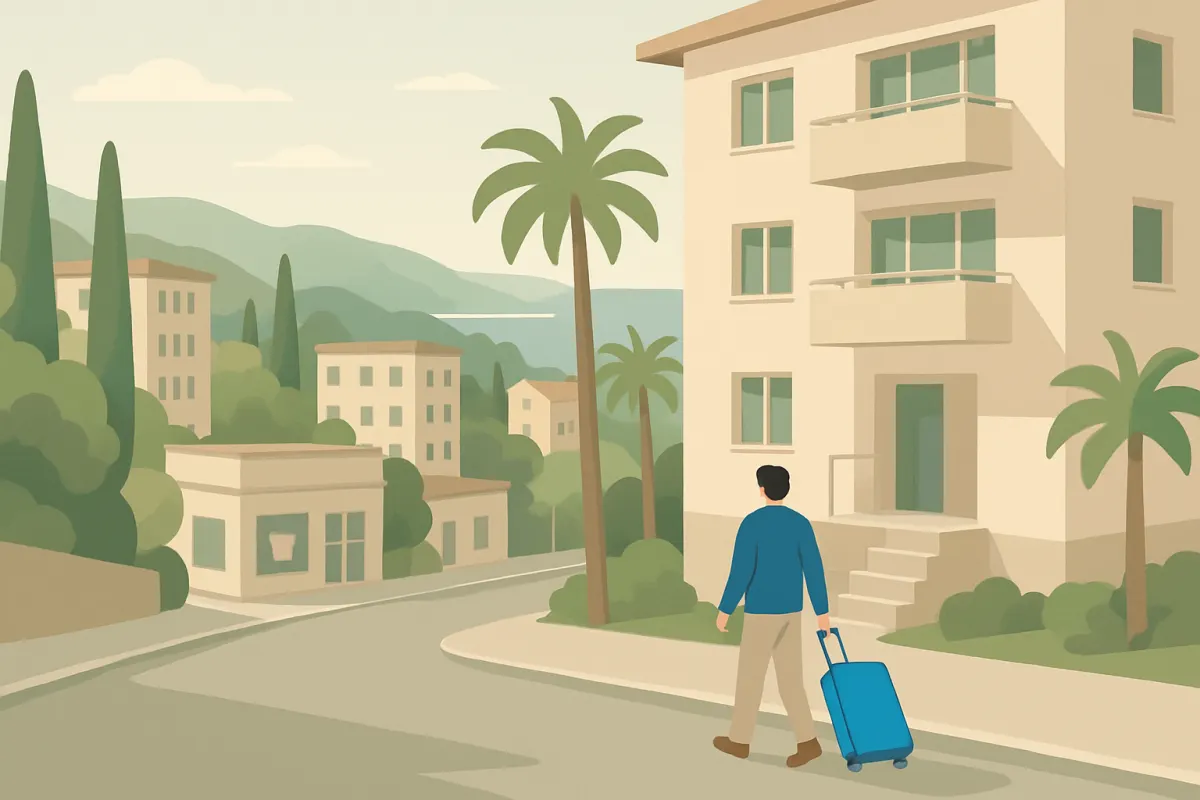
How to rent a flat for a month without seeing the area: six checks of the address before you book, using Sochi from Khosta to Adler and Lazarevskoye.

Comparing two flats in Kazan: 46 Yamasheva Avenue scores 83.7, 72 Fuchika Street 79.1. Where the 4.6 points come from and what they mean for you.

How an uphill walk changes walking time and the score. A look at 12 Rustaveli Avenue in Tbilisi: average gradient 6.4%, 9.6 minutes on climbs.

A neighbourhood with a pram: stairs, kerbs and climbs on the way to nursery and playground. How the report shows it, using 12 Rustaveli Avenue in Tbilisi.
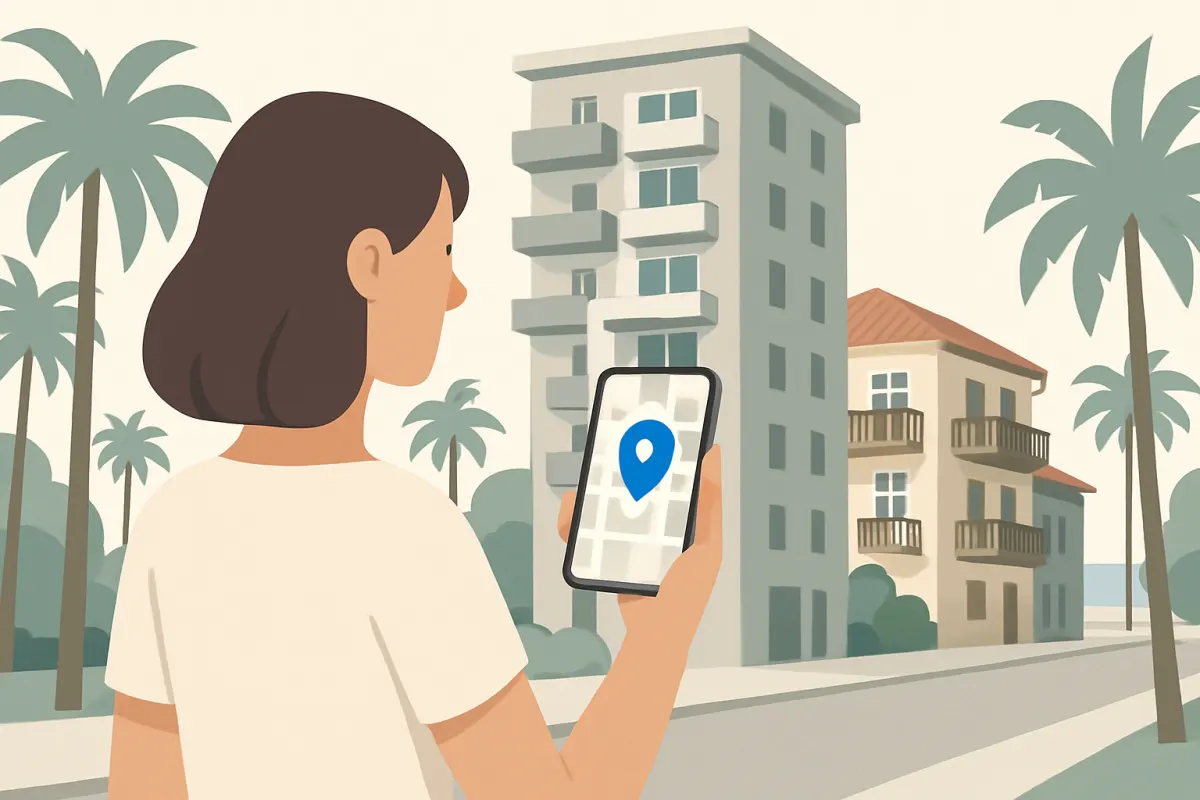
Five steps to check a flat by its address before a viewing: the score, four distances, penalties and confidence. Shown on nine Batumi addresses.
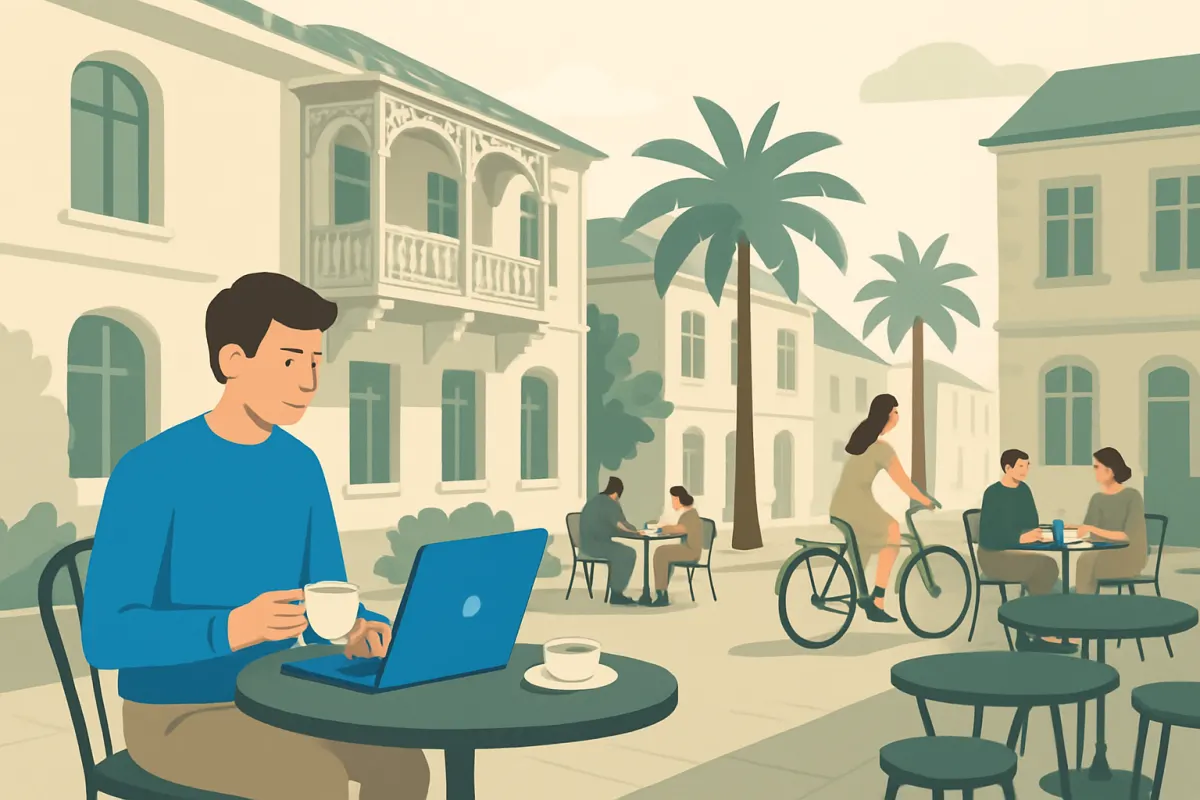
Where to work in Batumi outside your flat: by Europe Square a coworking space is 4 minutes away and Remote work scores 97, on the New Boulevard 24.
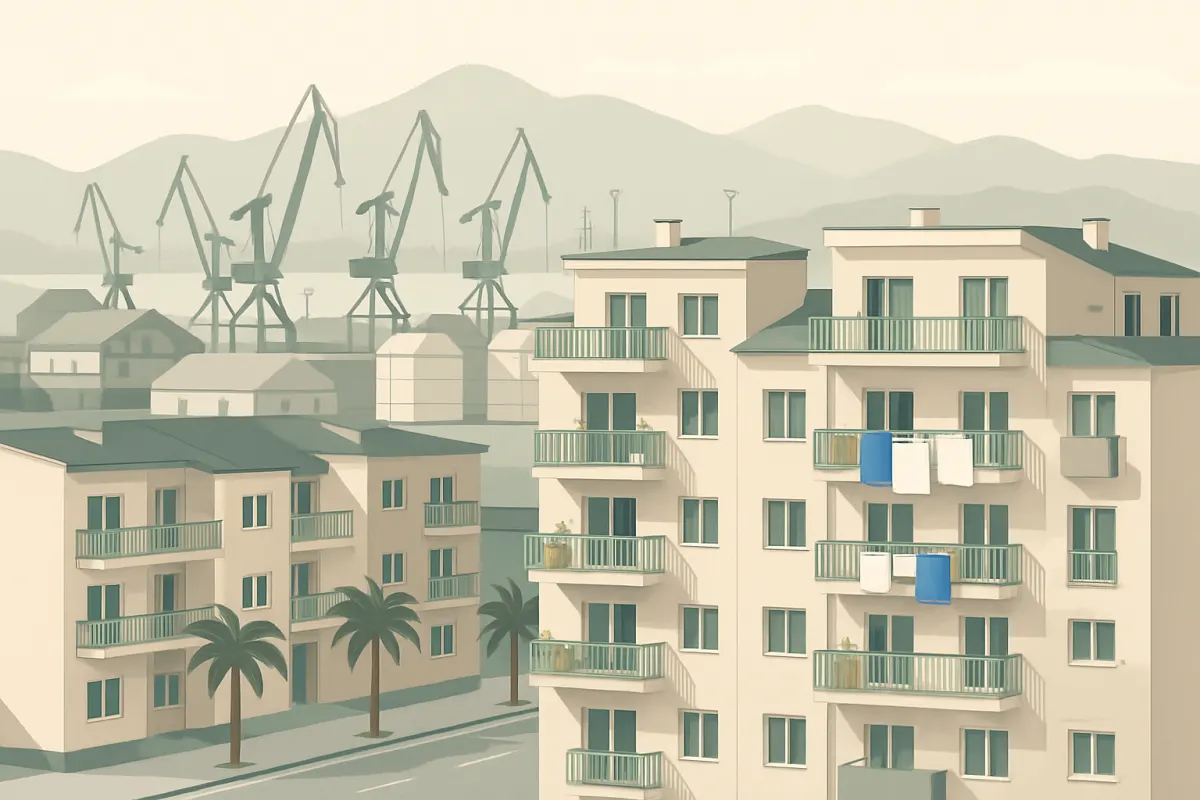
Industry near home takes up to 4 points off if its edge is within 300 metres. How the penalty works and what it showed at four Batumi addresses.
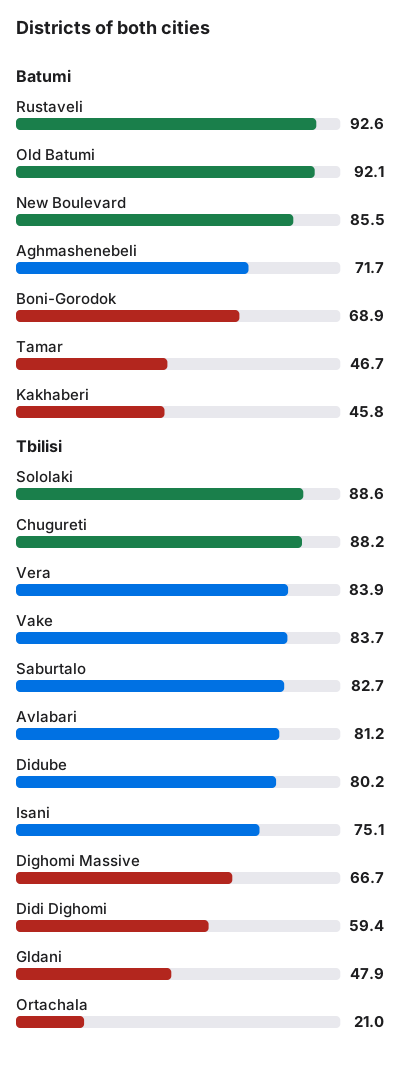
57 addresses in 19 districts of Batumi and Tbilisi. The averages are almost level, 71.9 and 71.6; transport, noise, schools and climate differ.
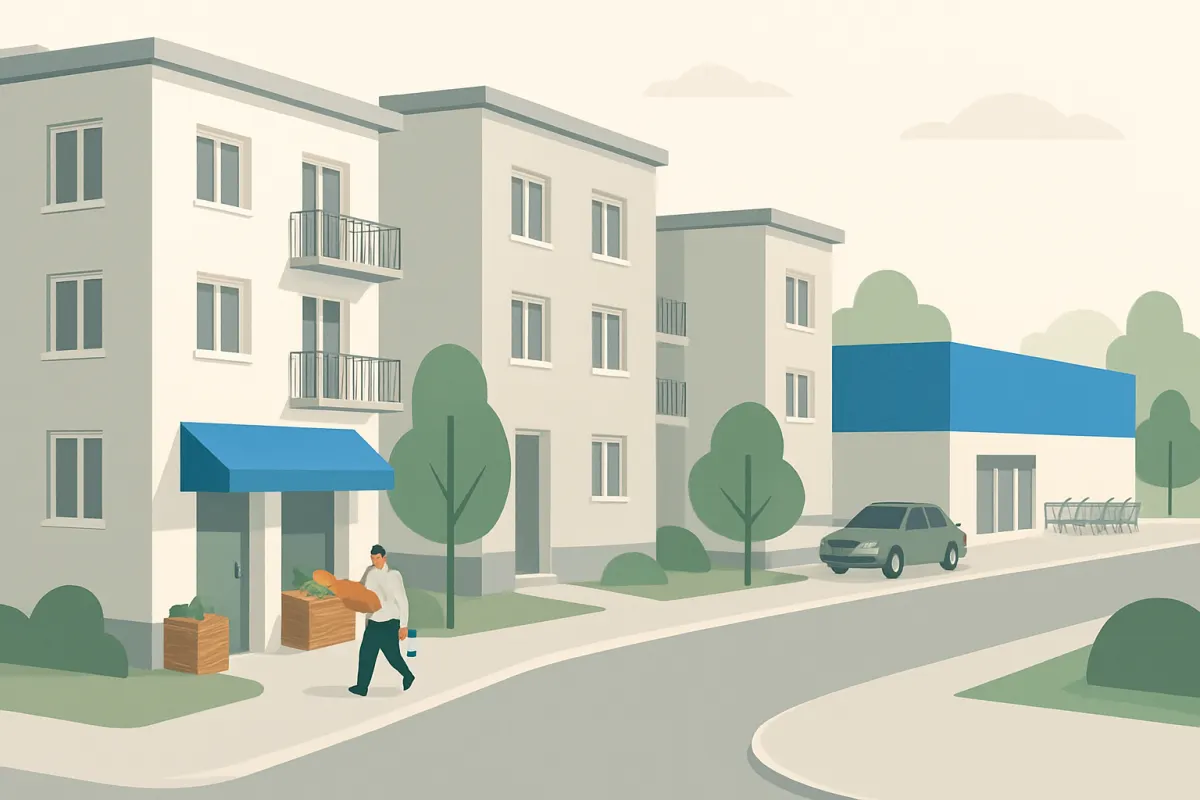
A shop by the door or a supermarket nine minutes away: which is worth more? How shop type, minutes and the top three places count, shown in Tbilisi.
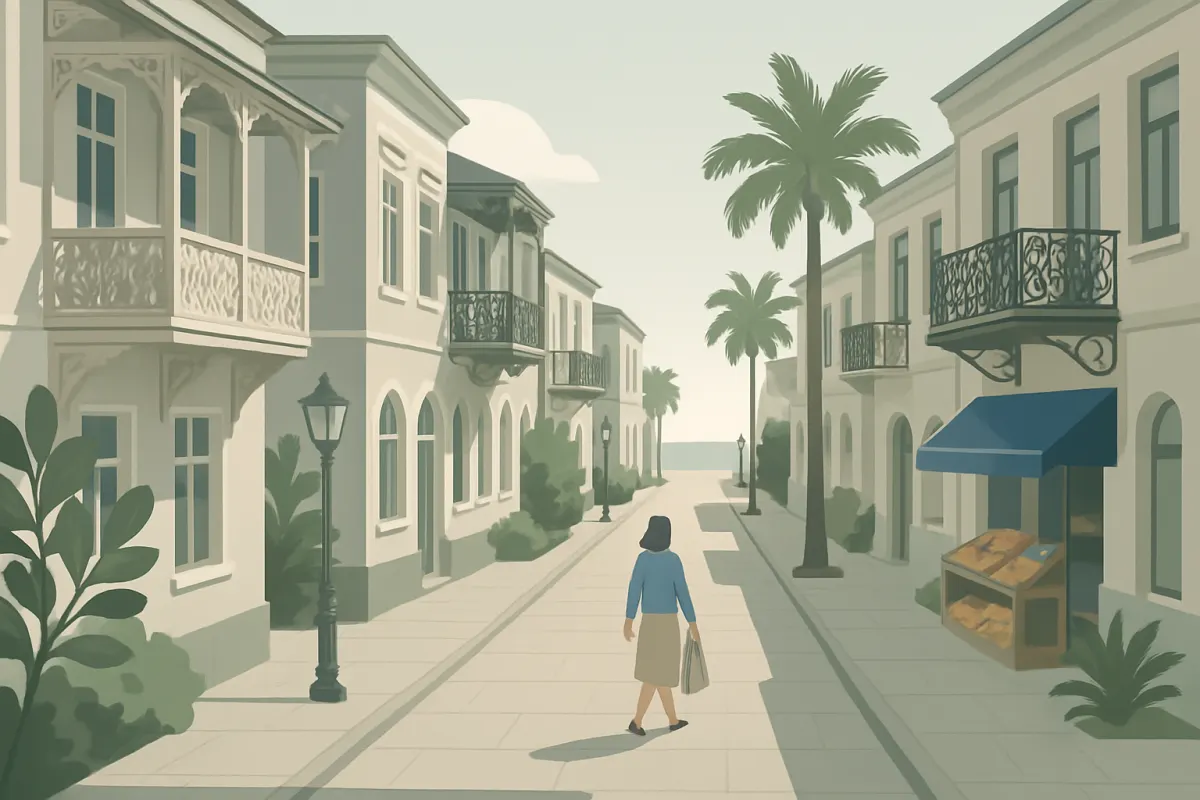
Where to live in Batumi without a car: nine addresses in minutes to the shop, the stop and the school. Old Batumi 91.4–92.6, Boni-Gorodok from 51.8.
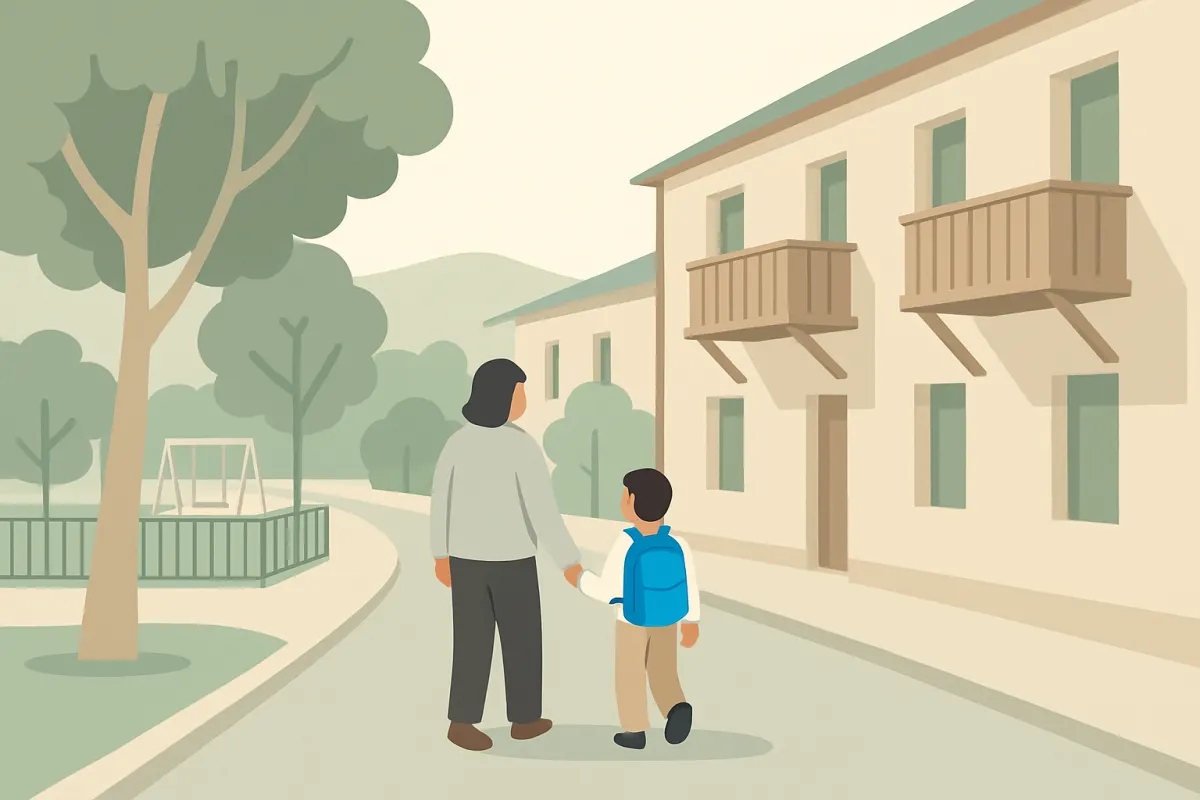
Tbilisi with a child: nine addresses in Vake, Saburtalo and Vera by minutes to school and park, noise and metro. What the family profile changes.

21 addresses in 7 Batumi districts: average score, noise and minutes to a stop in one table. Rustaveli 92.6 with no noise, Kakhaberi the loudest.
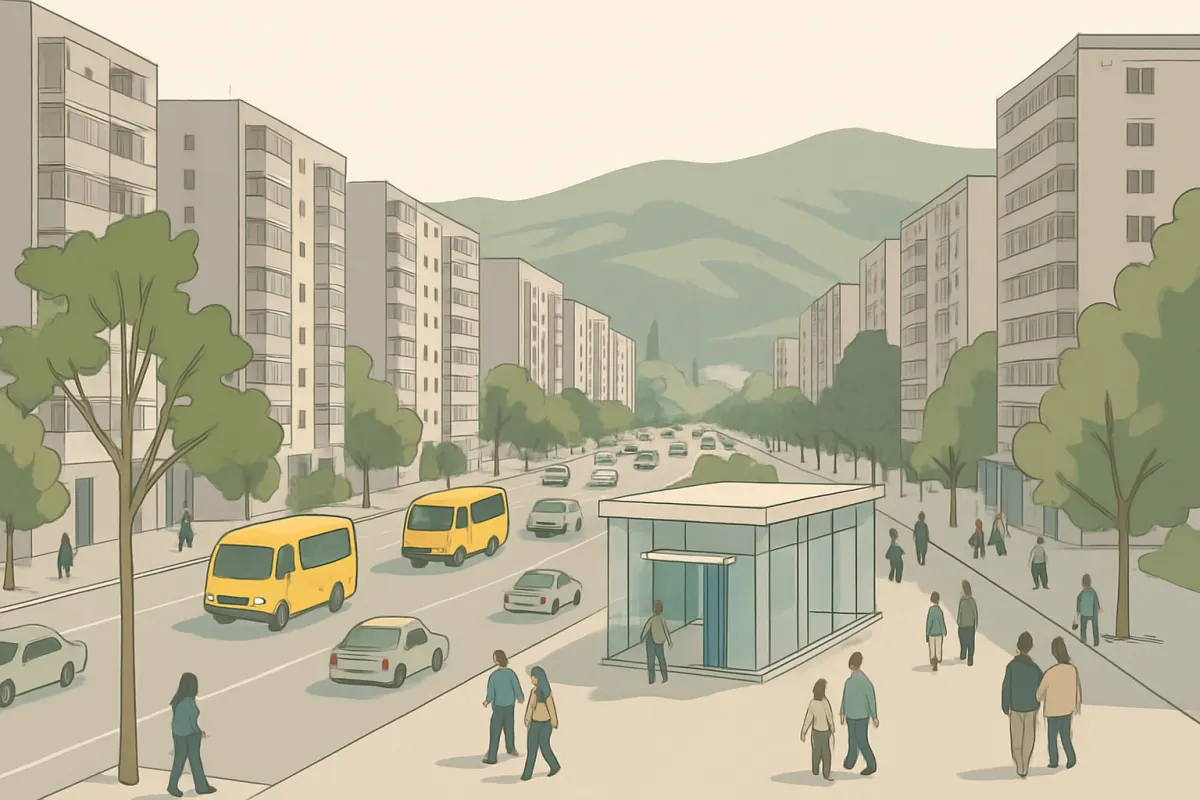
36 addresses in 12 Tbilisi districts: average score, noise and minutes to a station in one table. Sololaki 88.6, Vera and Saburtalo the loudest.

Where to live in Batumi in winter and summer: 93.8 by 6 May Park, 62.3 on New Boulevard 57 metres from the beach. Four addresses and what works in winter.

Moving abroad and choosing a neighbourhood you have not seen: five steps from a city to an address, worked through in Tbilisi from Vake to Saburtalo.
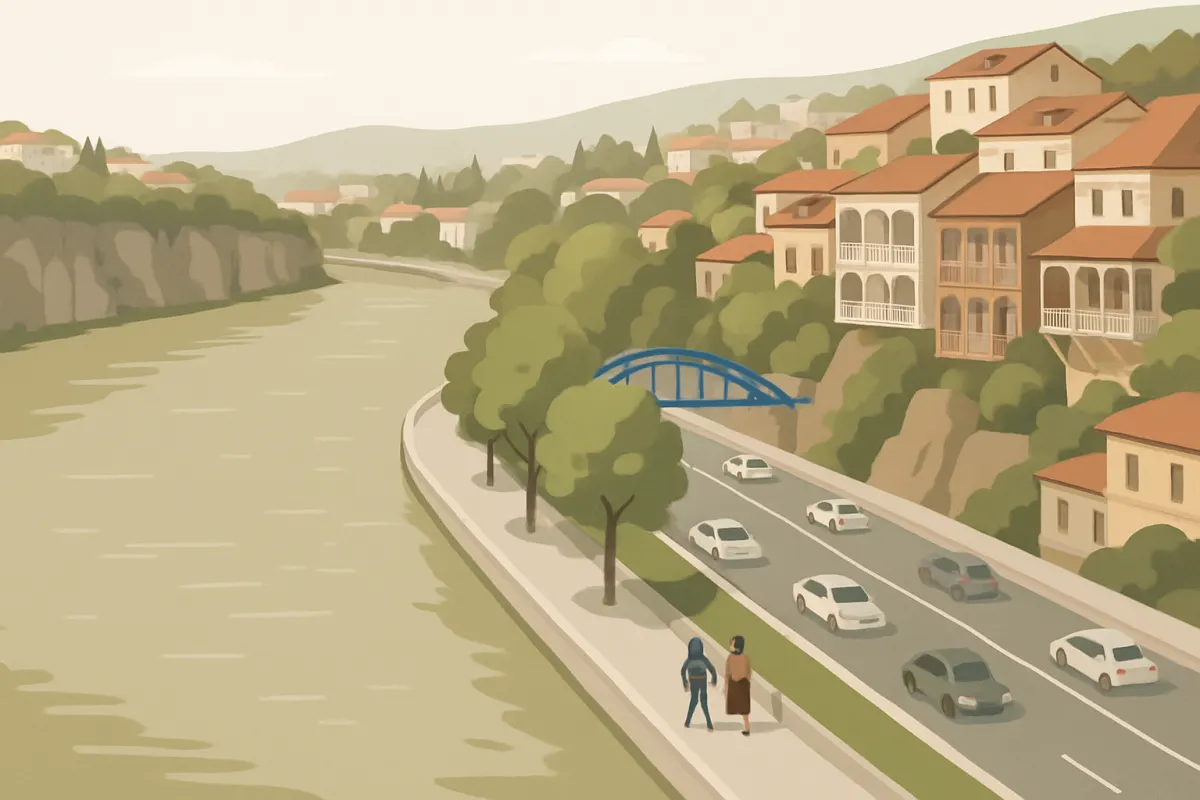
A flat "by the river" on the map and on foot: in Tbilisi 639 m in a straight line become 787 m and 10.6 minutes. How water enters an address score.

Tbilisi districts for living, by four addresses: 12 Rustaveli scores 88.4, Saburtalo 81.1. Vake or Saburtalo: what the metro, noise and slopes decide.
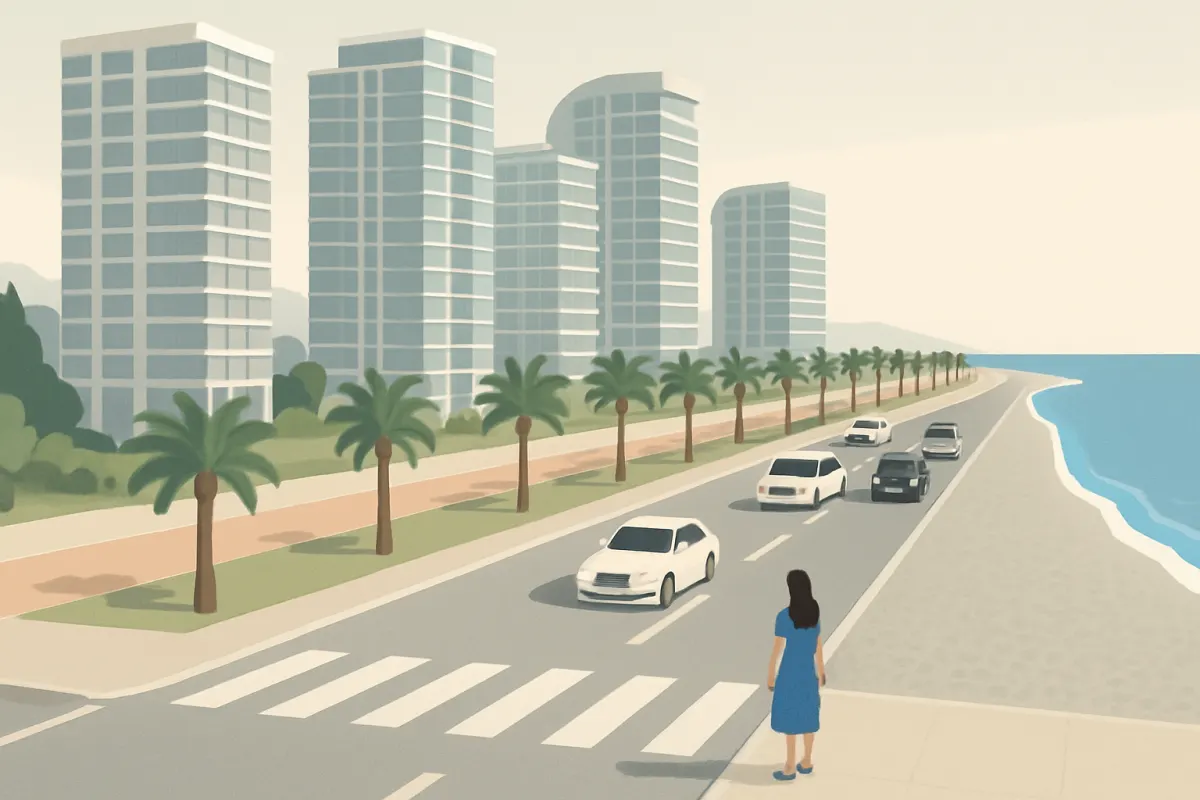
Renting by the sea in Batumi: 57 metres from the beach scores 62.3, 474 metres scores 93.8. What the seafront costs you and how to price a minute.
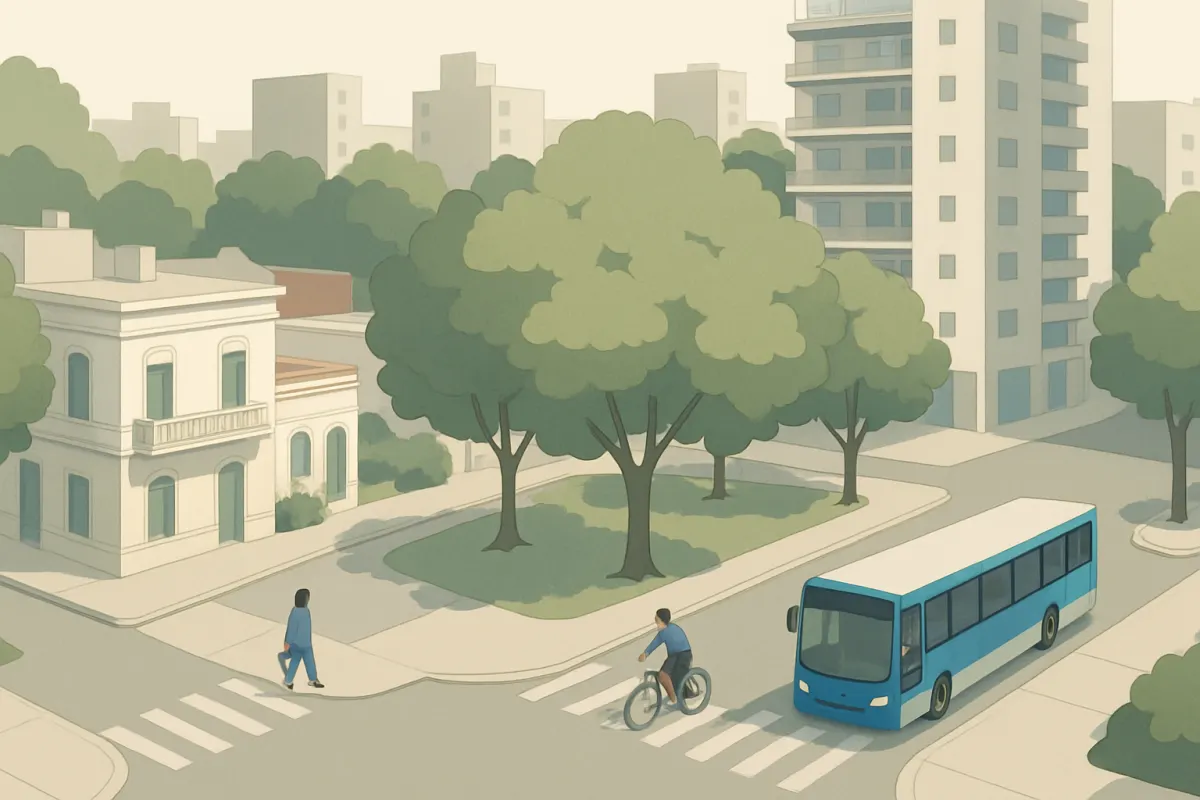
Where to live in La Plata: inside the Casco Urbano square addresses score 83–92, in City Bell 46–63. What the grid, plazas and diagonals give.

Living in Mendoza without a car: Quinta Sección and the centre at five addresses, 63.2 to 73. Everything close on foot, weak transport, noisy bars.
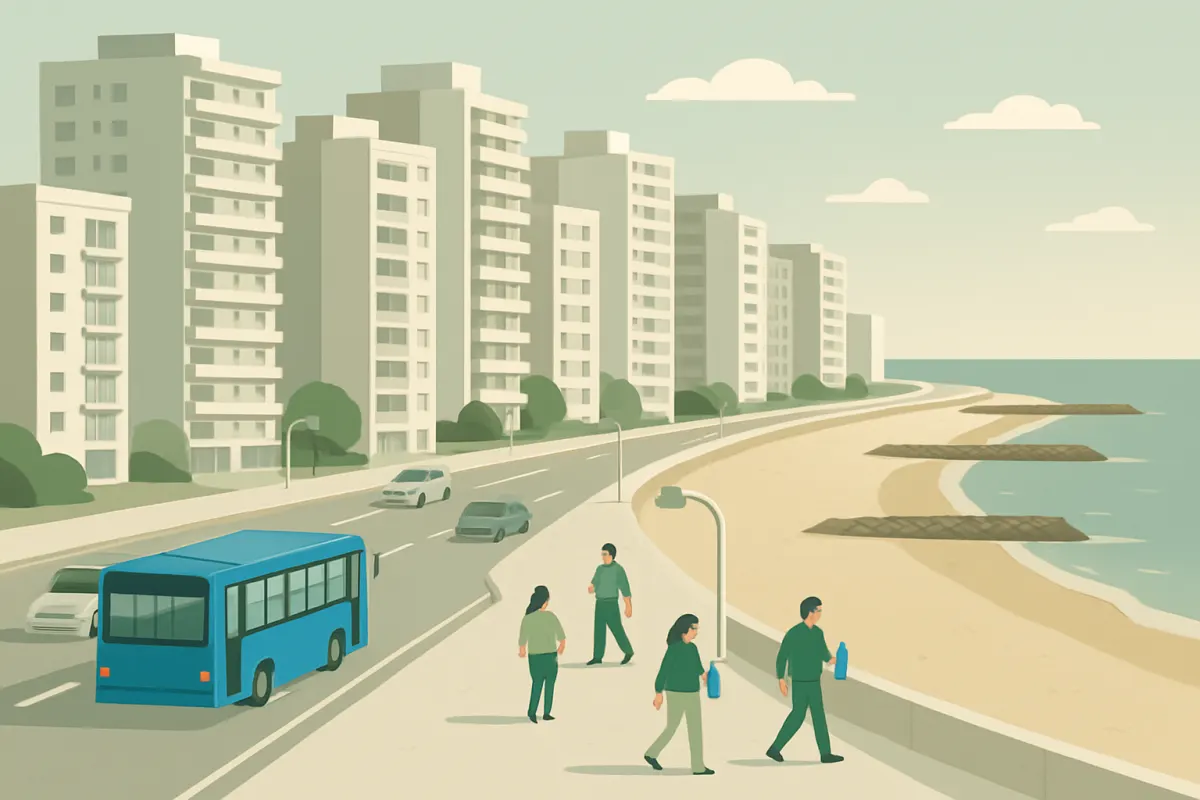
Where to live in Mar del Plata all year: six addresses in La Perla and Los Troncos, 45.9 to 67.4. The sea nearby, noisy avenues and distant buses.
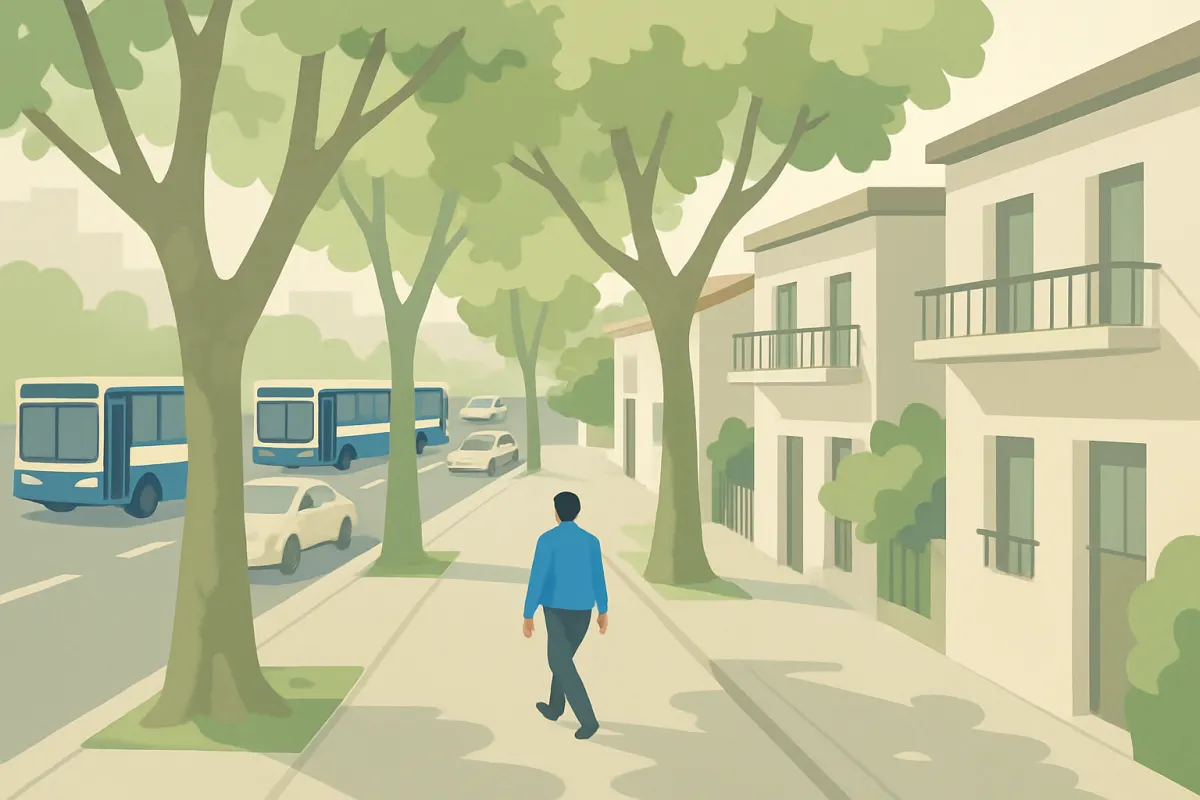
Why 600 metres along a quiet street can be closer than 400 metres along an avenue. How the score counts crossings and big roads, using Buenos Aires.
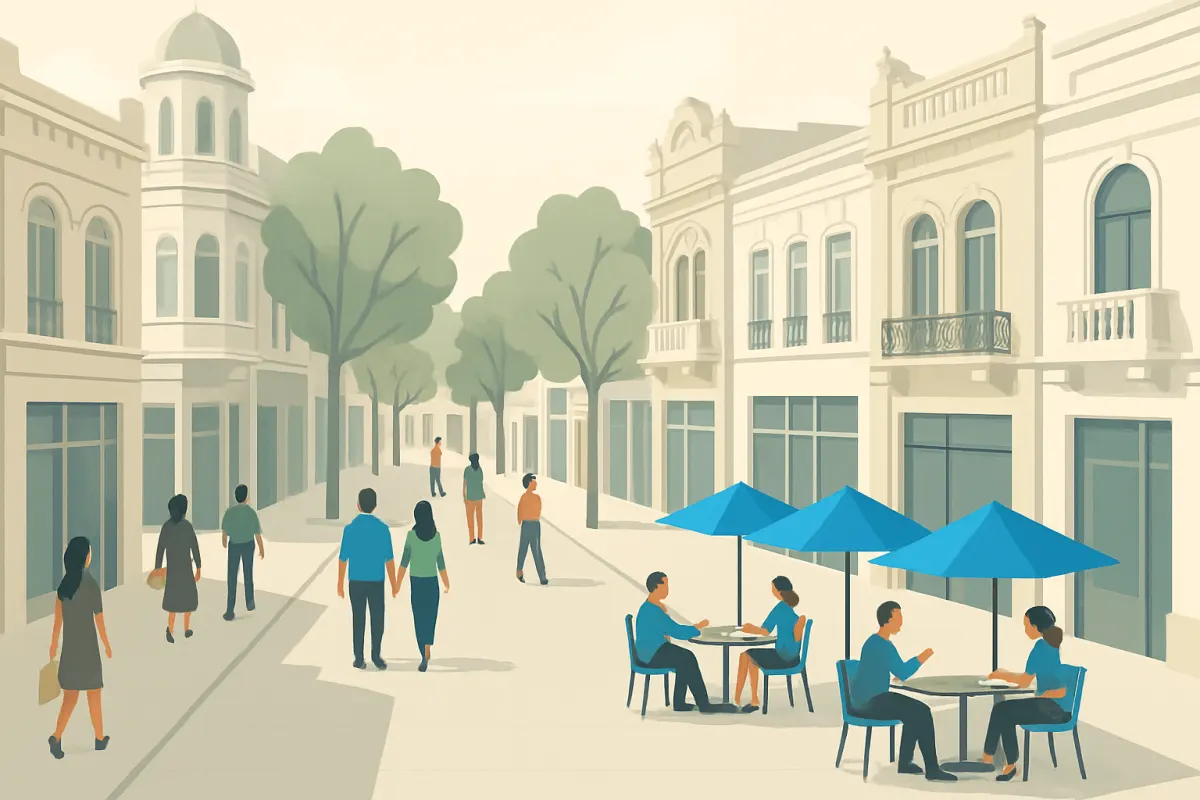
Rosario's barrios at six addresses: the centre scores 87–91, Pichincha 74–78. What the pedestrian streets give, and where noise and schools cost points.
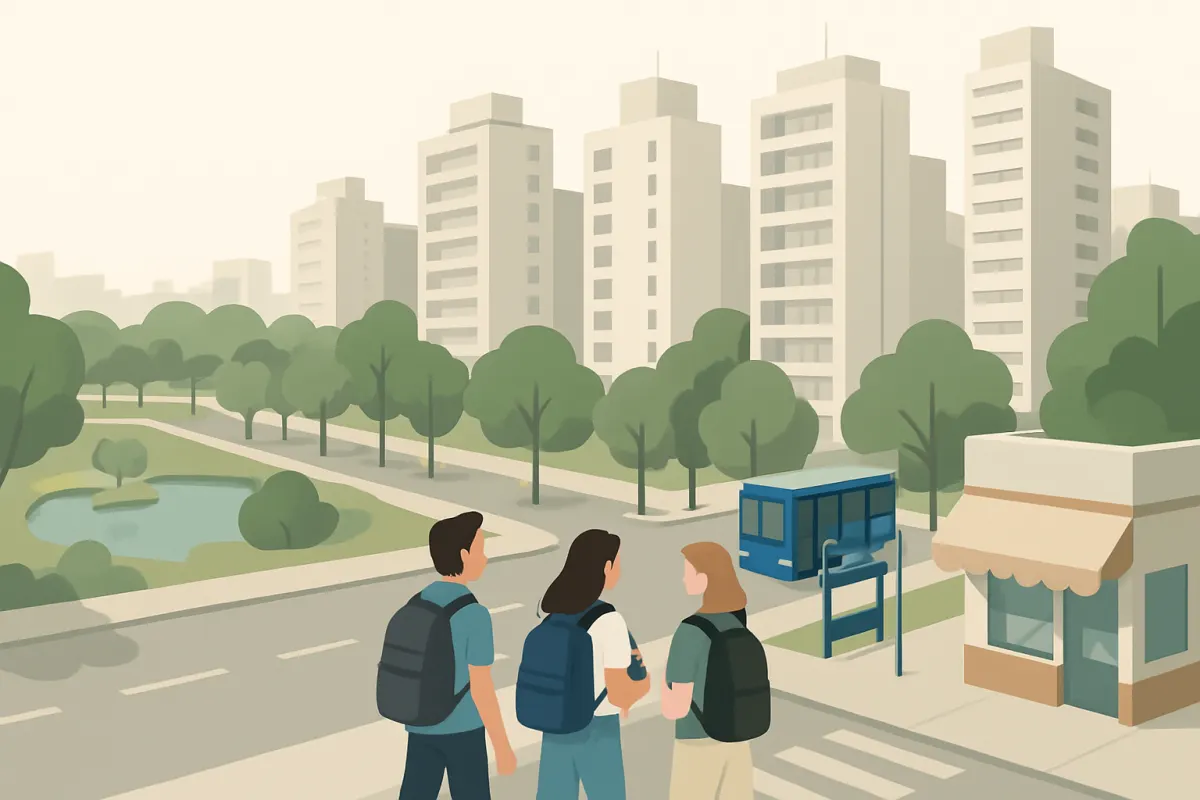
Where to live in Córdoba without a car: six addresses in Nueva Córdoba and Güemes, 79.7 to 83.3. Minutes to a shop, school and park, and what noise costs.

Palermo or Recoleta for a couple: six addresses in minutes. Palermo up to 91.9 with no noise penalty, Recoleta up to 88.3: its avenues are loud.

A pharmacy two minutes away, the nearest doctor twelve: how to check healthcare near home before you move. A look at the report for Avenida de Mayo 825.

Is transport good at a home with no metro? Count lines, not stops, then check frequency and minutes on foot. Examples from Córdoba.
42 addresses in 14 Buenos Aires districts: average score, noise and minutes to a station in one table. Palermo 89.3, no noise; Vicente López the loudest.
15 addresses in 5 districts of Córdoba, Argentina: average score, noise and minutes to a stop in one table. The centre 82.3, Nueva Córdoba the loudest.
Four Mar del Plata districts, three addresses each: the centre averages 63.9, Playa Grande 49.1. Which avenues are loud, how far the bus is, what to pick.
15 addresses in 5 Mendoza districts: average score, noise and minutes to a stop in one table. The centre leads on 73.5, Las Heras is the loudest.
18 addresses in 6 Rosario districts: average score, noise and minutes to a stop in one table. Centro 89.4, Funes the loudest, Puerto Norte last.
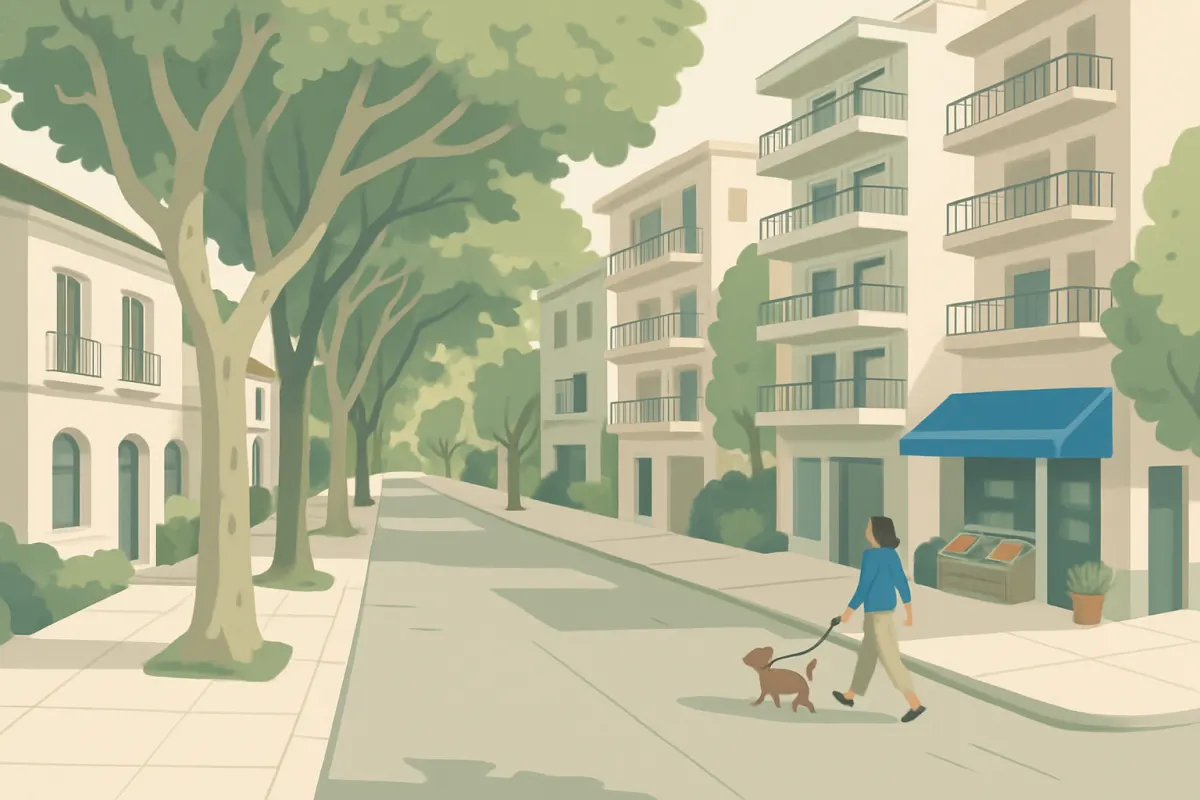
Four barrios in numbers: Belgrano 91.6, Recoleta 87.4, Palermo 83.8, Caballito 82.9. What the avenues' noise and the Subte lines decide.

The cost of living in a neighbourhood, shown on La Plata: centre 79.4, City Bell 44.8, Los Hornos 30.2. What you pay for again away from the centre.
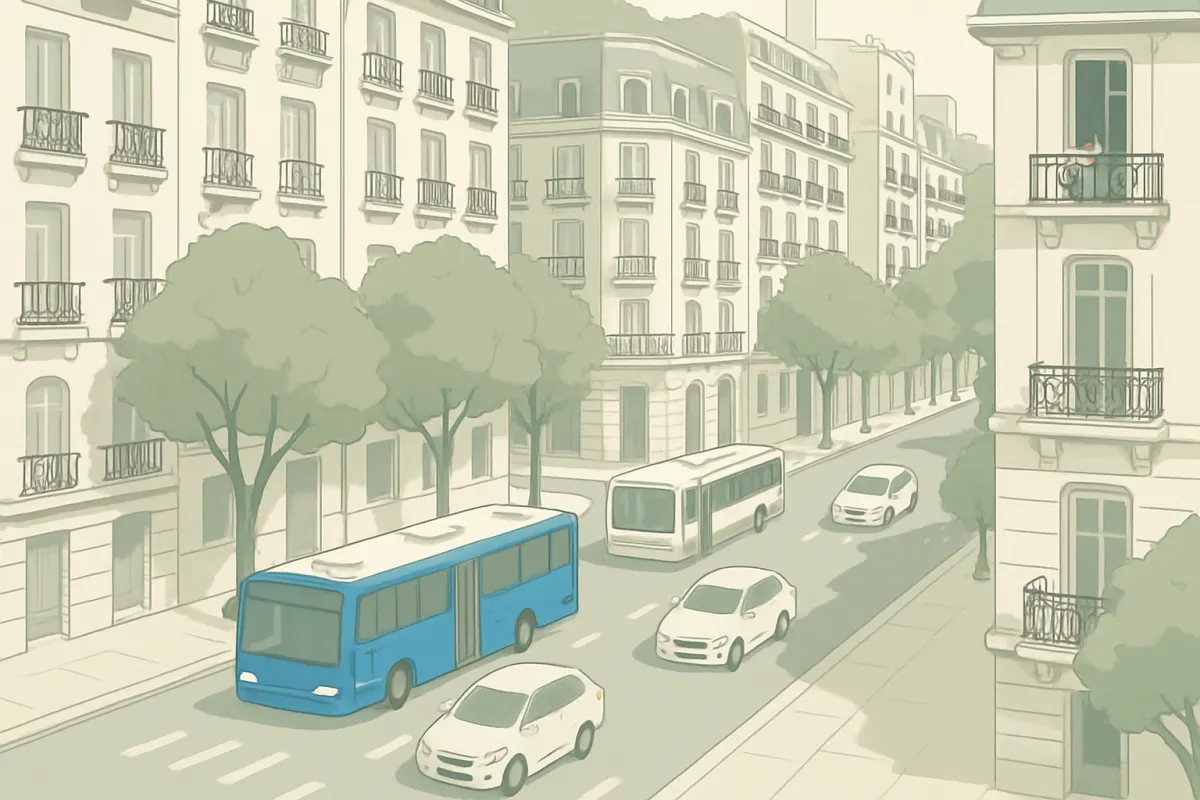
In Buenos Aires, Caballito loses 7.7 points to its avenue and misses the top band; Belgrano loses none. The noise formula and how to check an address.
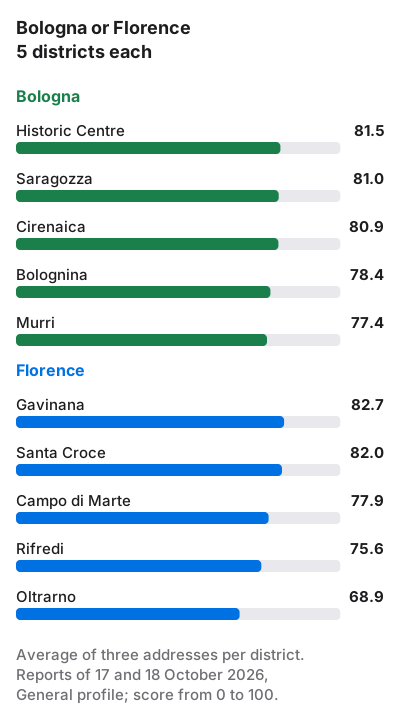
Bologna or Florence: 30 addresses, 5 districts in each city. Average score 79.9 against 77.4, noise and minutes to a station side by side.
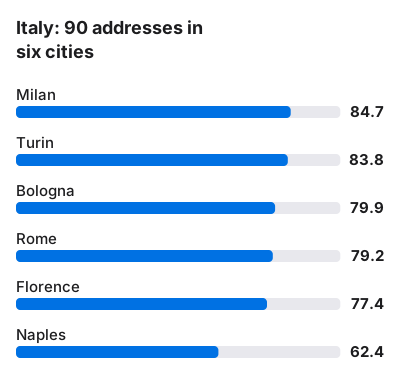
90 addresses in six Italian cities: average score, noise and minutes to the station in one table. Milan 84.7, Naples 62.4.
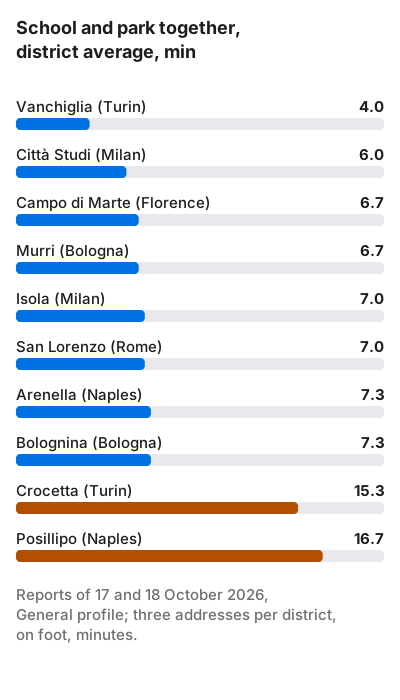
School and park walks and noise in 30 Italian districts, 90 addresses: school plus park take 4.0 min in Vanchiglia, Turin, 16.7 in Posillipo, Naples.
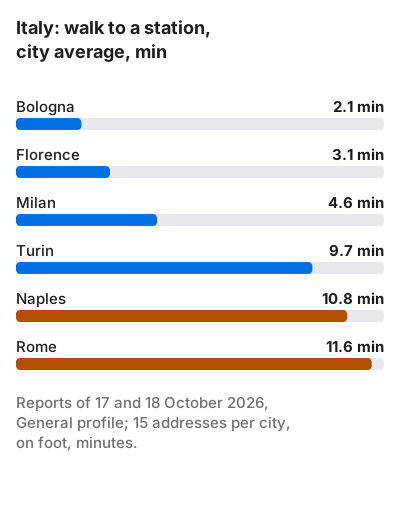
Station and shop on foot in 30 districts of six Italian cities: 54 of 90 addresses have a station within 5 min. The farthest one is in Posillipo.
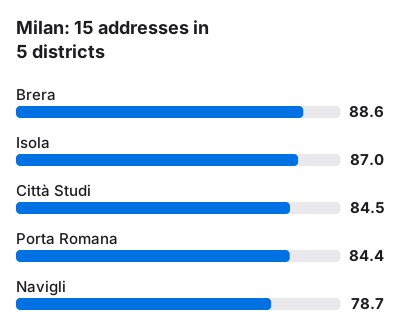
15 addresses in 5 Milan districts: average score, noise and minutes to the station in one table. Brera 88.6 and quiet, Navigli the lowest.
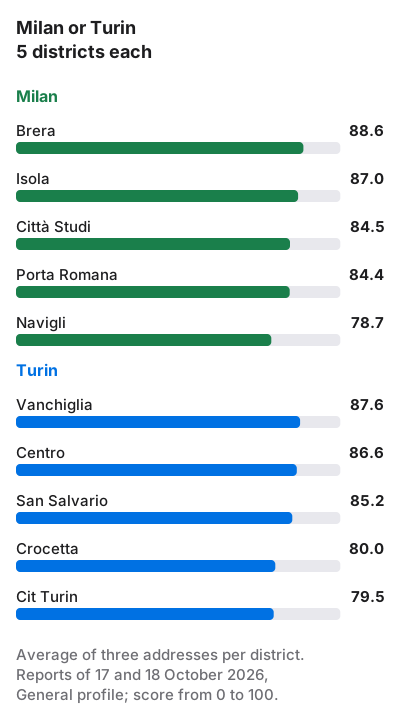
Milan or Turin: 30 addresses, 5 districts in each city. Average score 84.7 against 83.8, noise and minutes to a station side by side.
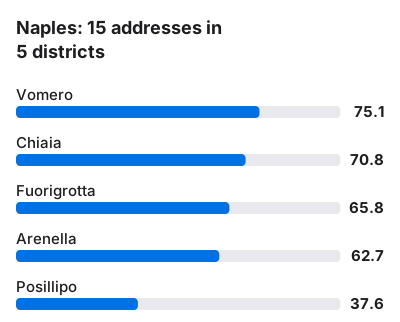
15 addresses in 5 Naples districts: average score, noise and minutes to the station in one table. Vomero 75.1, Posillipo the lowest.
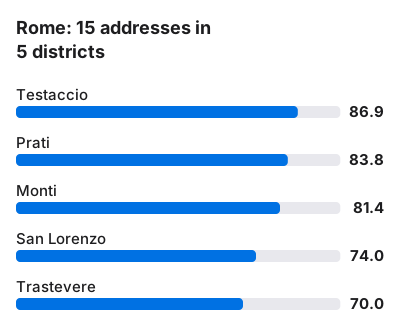
15 addresses in 5 Rome districts: average score, noise and minutes to the station in one table. Testaccio 86.9, Trastevere the lowest.
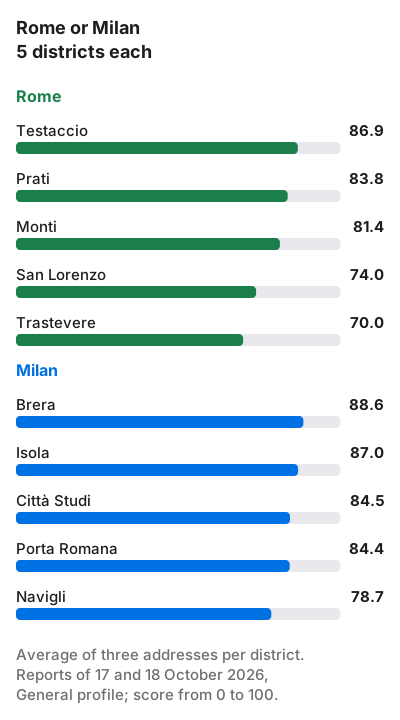
Rome or Milan: 30 addresses, 5 districts in each city. Average score 79.2 against 84.7, noise and minutes to a station side by side.
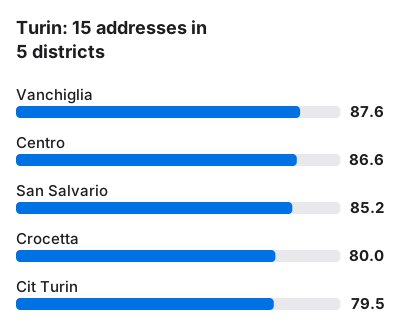
15 addresses in 5 Turin districts: average score, noise and minutes to the station in one table. Vanchiglia 87.6, Cit Turin the lowest.
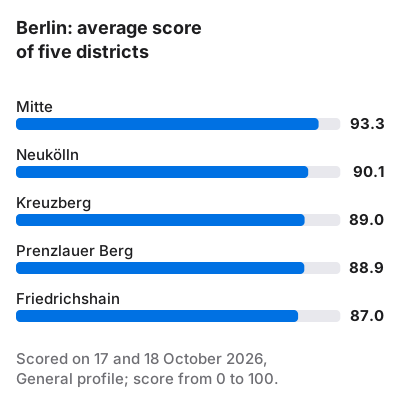
15 addresses in 5 Berlin districts: score, noise and minutes to the station in one table. Mitte on top at 93.3, Friedrichshain last at 87.0.
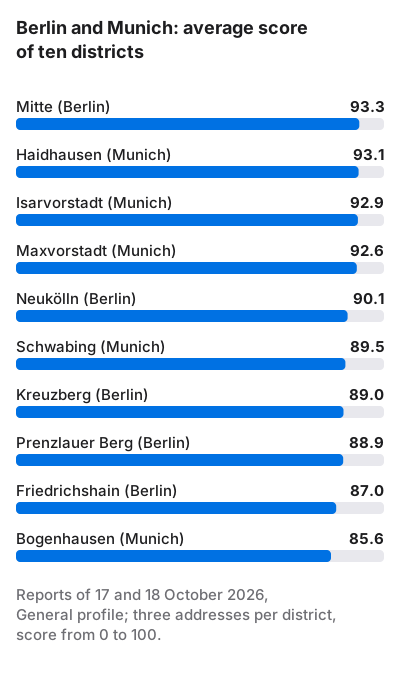
30 addresses in 10 districts: Munich averages 90.7, Berlin 89.7. Score, noise and minutes to the station, school and park side by side.
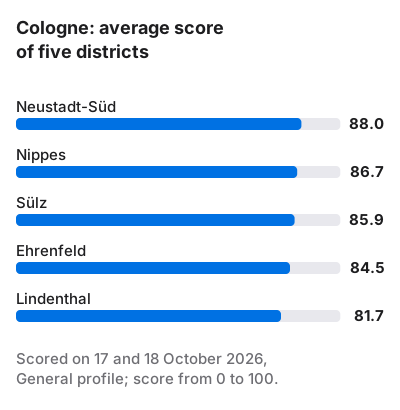
15 addresses in 5 Cologne districts: score, noise and minutes to the station in one table. Neustadt-Süd on top at 88.0, Lindenthal last at 81.7.
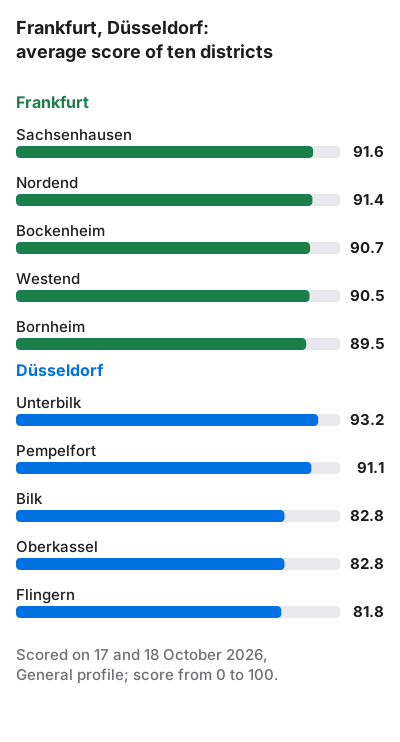
30 addresses in 10 districts: Frankfurt averages 90.7, Düsseldorf 86.3. Score, noise and minutes to the station side by side.
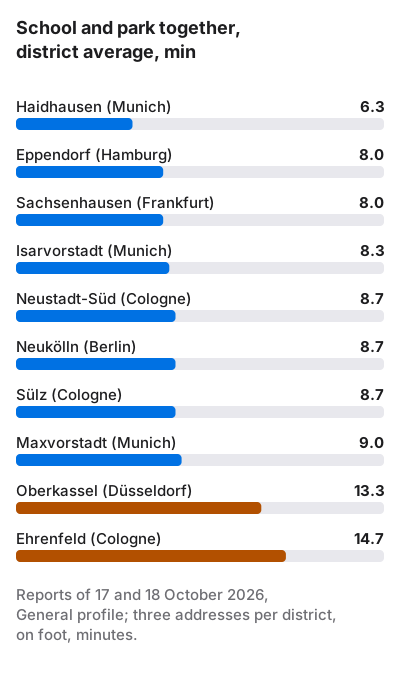
School and park walks and road noise in 30 districts of six German cities. School plus park: 6.3 min in Haidhausen, 14.7 in Ehrenfeld.
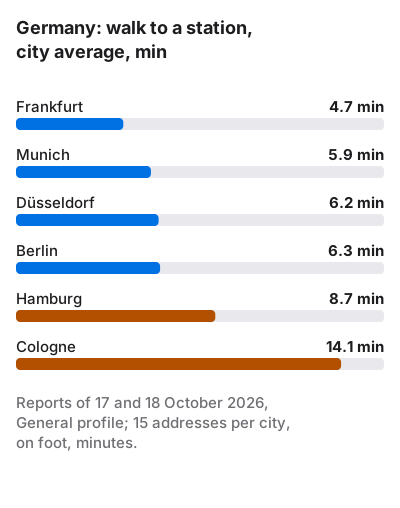
Station and shop on foot in 30 districts of six German cities: 40 of 90 addresses have a station within 5 min, Cologne has 11 beyond 10.
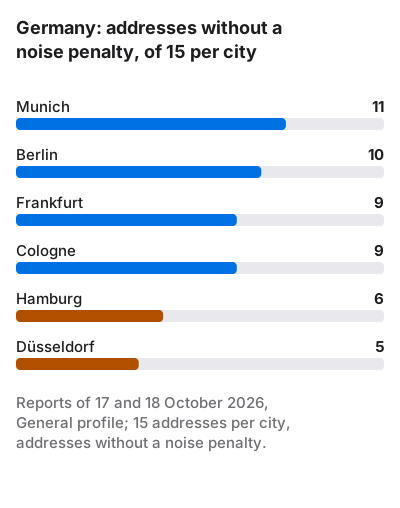
Road noise at 90 addresses in 30 districts of six German cities: 50 lose nothing, 7 districts are quiet at every address, Winterhude loses 4.82.
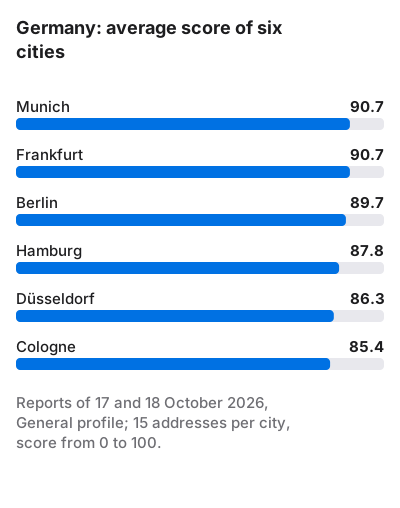
30 districts in six German cities: average score, best and weakest district of each. Munich and Frankfurt lead on 90.7, Cologne trails on 85.4.
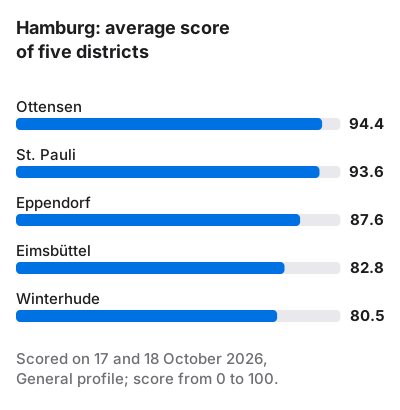
15 addresses in 5 Hamburg districts: score, noise and minutes to the station in one table. Ottensen on top at 94.4, Winterhude last at 80.5.
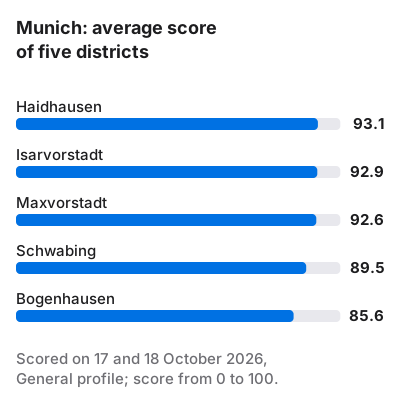
15 addresses in 5 Munich districts: score, noise and minutes to the station in one table. Haidhausen on top at 93.1, Bogenhausen last at 85.6.
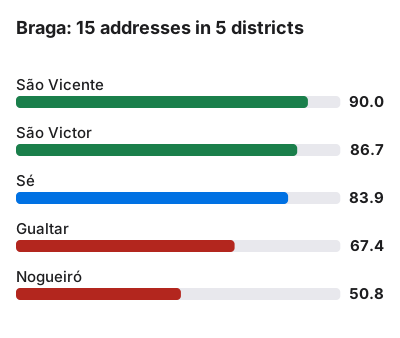
15 addresses in 5 Braga districts: score, minutes to the nearest stop, school, park. São Vicente 90.0 leads, Nogueiró 50.8 is last.
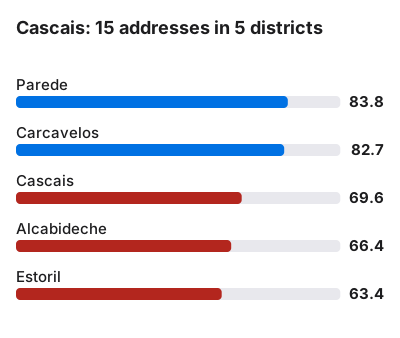
15 addresses in 5 Cascais districts: score, minutes to the nearest stop, school, park. Parede 83.8 leads, Estoril 63.4 is last.
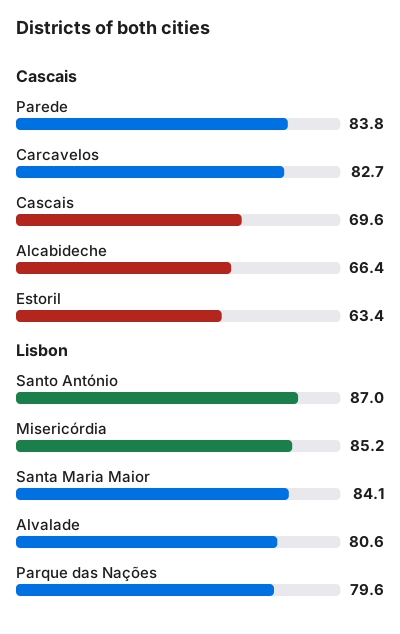
30 addresses in Cascais and Lisbon: score, noise and minutes to the nearest station in one table. Cascais 73.2, Lisbon 83.3 on average.
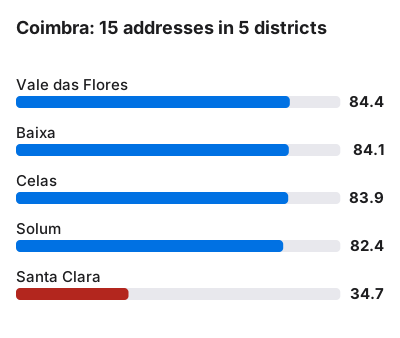
15 addresses in 5 Coimbra districts: score, minutes to the nearest stop, school, park. Vale das Flores 84.4 leads, Santa Clara 34.7 is last.
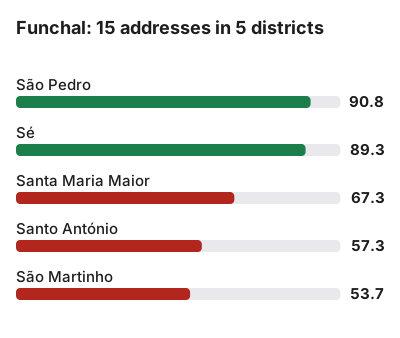
15 addresses in 5 Funchal districts: score, minutes to the nearest stop, school, park. São Pedro 90.8 leads, São Martinho 53.7 is last.
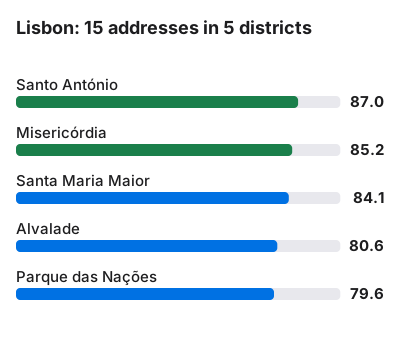
15 addresses in 5 Lisbon districts: score, noise, minutes to the nearest station. Santo António 87.0 leads, Parque das Nações 79.6 is last.
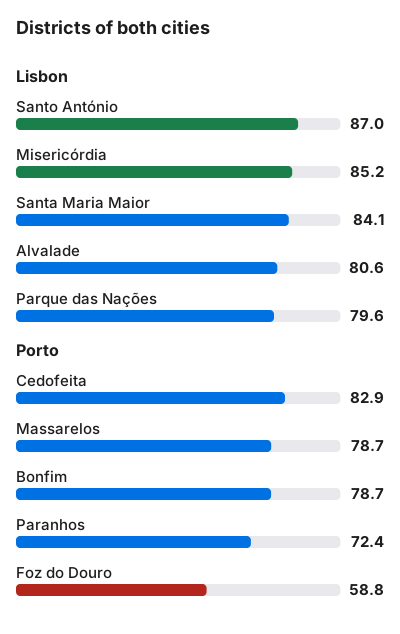
30 addresses in Lisbon and Porto: score, noise and minutes to the nearest station in one table. Lisbon 83.3, Porto 74.3 on average.
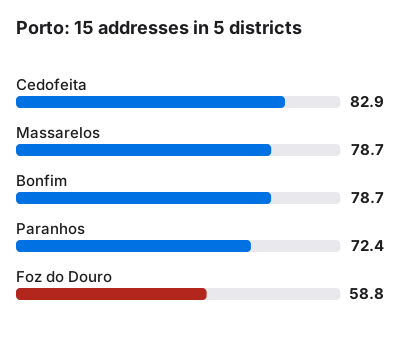
15 addresses in 5 Porto districts: score, noise, minutes to the nearest station. Cedofeita 82.9 leads, Foz do Douro 58.8 is last.
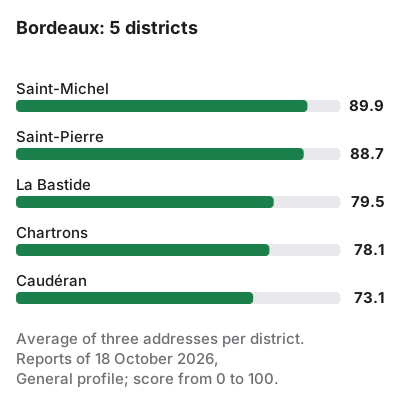
15 addresses in 5 districts of Bordeaux: score, traffic noise and minutes to a station in one table. Saint-Michel leads with 89.9.
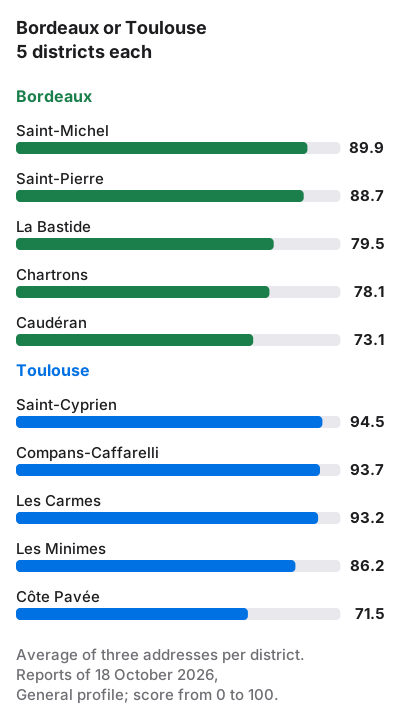
Bordeaux or Toulouse: 30 addresses, 5 districts in each city. Average score 81.9 against 87.8, traffic noise and minutes to a station side by side.
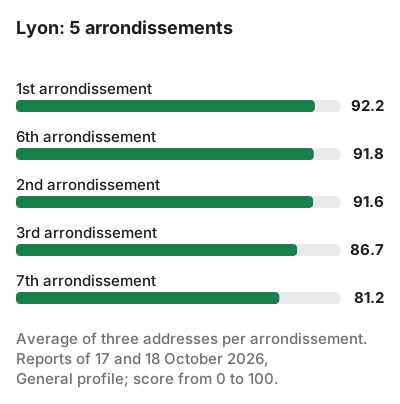
15 addresses in 5 arrondissements of Lyon: score, traffic noise and minutes to a station in one table. 1st arrondissement leads with 92.2.
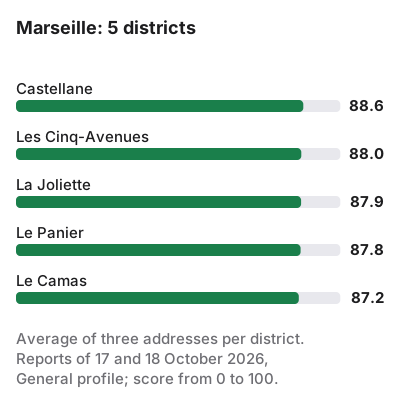
15 addresses in 5 districts of Marseille: score, traffic noise and minutes to a station in one table. Castellane leads with 88.6.
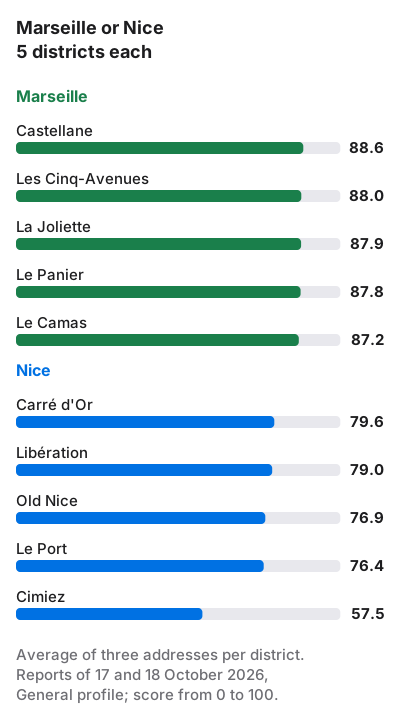
Marseille or Nice: 30 addresses, 5 districts in each city. Average score 87.9 against 73.9, traffic noise and minutes to a station side by side.
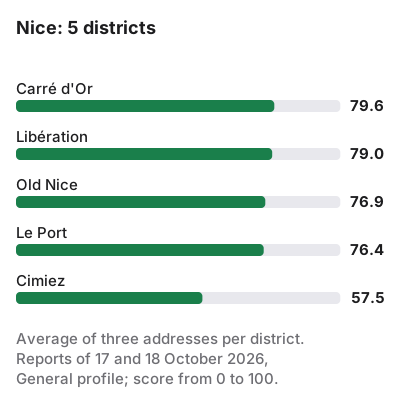
15 addresses in 5 districts of Nice: score, traffic noise and minutes to a station in one table. Carré d'Or leads with 79.6.
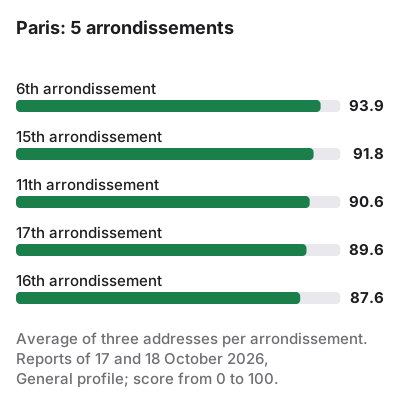
15 addresses in 5 arrondissements of Paris: score, traffic noise and minutes to a station in one table. 6th arrondissement leads with 93.9.
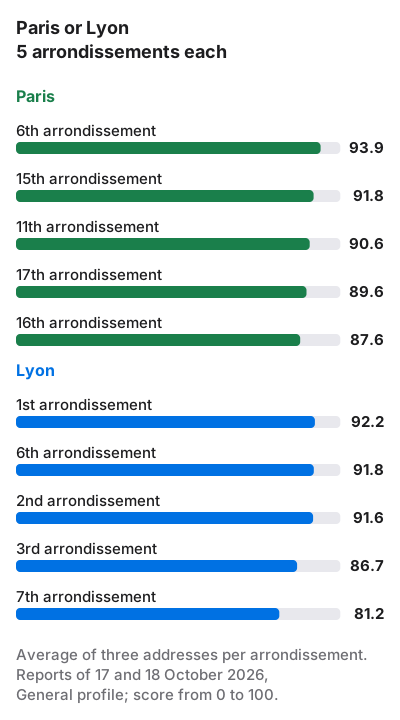
Paris or Lyon: 30 addresses, 5 arrondissements in each city. Average score 90.7 against 88.7, traffic noise and minutes to a station side by side.
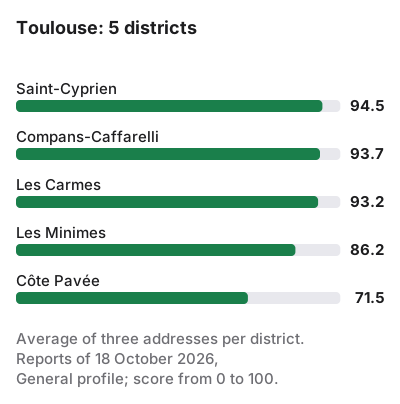
15 addresses in 5 districts of Toulouse: score, traffic noise and minutes to a station in one table. Saint-Cyprien leads with 94.5.
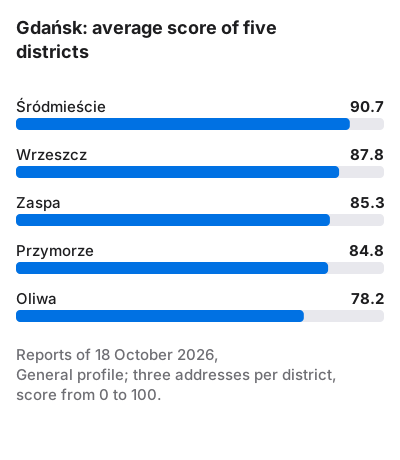
15 addresses in 5 Gdańsk districts: average score, noise and minutes to a station in one table. Śródmieście leads on 90.7, Oliwa trails on 78.2.
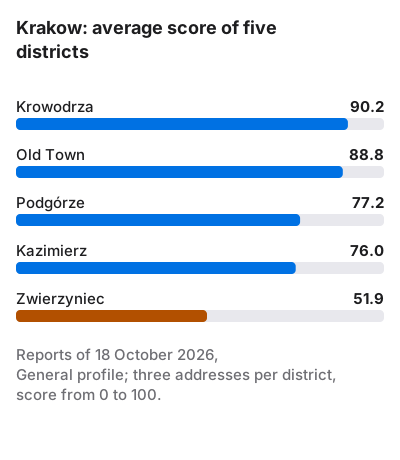
15 addresses in 5 Krakow districts: average score, noise and minutes to a station in one table. Krowodrza leads on 90.2, Zwierzyniec trails on 51.9.
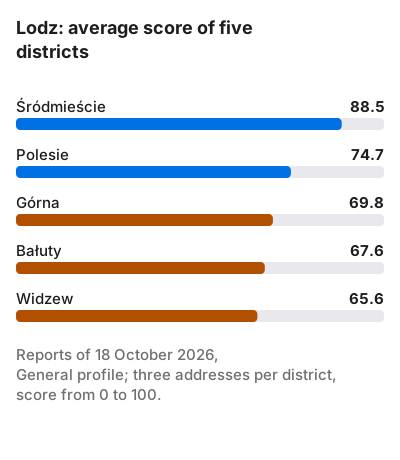
15 addresses in 5 Lodz districts: average score, noise and minutes to a station in one table. Śródmieście leads on 88.5, Widzew trails on 65.6.
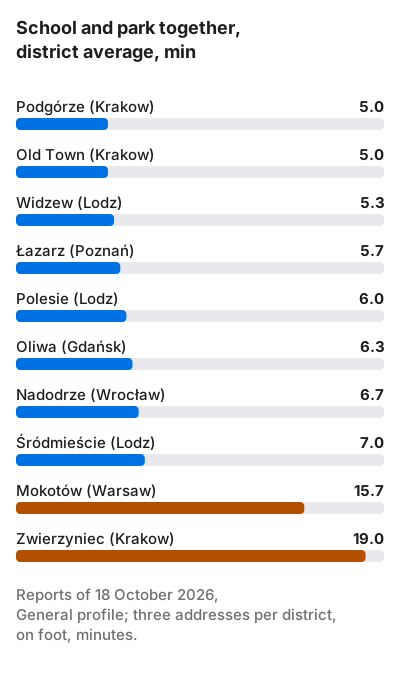
School and park walks and road noise in 30 districts of six Polish cities. School plus park is 5 min in Krakow's Podgórze, 19 in Zwierzyniec.
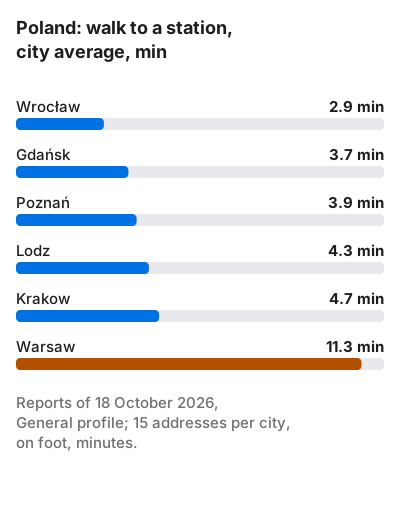
Station and shop on foot in 30 districts of six Polish cities: 67 of 90 addresses have a station within 5 min. Warsaw's Mokotów is the far exception.
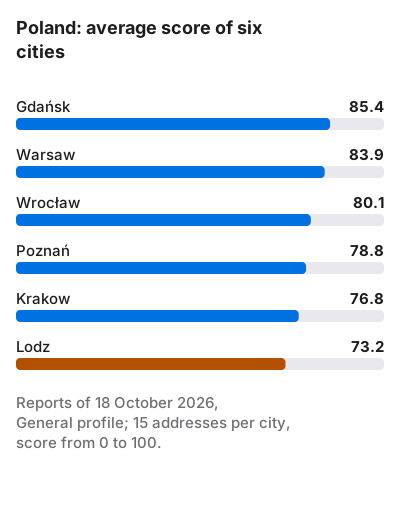
30 districts in six Polish cities: average score, best and weakest district of each. Gdańsk leads on 85.4, Lodz trails on 73.2.
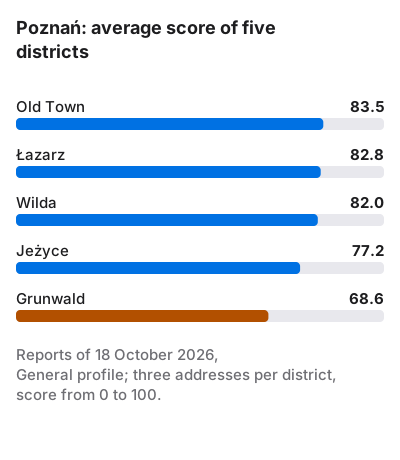
15 addresses in 5 Poznań districts: average score, noise and minutes to a station in one table. The Old Town leads on 83.5, Grunwald trails on 68.6.
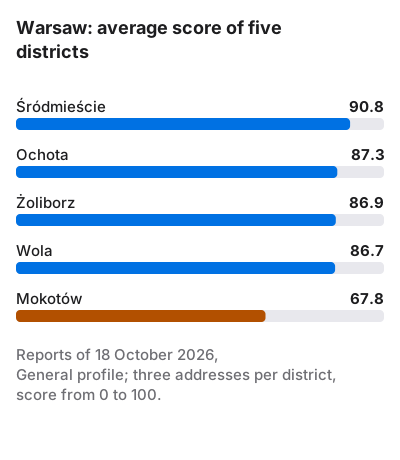
15 addresses in 5 Warsaw districts: average score, noise and minutes to a station in one table. Śródmieście leads on 90.8, Mokotów trails on 67.8.
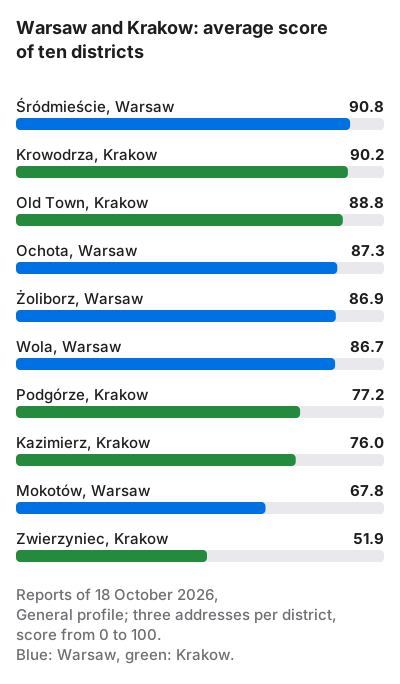
Warsaw averages 83.9 and Krakow 76.8 over 15 addresses each: minutes to a station, school, grocery and park and road noise in one table.
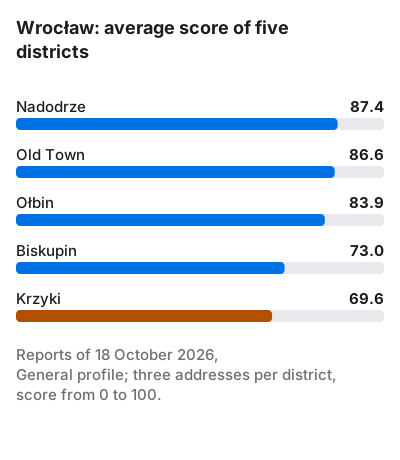
15 addresses in 5 Wrocław districts: average score, noise and minutes to a station in one table. Nadodrze leads on 87.4, Krzyki trails on 69.6.
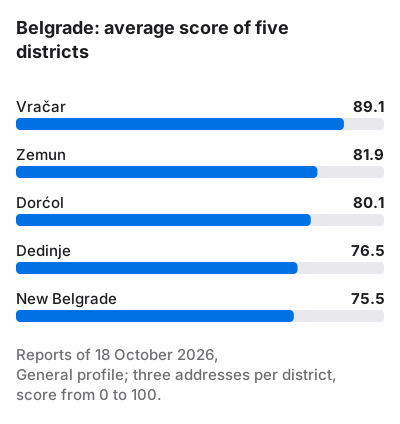
15 addresses in 5 Belgrade districts: average score, noise and minutes to a stop in one table. Vračar leads on 89.1, New Belgrade trails on 75.5.
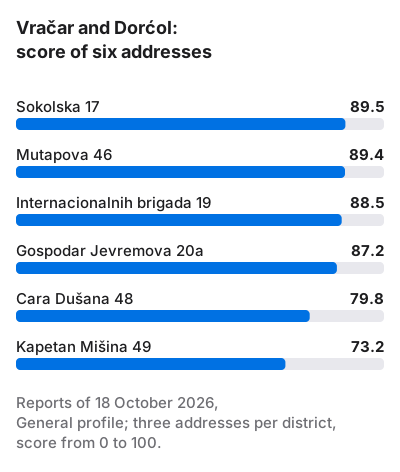
Vračar or Dorćol: six Belgrade addresses by minutes on foot. Vračar scores 89.1, Dorćol 80.1: compare the school, the stop and the noise.
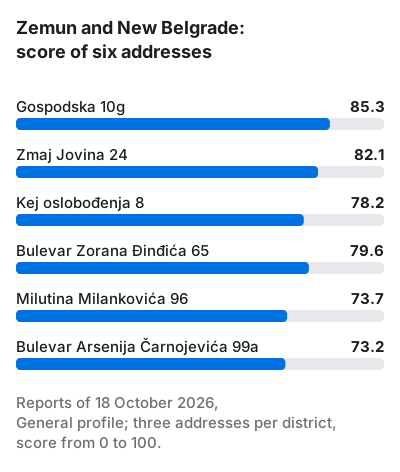
Zemun or New Belgrade: six Belgrade addresses by minutes on foot. Zemun scores 81.9, New Belgrade 75.5; schools favour one, stops the other.
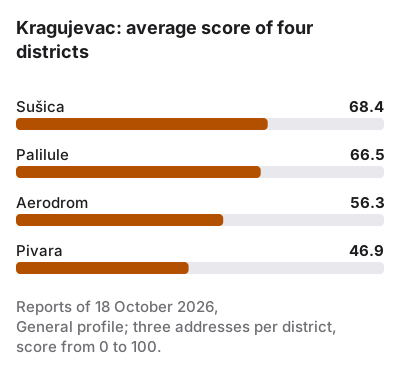
12 addresses in 4 Kragujevac districts: average score, noise and minutes to a stop in one table. Sušica leads on 68.4, Pivara is last on 46.9.
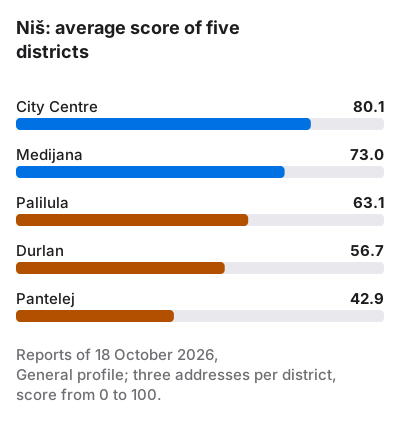
15 addresses in 5 Niš districts: average score, noise and minutes to a stop in one table. The centre leads on 80.1, Pantelej is last on 42.9.
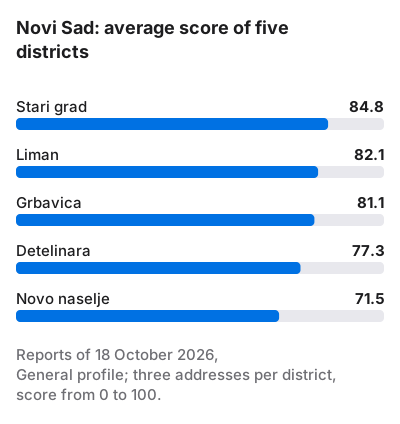
15 addresses in 5 Novi Sad districts: average score, noise and minutes to a stop in one table. Stari grad leads on 84.8, Novo naselje has 71.5.
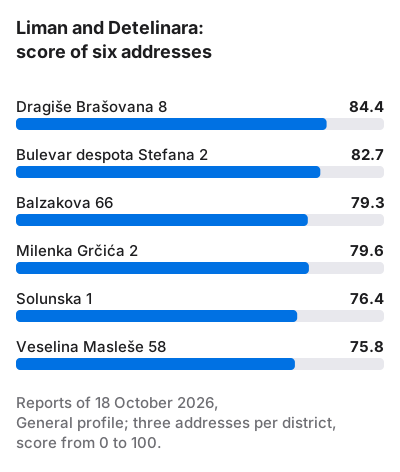
Liman or Detelinara: six Novi Sad addresses by minutes on foot. Liman scores 82.1, Detelinara 77.3: compare the school, the stop and the noise.
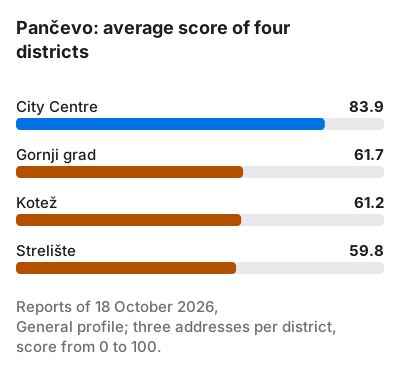
12 addresses in 4 Pančevo districts: average score, noise and minutes to a stop in one table. City Centre leads on 83.9, Strelište is last on 59.8.
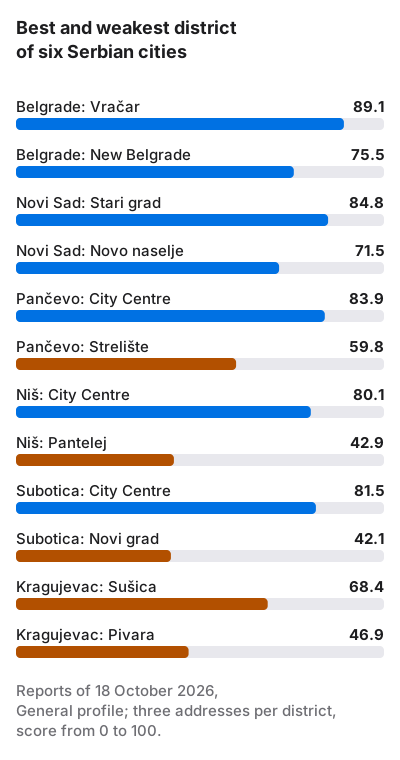
Six Serbian cities, 28 districts, one scale: Belgrade averages 80.6, Kragujevac 59.6. Best and weakest district are 13.3 to 39.4 points apart.
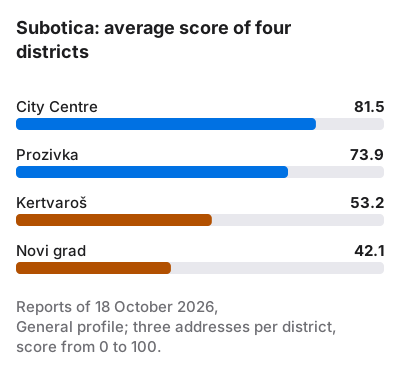
12 addresses in 4 Subotica districts: average score, noise and minutes to a stop in one table. City Centre leads on 81.5, Novi grad is last on 42.1.

Which map errors reach a neighbourhood score: the wrong kind of place, empty rows, missing hours. Examples from six Russian cities and how to spot them.
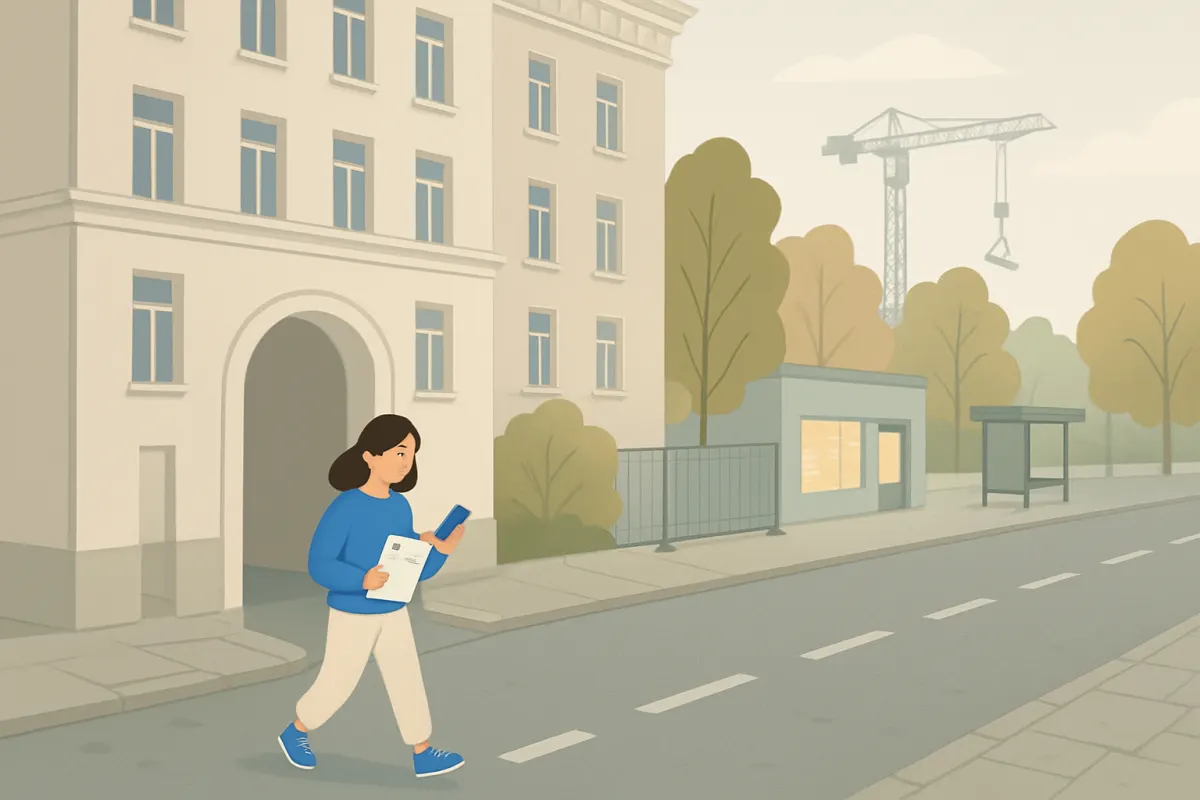
What a district score knows and what you have to check in person: building sites, noise in the flat, opening hours, pavements. Using 13 Tverskaya Street.
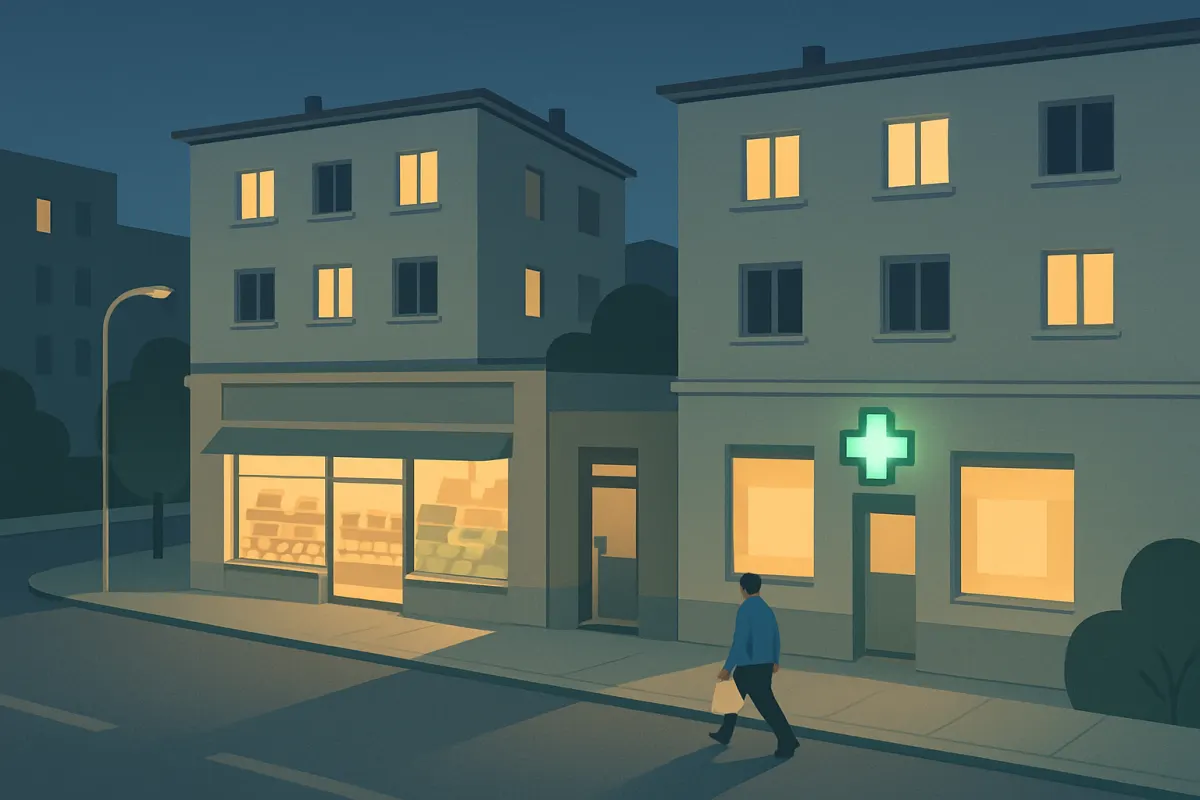
What is open near home at 9 pm: groceries, pharmacies and cafes at four addresses in Moscow, Madrid, Buenos Aires and Tbilisi, and what the map misses.
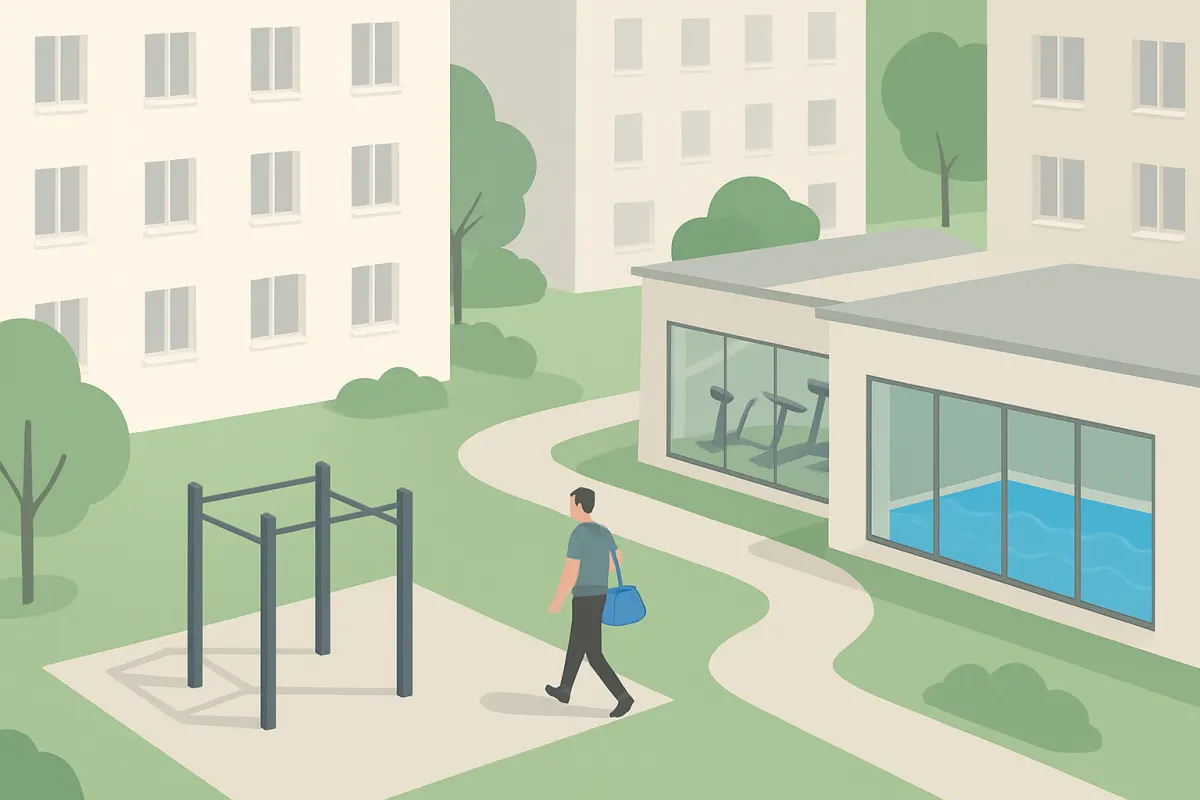
How far can a gym or pool be before you stop going? How the score counts sport near home, with examples in Moscow, Madrid, Buenos Aires and Tbilisi.

The first crossing by your door is part of every route. How the report counts waiting, traffic alongside and noise, at Avenida de Mayo 825.
How the Family with a child, Older person and Remote worker profiles differ from General: weights, pace, the cost of steps. Three Kazan addresses.

The 15-minute city in Yekaterinburg: in Akademichesky the shop is two minutes away and the metro 34. Who such a district suits and who it does not.

The overall score knows the nearest gym, not yours. How to pick three own places, what the report shows for each and how it changes the choice of a flat.

Where to go between calls when you work from home: in St Petersburg one address is a minute from a garden, another nine. How much is left for the park.
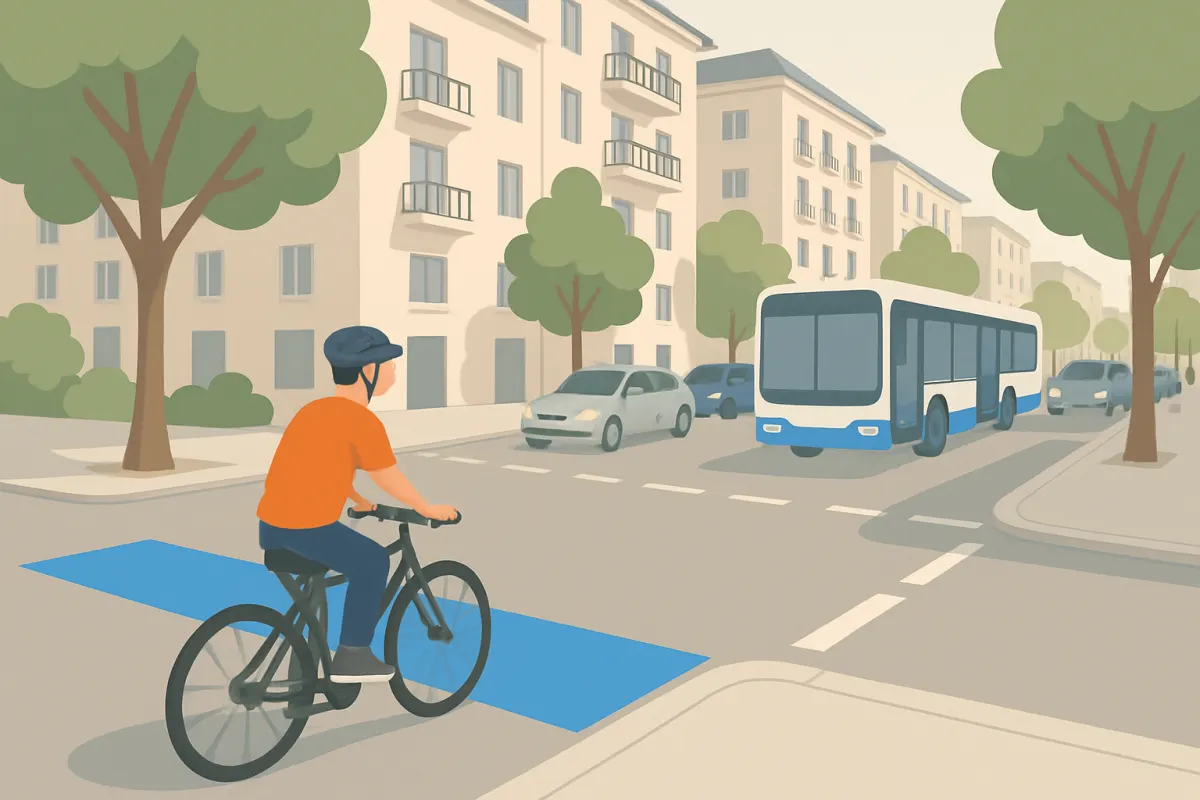
Bike lanes near home are often broken into pieces. How the report tells a network from scraps: 4.2 km of lanes around Gran Vía score 40.2 out of 100.

How to judge a family morning route: kindergarten, school and the station on the way to work. Minutes at nine St Petersburg addresses and a child's pace.
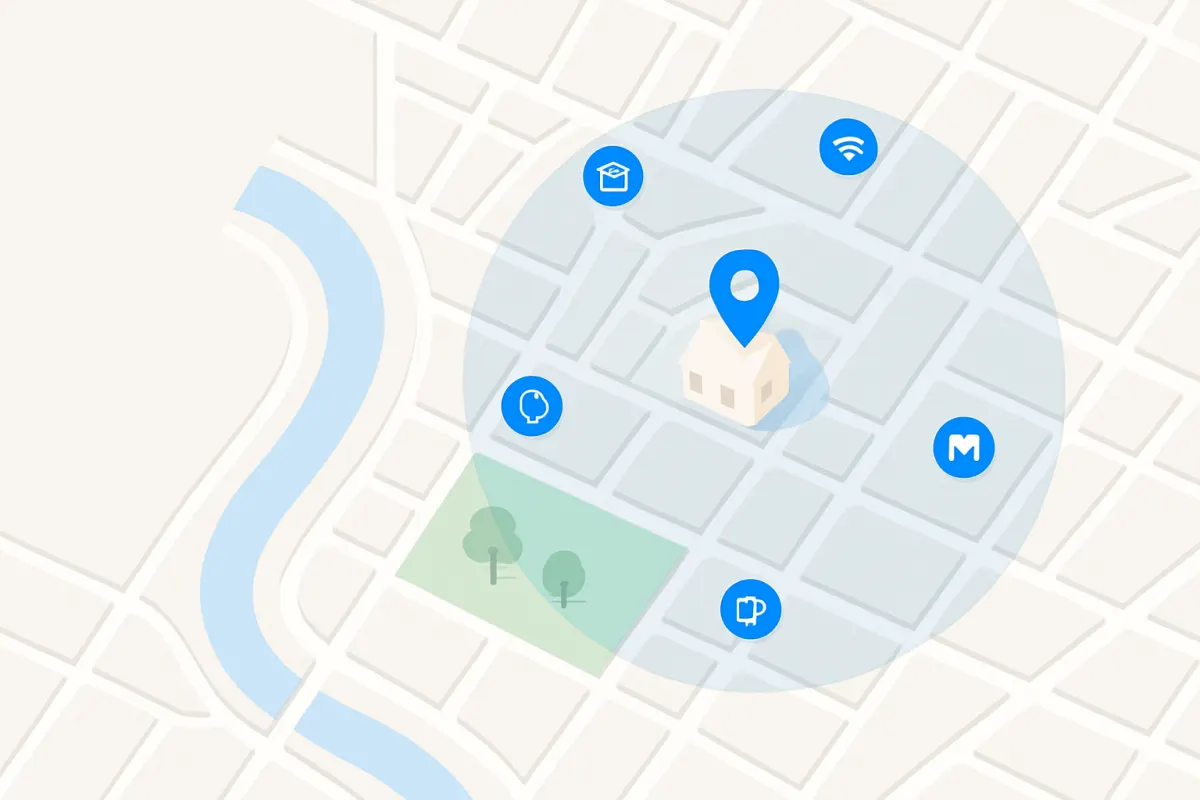
Why we measure access in minutes on foot rather than metres: the route instead of a straight line, slopes, crossings and pace. 13 Tverskaya as an example.
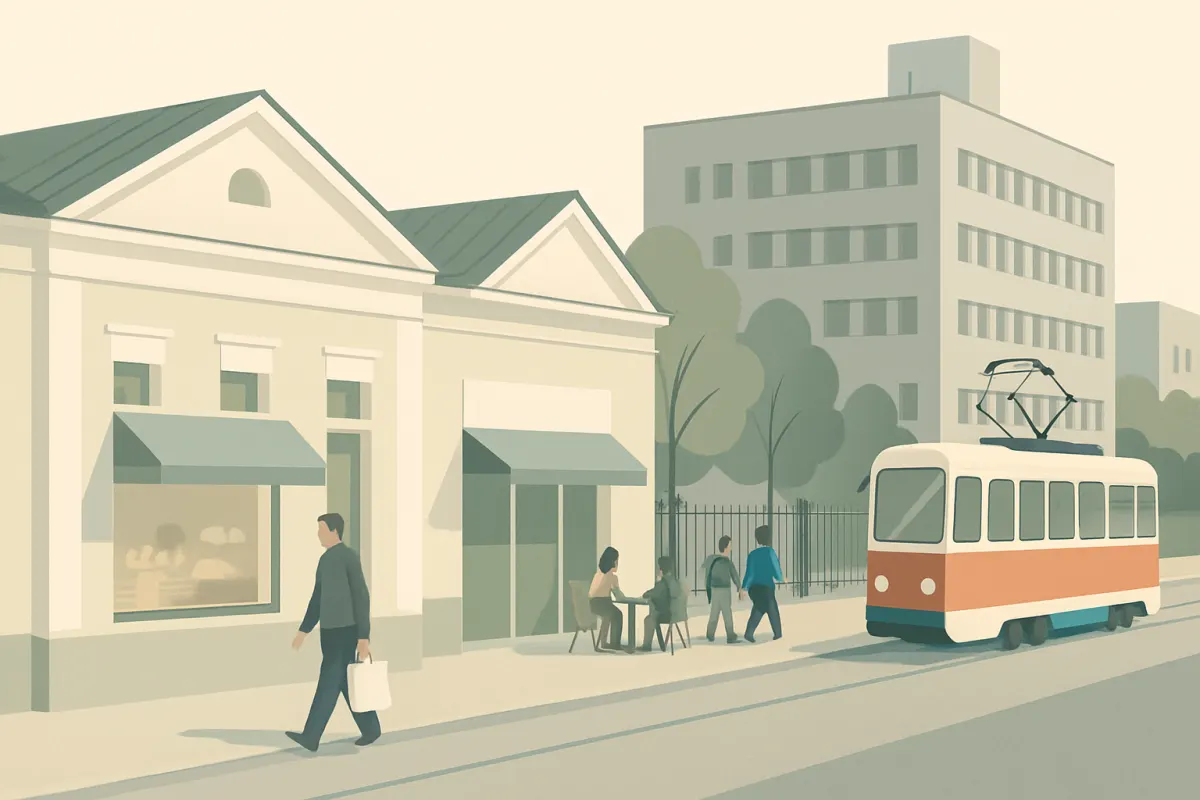
A score of 90 means everything on foot, 70 the basics on foot. How they differ in minutes and penalties, at Yekaterinburg addresses from 90.7 to 64.6.

Can a Moscow address be compared with one in Valencia? The median of 18 rated addresses: Spain 83.9, Russia 80.2, Argentina 66.1, Georgia 65.2.
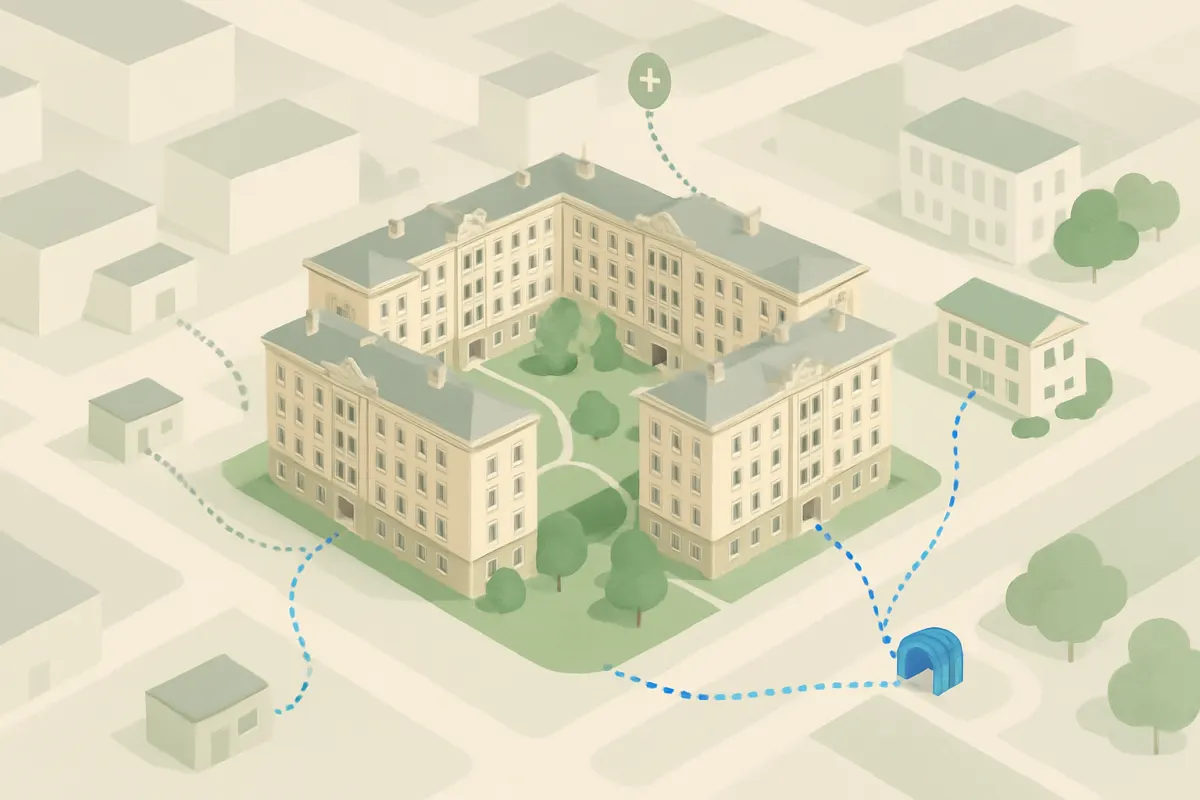
One address step by step: at 13 Tverskaya Street, Moscow, eleven categories earn 93.17, the air takes 5.48 and 87.7 is left. Where each point comes from.

58 Kirova Street in Adler scores 61.7 with standard weights, 66.8 with a family's and 56.2 with those of life without a car. Set the weights to your life.

Add your office, gym and school to an address report. On 13 Tverskaya Street three places within seven minutes lift 87.7 to 88.7; elsewhere they cut it.