How to check bike lanes near home: a network or scraps
Bike lanes near home are often broken into pieces. How the report tells a network from scraps: 4.2 km of lanes around Gran Vía score 40.2 out of 100.
Score your own address
Everything this article covers, you can check on your own address: free, in a minute.
Free. The score at once, the full report after an e-mail sign-in.
Contents 7 sections
A lane on the map and a lane under your wheels
On a map of the neighbourhood the bike lanes look convincing: green lines here and there. Under your wheels it is another story. A lane runs for three blocks, stops at a junction, turns into a painted strip on the road, then into nothing at all. Anyone who rides every day knows what these gaps cost: at each one you choose between the pavement and the traffic.
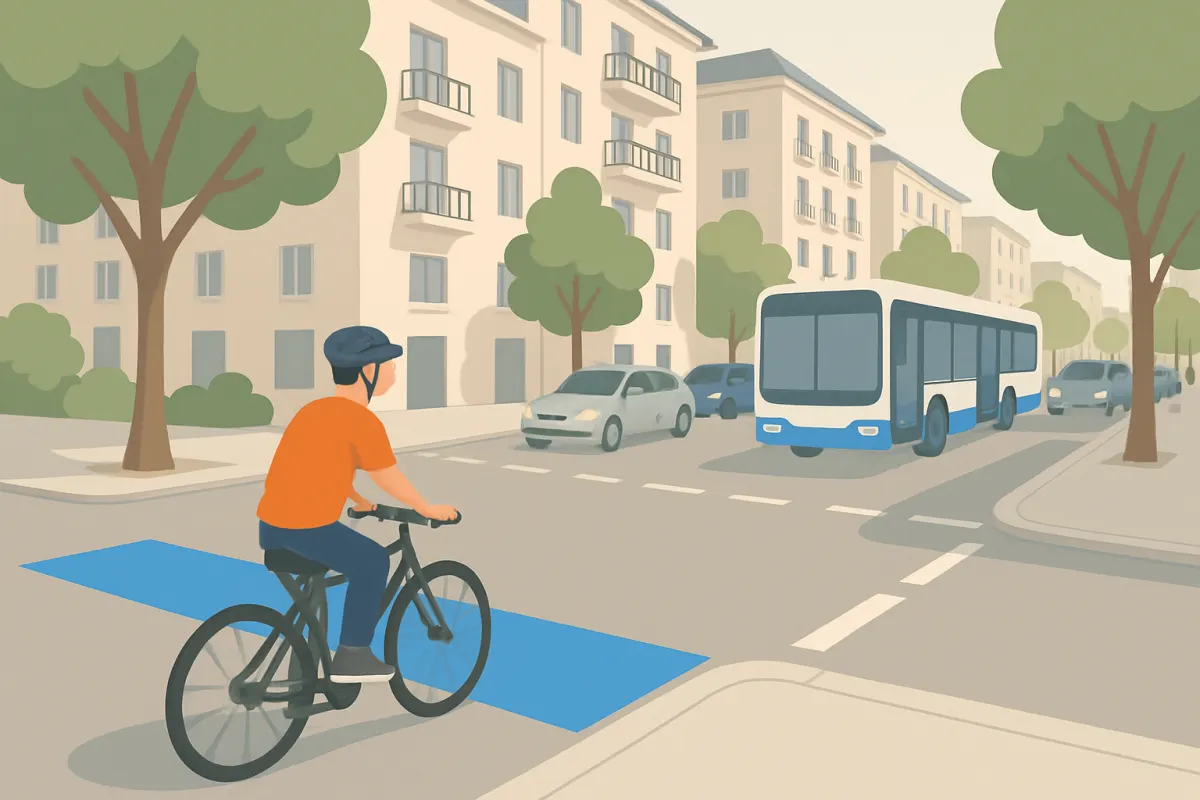
Total kilometres do not show this. Five pieces of 800 metres and one lane of 4 kilometres add up to the same length, yet riding them is nothing alike. That is why the report looks at two numbers, not one.
Two numbers: how much in total and how much in one go
The need "Bike lanes nearby" draws a circle with a one-kilometre radius around the building and counts the separated bike lanes and painted cycle lanes inside it. The first number is their total length. It gets full marks from 8 kilometres. The second is the longest unbroken stretch, the part of the network you can ride without leaving the lane. Full marks from 3 kilometres.
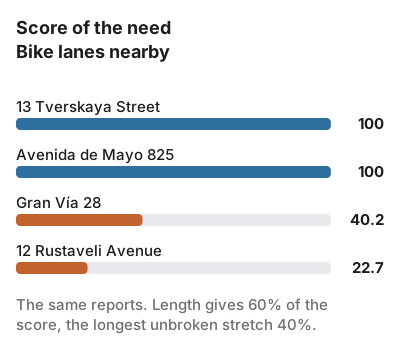
Length gives 60% of the score and the unbroken stretch 40%. The formula is simple: 100 × (0.6 × length / 8 km + 0.4 × stretch / 3 km), with each share capped at one. In the report it is a single line: how many lanes lie within a kilometre, what share of the streets that is, and how far the longest stretch runs.
Four addresses, four networks
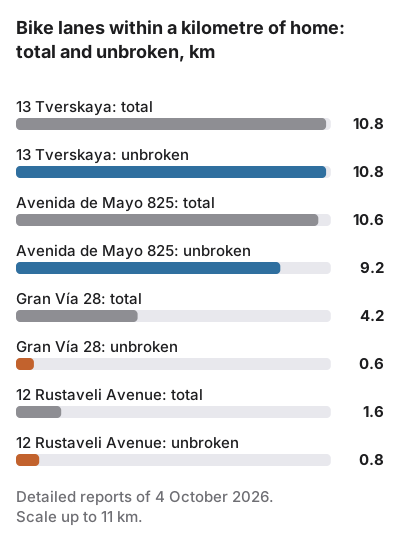
We took four detailed reports of 4 October 2026, one in each country. Around 13 Tverskaya Street in Moscow there are 10.8 kilometres of lanes within a kilometre of home, and all of them join into one stretch of the same length. Both shares are full and the need scores 100.
Around Avenida de Mayo 825 in Buenos Aires there are 10.6 kilometres, 9.2 of them in one go. That is 100 as well: both length and stretch are above the thresholds. Bike lanes here take up 10.6% of the streets, the largest share of the four.
Around Gran Vía 28 in Madrid there are 4.2 kilometres of lanes, but the longest stretch is 625 metres. Length gives 31.9 of a possible 60, the stretch 8.3 of 40. The total is 40.2. Around 12 Rustaveli Avenue in Tbilisi there are 1.6 kilometres, 812 metres of them unbroken: 22.7.
| Address | Total, m | Unbroken, m | Share of streets | Score |
|---|---|---|---|---|
| 13 Tverskaya Street | 10,837 | 10,837 | 5% | 100 |
| Avenida de Mayo 825 | 10,564 | 9,234 | 10.6% | 100 |
| Gran Vía 28 | 4,249 | 625 | 2.8% | 40.2 |
| 12 Rustaveli Avenue | 1,578 | 812 | 1.1% | 22.7 |
What a gap costs
Let us work out on the Madrid address what it would look like without the gaps. Suppose the same 4,249 metres of lanes formed one lane. Then the stretch would be longer than 3 kilometres and give all 40 points, while length would still give 31.9. The total would be 71.9 instead of 40.2. The gaps cost this need almost 32 points out of 100.
In Tbilisi the gaps cost less, because there are few lanes to begin with. If all 1,578 metres were one stretch, the need would score 32.9 instead of 22.7. The real problem there is not the breaks but that there are hardly any lanes: 1.1% of the streets.
In the final score these differences are small. The need weighs 2.5 out of 10 within the category Bikes and shared cars, and the category weighs 3 points out of 100 in the General profile. Thirty-two points of the need turn into roughly a quarter of a point of the total. But in the line for the need the gap shows at once, and that is exactly where a daily rider should look.
The second place gaps show up: the ride to the centre
A connected network around home does not yet mean it takes you to work. For the ride to the centre the report plans a route and states what share of it runs on bike lanes and cycle lanes and what share on quiet streets. From 13 Tverskaya, with its unbroken network nearby, 38% of the way to the centre is on lanes and 58% on quiet streets: 2.4 kilometres and 11 minutes in all.
From Gran Vía 28 the route to the centre is under a kilometre, 470 metres, and the report counts it in full without any calculation. Here the broken network does not stop you reaching the centre, but it does get in the way of going further. In Tbilisi the way from 12 Rustaveli to the centre is 1.6 kilometres and 9 minutes, with 24 metres of climb, and not a single metre of it is on a lane: 74% on quiet streets, the rest on busier ones.
Why connectedness weighs less than length
You might ask why the unbroken stretch gives only 40% if breaks are such a nuisance. The answer is that short pieces are useful too: a block on a lane instead of a busy street is safer, even if the lane ends afterwards. Length answers the question of how much room there is for bikes in the area. Connectedness answers whether that room takes you anywhere. Both answers are needed, and the formula keeps them side by side so that neither hides the other.
How to check the bike lanes before you move
- Find the bike-lane line in the report and compare its two numbers. If the longest stretch is less than a third of the total length, the network is broken.
- Look at the share of the route to the centre that runs on lanes. Zero despite a good network near home means the network leads somewhere other than where you need to go.
- Open the route on the map and find where the lane stops at big junctions. Those are worth riding yourself.
- Do not confuse a painted lane on the road with a separated track. The report line counts them together, but they feel very different.
The formula, thresholds and factors of the need are published on the page How it is calculated. Addresses with detailed reports are on the city pages, for example the Madrid page and the Moscow page.
Questions
How can I tell that the bike lanes in an area are broken up?
Compare two numbers in the report: the total length of lanes within a kilometre of home and the longest unbroken stretch. Around Gran Vía 28 in Madrid these are 4.2 kilometres and 625 metres.
How many lanes does an address need for full marks?
8 kilometres within a one-kilometre radius of home and an unbroken stretch of at least 3 kilometres. Length gives 60% of the score, the stretch 40%.
Does a painted cycle lane on the road count?
Yes, separated bike lanes and painted cycle lanes are counted together. How calm the ride to the centre is gets scored separately, by the share of the route on lanes and quiet streets.