
Four countries, one scale: Moscow against Valencia
Can an address in Moscow be compared with one in Valencia? The median of 18 rated addresses is 83.9 in Spain and 65.2 in Georgia. What lies behind it.
Contents 8 sections
Can Pokrovka be compared with Plaza del Ayuntamiento
27 Pokrovka Street in Moscow scores 84.7. Plaza del Ayuntamiento 1 in Valencia scores 91.4. Almost seven points between two central addresses in two large cities. Does that mean the centre of Valencia is easier to live in, or are the scales different?
The scale is one, and that can be checked. By the list of places the two addresses earned almost the same: 92.9 and 92.2 out of 100, Pokrovka slightly more. The penalties made the whole gap. Pokrovka lost 8.2 points, 5.48 of them to the air. The square in Valencia lost 0.84, to air alone. The figures are from the stored rating reports of 2 October 2026.
So on foot you reach the same things in both centres, and the air is what differs.
What is the same in every country
Comparison works because three things are the same.
The data. Places, streets, stops and parks come from OpenStreetMap; terrain and air come from the open models of Open-Meteo. No national register that exists in one country and is missing in another enters the sum.
The formula. Five minutes on foot count in full in Kazan and in Córdoba. A supermarket is worth one, a convenience store 0.75, a metro line three bus lines. The thresholds for noise and air are shared: 55 decibels and the WHO guideline.
The unit. We count walking minutes with climbs and crossings, not metres. Four hundred metres uphill in Tbilisi and four hundred on the flat in Valencia give different times, and that is the point.
72 addresses on one axis
The ratings hold eighteen addresses per country, three in each of six cities.
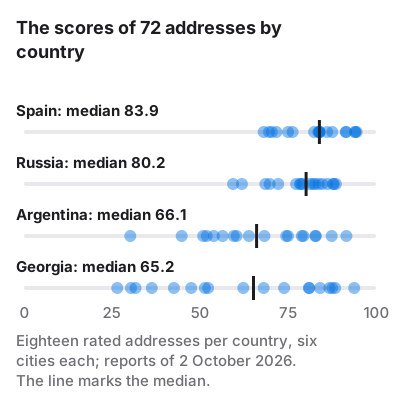
| Country | Lowest | Median | Highest | 90 and above | Below 60 |
|---|---|---|---|---|---|
| Spain | 68.1 | 83.9 | 94.5 | 5 | 0 |
| Russia | 59.4 | 80.2 | 88.6 | 0 | 1 |
| Argentina | 30.2 | 66.1 | 91.6 | 1 | 7 |
| Georgia | 26.5 | 65.2 | 93.8 | 1 | 8 |
The four rows of dots look different, and each has its own explanation.
Spain: dense and high
The Spanish dots cluster at the right of the scale. No address falls below 68, and five rise above 90: Calle de Ibiza 35 in Madrid (94.5), Rambla del Poblenou 60 in Barcelona and Plaza de Benimaclet in Valencia (94.1 each), Plaça de la Virreina in Barcelona (91.5) and Plaza del Ayuntamiento in Valencia (91.4).
The cities are compact and the blocks dense. Even an address two and a half kilometres from the sea and the centre, Avenida de Novelda 60 in Alicante, scores 68.1. Air carries almost no penalty: from 0.39 in Alicante to 2.4 in Barcelona.
Russia: high, with nothing in the top band
Russian addresses earn as much by categories as Spanish ones. 16 7th Line of Vasilyevsky Island in Saint Petersburg earned 91.9, and 27 Pokrovka Street in Moscow 92.9. None of the eighteen reaches the band from 90.
The reason is air. In Moscow it takes between 5.48 and 7.47 points, in Saint Petersburg 3.27. After the penalty Vasilyevsky Island scores 88.6, the best in the Russian rating. East of the Urals the air is milder: in Yekaterinburg and Novosibirsk the penalty is about one point, so 7 Karl Marx Square in Novosibirsk scores 88 and 40 Wilhelm de Gennin Street in Yekaterinburg 87.8.
The low end of the Russian row is 208 Borisa Bogatkova Street in Novosibirsk at 59.4, where weak parks, 30 out of 100, meet 6.84 points of noise.
Georgia and Argentina: a long tail
In these two countries the rows stretch from 26 to 94. The top addresses match the Spanish ones: 6 May Park in Batumi scores 93.8, Juramento 2291 in Buenos Aires 91.6. The bottom ones sink to where no Spanish or Russian address is found.
The explanation is in the sample. The Russian rating holds five cities of over a million people and the resort of Sochi. The Georgian one, after Tbilisi and Batumi, has Kutaisi, Rustavi, Gori and Kobuleti, each with an address by the station or at the edge of town: Gori railway station 36.3, Kobuleti railway station 30.4, Avtomshenebeli Avenue in Kutaisi 26.5. The Argentine one includes the suburbs of La Plata: City Bell 44.8, Los Hornos 30.2.
A median describes our eighteen addresses and not the country. What it does say is that in Georgia and Argentina the distance between a good address and a weak one is greater, and a wrong choice is easier to make.
What does differ between countries
The formula is one; the map is drawn differently, and that is the main caveat.
The detail of the map. In the centres of large cities OpenStreetMap knows every pharmacy. In small towns some places are not on it. That is what the confidence figure beside the score is for: where the map is thin, the score is shown as "at least" with no verdict. The low score of Kobuleti is partly about the map and not only about the town.
Timetables. The interval between departures is mapped for a small share of routes: when the method was checked it was present on 104 of 919 route relations in Madrid, 6 of 39 in Kazan and none in Tbilisi. So frequency is hardly used, and the mode of transport carries the weight by itself. Where a bus runs seldom, the transport score can be kinder than life.
Road classes. The noise penalty depends on how a street is tagged. A street of the same width can carry a different class in two countries.
Air. The model covers Europe in finer detail than the rest of the world, so the figure for Buenos Aires or Novosibirsk is coarser than the one for Madrid.
Using the comparison
Two addresses in different countries can be compared if you read the breakdown and not just the total. An 85 in Tbilisi and an 85 in Valencia can be built differently: in Tbilisi points go more often to climbs and the noise of the avenues, in Valencia to schools and parks in the old centre.
Comparing countries by the median of our rating is not worth doing. Compare cities by their best and worst address, because that tells you what a mistake costs. In Valencia the worst of our four addresses scores 83.9. In La Plata it scores 30.2.
One more use is for people who have lived in one of these cities and are moving to another. Score the address you know first. If your flat in Madrid's Retiro scored 94 and you were content, an 81 on Pekini Avenue in Tbilisi tells you something concrete: read which categories fell and whether you used them. If the loss is all noise and you slept on the courtyard side anyway, the gap may not be yours.
All eighteen addresses of each country, broken down by category, are open in the ratings: Spain, Georgia, Argentina, Russia. The formula, the thresholds and the known weaknesses of the method are on the page How it is calculated.
Questions
Is the score computed the same way in every country?
Yes. The data, the formula, the weights and the thresholds are the same; only the detail of the map differs, and the confidence figure shows it.
Why does no Russian address score 90 or more?
By the list of places some do: Pokrovka earned 92.9. But air takes between 5.5 and 7.5 points in Moscow and 3.27 in Saint Petersburg.
Does a low median mean a worse country to live in?
No. The median describes the eighteen addresses of the rating, which include the edges of small towns. The best addresses in Georgia and Argentina score above 90.
Related posts
Moving abroad: choosing a neighbourhood you have not seen
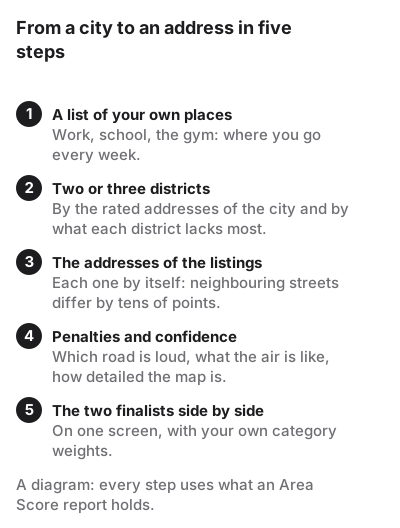
Five steps from a city to an address when you cannot visit first, worked through in Tbilisi, from Vake to Saburtalo.
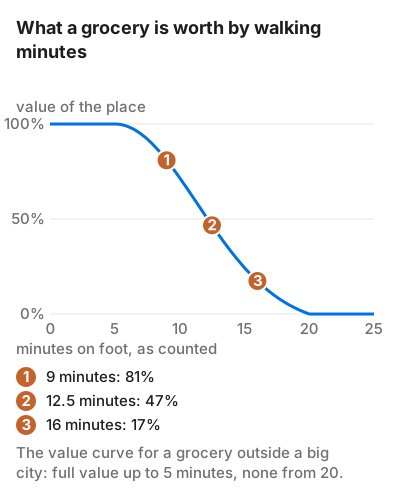
How the score is made: formula, weights, penalties
One address step by step: at 13 Tverskaya Street, Moscow, eleven categories earn 93.17, the air takes 5.48 and 87.7 is left. Where each point comes from.
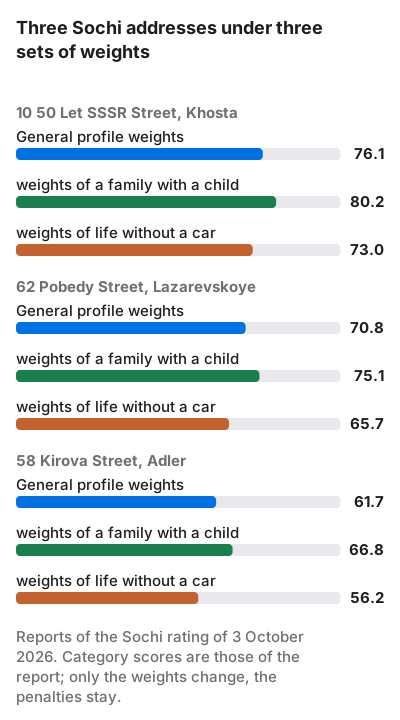
One address, three scores: what the weights change
58 Kirova Street in Adler scores 61.7 with standard weights, 66.8 with a family's and 56.2 with those of life without a car. Set the weights to your life.