
One address, three scores: what the weights change
58 Kirova Street in Adler scores 61.7 with standard weights, 66.8 with a family's and 56.2 with those of life without a car. Set the weights to your life.
Contents 8 sections
Why one building has several scores
A score is the sum of eleven categories, and each has a weight. In the General profile groceries take 9 points out of 100, services nearby 13, public transport 18, parks and the street network 14 each, education 10. Those are weights for a person in general. For a family with a six-year-old the school outweighs the bus; for somebody without a car it is the other way round.
Under the score every report has a panel called "Your weights": one slider per category. Move one and the score is recomputed in the browser. The places and the minutes stay as they were; only the importance you give each category changes.
Three sets of weights on three addresses
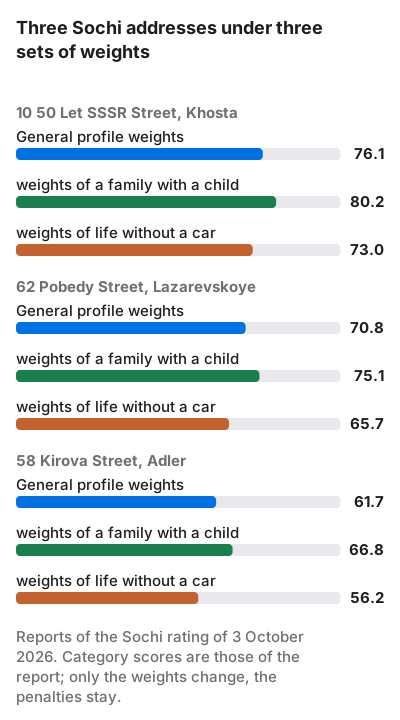
We took three stored reports of the Sochi rating, made on 3 October 2026, and set the sliders three ways: as in the General profile, as for a family with a child (education 22, parks 16, transport 13) and as for a person without a car (transport 28, services nearby 14, groceries 10).
| Address | General | As a family | As without a car |
|---|---|---|---|
| 10 50 Let SSSR Street, Khosta | 76.1 | 80.2 | 73.0 |
| 62 Pobedy Street, Lazarevskoye | 70.8 | 75.1 | 65.7 |
| 58 Kirova Street, Adler | 61.7 | 66.8 | 56.2 |
Khosta: four points better for a family
At 10 50 Let SSSR Street in Khosta schools (94), parks and sport (96) and cafes and culture (99) are strong. The weak spots are public transport, 52, and bikes and shared cars, 6. With a family's weights, where education and parks count for more, the address rises from 76.1 to 80.2 and enters the band "Most errands on foot". For somebody without a car it is worth 73.0.
If the sliders hardly move the number, the address is even. None of our three Sochi addresses is: all have weak transport, and across six sets of weights each moves by 9 to 12 points. In a city like this it pays to look at a report with your own weights.
Adler: ten and a half points between neighbours on one landing
58 Kirova Street in Adler, the southern end of Sochi near the airport, has nearly every household errand close by: groceries and services nearby close to 100, health 100, street network 93, cafes and culture 84. Public transport scores 8 out of 100. The map knows almost no lines within a walk.
A family that lives inside the neighbourhood can bear that. With a family's weights the address scores 66.8: school and kindergarten are near (81), so is a park (75). For somebody without a car the same building is worth 56.2, because transport then weighs 28 points. The gap is 10.6 points, and it moves the address from the band "The basics on foot" down to "Half on foot".
A penalty is at work here too: 9.49 points for noise, the largest among the 72 addresses of our ratings. Weights do not touch it. Penalties are subtracted after all the categories, and no slider makes them smaller. The noise figure is for the spot the building stands on: inside a flat it depends on which way the windows face and on the glazing, and a flat on the courtyard side can be much quieter.
Lazarevskoye: in between
62 Pobedy Street is in Lazarevskoye, on the coast at the northern end of Sochi. Cafes and culture score 100, groceries 97, parks and sport 95. Public transport scores 26, and bikes and shared cars almost nothing: 1 out of 100.
For a family the address is better than "on average": 75.1 against 70.8. For a person without a car it is worse: 65.7. A report run with the family profile would be stricter than our sliders, which is the subject of the next section.
Weights and profiles are not the same thing
Sliders change how much each category matters and nothing else. A profile changes more, which is why choosing one runs the report again.
- Pace. The General profile walks at 4.8 km/h, a family with a child at 3.9, an older person at 3.6. The same 500 metres to school become different minutes.
- The cost of slopes and steps. For a family with a pram a staircase counts as three times its length.
- Essentials. In the family profile a school, a playground and a park are required; without any one of them its category loses another 40% of what is left.
- The transport gate. In the profile "Without a car" weak transport cuts the whole sum by up to a quarter.
Sliders are for a quick "what if"; the profile is for the decision. Adler under the real "Without a car" profile scored 41.0 in the report of 2 October 2026 rather than our 56.2: with transport at 8 out of 100 the gate removes almost a quarter of the category sum.
The tick "Cannot do without"
Beside the sliders every need has a tick. Set it and the need becomes essential: when it is missing, the category loses more than that need's own share.
The tick multiplies the whole category by 1 − 0.4 × (1 − the need's score / 100). A hospital five minutes away changes nothing. A hospital at the edge of a twenty-five-minute walk, whose need scores 30 out of 100, cuts Health by 28%. The tick states plainly what this building lacks for you in particular.
Using the panel
Start by setting to zero the categories you do not need. No dog and no plans for one: drop Pets. An office job: drop Remote work. Then add weight to the two or three that matter most. The sliders need not add up to 100; the panel turns them into shares.
The settings live in the address bar. Send the link to the person you are choosing a flat with and they see the same view. "Back to the profile" restores the number of the report, and the stored report itself is never altered.
A practical order for two shortlisted flats: set the same weights on both reports, then compare. With the General weights the difference tells you which flat is better for a typical tenant. With yours it tells you which is better for you, and the two answers disagree more often than people expect. Our Khosta and Lazarevskoye examples move apart by four points as soon as transport stops being a daily need.
All six rows of weights and the essentials of each profile are published on the page How it is calculated. The addresses used here are on the Sochi page and in the rating for Russia.
Questions
Can a slider remove the noise penalty?
No. The penalties for noise, air and industry are subtracted after the category sum and do not depend on the weights.
How do weights differ from a profile?
Weights change how much the categories matter in a finished report. A profile also changes walking pace, the cost of slopes and the set of essentials, so the report is computed again.
Will the person I send the link to see my weights?
Yes, they are written into the address of the page. The stored score of the report stays the same.
Related posts
Four countries, one scale: Moscow against Valencia
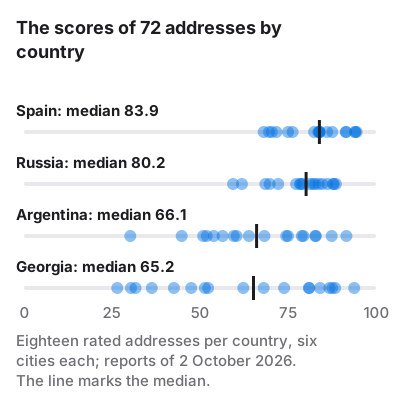
Can an address in Moscow be compared with one in Valencia? The median of 18 rated addresses is 83.9 in Spain and 65.2 in Georgia. What lies behind it.
How the score is made: formula, weights, penalties
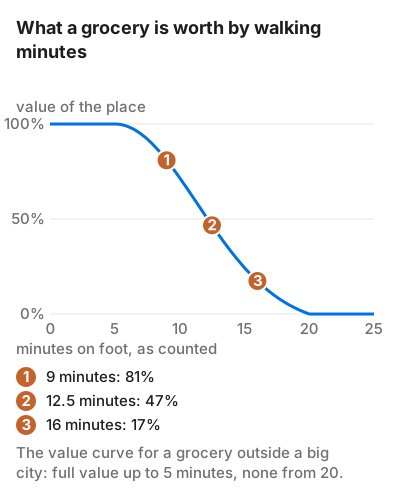
One address step by step: at 13 Tverskaya Street, Moscow, eleven categories earn 93.17, the air takes 5.48 and 87.7 is left. Where each point comes from.
Score a neighbourhood by your own places, not averages
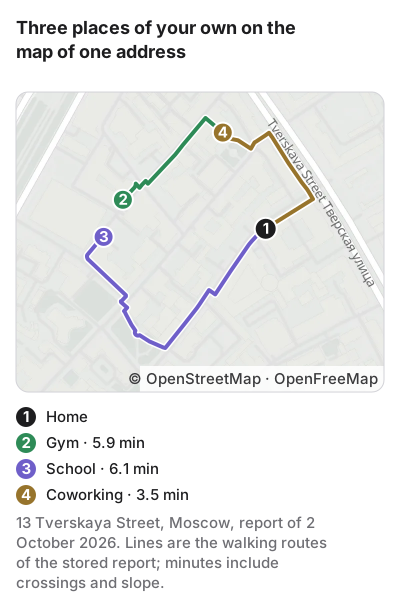
Add your office, gym and school to an address report. On 13 Tverskaya Street three places within seven minutes lift 87.7 to 88.7; elsewhere they cut it.