
How the score is made: formula, weights, penalties
One address step by step: at 13 Tverskaya Street, Moscow, eleven categories earn 93.17, the air takes 5.48 and 87.7 is left. Where each point comes from.
Contents 8 sections
One question and two steps
The score answers one question: how much of everyday life can you do on foot from this door, and how pleasant is the walk. It is computed in two steps. First eleven categories earn points, each with its weight. Then what spoils the address itself is subtracted: noise, air, an industrial site next door.
Take one building. In the report of 2 October 2026 for 13 Tverskaya Street in Moscow, General profile, the categories earned 93.17 out of 100, the air took 5.48, and 87.7 is left. The band "Most errands on foot" starts at 75, and "Everything on foot", which starts at 90, is 2.3 points away. The report is open in full as a sample.
Minutes, not metres
To every place we find the walking route along real streets and work out how long it feels. To the time at 4.8 km/h we add the climb, the wait at crossings of big roads and a surcharge for stretches beside heavy traffic with no pavement. The report shows both numbers: minutes on the clock and the minutes it "counts as".
On Tverskaya the shopping centres show it. The Petrovsky Passage is 925 metres away, with 8 metres of climb and crossings on the way, and it counts as 12.1 minutes. A veterinary clinic at 1,582 metres counts as 20.3 minutes, and 14% of its value is left.
Near counts in full, far counts for nothing
Anything within five minutes counts in full. Beyond that the value falls smoothly, with no cliff, and is gone by 15 or 20 minutes depending on the kind of place. In a big city with a metro the limit is 1.25 times further, 25 minutes at most: Moscow is such a city. A grocery nine minutes away is worth 81%, at 12.5 minutes 47%, at 16 minutes 17%.
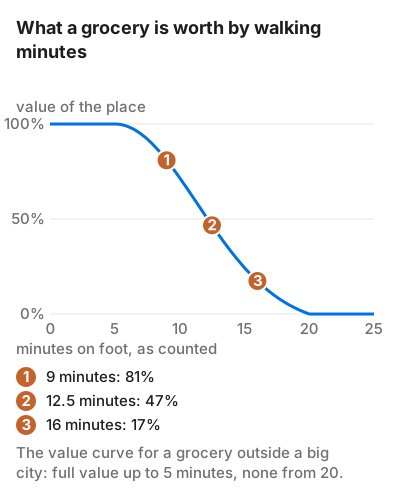
The shape is chosen on purpose. A minute more near the door changes nothing, so the curve begins with a plateau. The fall is steepest in the middle. A pharmacy six minutes away should not be clearly worse than one at five, and here it is not.
The first one matters most
The nearest supermarket gives 70% of the need "Groceries", the second 20%, the third 10%. Cafés are counted differently: we have no reviews or ratings, so the three nearest count, not how many there are. Around 13 Tverskaya Street the map knows 711 cafés and restaurants, and the need is met in full by the first three.
Quality counts as well. A supermarket is worth one, a convenience store 0.75, a greengrocer a half. A park of half a hectare or more is a full park; a garden under a tenth of a hectare is worth 0.3. The supermarket nearest to 13 Tverskaya Street, Magnolia at 307 metres, gets the full value.
Some needs a category cannot do without: in the General profile these are a grocery in "Groceries" and a pharmacy in "Services nearby". When one is missing, its category loses that need's own weight and then 40% of what is left. A neighbourhood with everything but a grocery scores 15 in "Groceries", not 25.
Eleven categories and their weights
| Category | Weight | Earned at 13 Tverskaya Street |
|---|---|---|
| Groceries | 9 | 8.72 |
| Services nearby | 13 | 12.83 |
| Public transport | 18 | 16.48 |
| Parks and sport | 14 | 13.01 |
| Street network | 14 | 13.09 |
| Education and children | 10 | 9.15 |
| Health | 9 | 8.49 |
| Cafes and culture | 8 | 7.71 |
| Bikes and shared cars | 3 | 2.17 |
| Remote work | 1 | 0.92 |
| Pets | 1 | 0.59 |
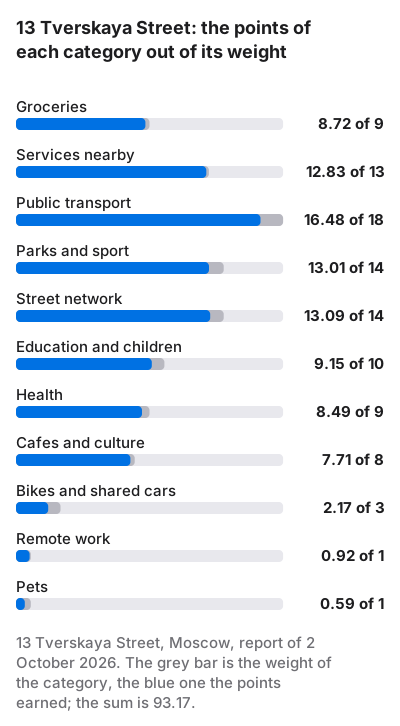
Most is lost where the weight is large. On Tverskaya public transport gave up 1.52 points: the nearest station, Chekhovskaya, is five and a half minutes on foot, not at the door. "Bikes and shared cars" earned 2.17 of 3 there, because the map knows no bike rental nearby. Car sharing in Moscow works through apps all over the city, so no stations are looked for and the need stays out of the score. Next on the list "What is missing" is the kindergarten, 0.65 points: the nearest, Baby Club, is 357 metres away, but the map calls it a childcare centre rather than a kindergarten, and its quality in the method is 0.8.
Transport is counted by lines, not stops. In a big city it has two parts: metro and suburban rail give 60% of the value, buses and trams 40%, and the nearest station comes first in the report. Within a walk of 13 Tverskaya Street there are eight metro lines and thirteen bus routes, and the category scores 91.56 out of 100.
What takes points away
There are three penalties, and each is stored in the report with its source. Noise, up to 10 points, once the building gets more than 55 decibels. Tverskaya Street is 86 metres from the address point, the level works out at 54 decibels, and there is no penalty. Air, up to 8 points. Here PM2.5 particles decide: an annual mean of 27.4 micrograms per cubic metre against a WHO guideline of 5, and the penalty is 5.48. Industry, up to 4 points, when the edge of an industrial site is closer than 300 metres; Tverskaya has none. The noise figure is for the spot the building stands on: inside a flat it depends on which way the windows face and on the glazing, and a flat on the courtyard side can be much quieter.
Penalties are capped at 20 points in all. A quiet address gets nothing for being quiet: we add nothing for the absence of a road and only subtract for its presence.
A profile changes the weights and the pace
The six profiles differ in more than weights. A family with a child walks at 3.9 km/h, steps count three times their length, and a school, a playground and a park become essential. An older person walks at 3.6 km/h, and slopes cost them the most. In the profile "Without a car" transport weighs 28 out of 100, and weak transport cuts everything else by up to a quarter.
How far to trust the number
Every place comes from OpenStreetMap, and the map is detailed in some places and thin in others. So a confidence figure stands beside the score. At 13 Tverskaya Street it is 0.985: the address was found exactly, the map holds many buildings and streets, and a real route was built to nearly every place. Where the map is empty, the score is shown as "at least" with no verdict. An empty map does not make a bad neighbourhood.
The full tables, the formulas and the addresses the method is checked against are on the page How it is calculated. Eighteen scored addresses in six Russian cities are in the rating for Russia.
Questions
Why does a central address not score 100?
Because the air and, on a loud street, the noise take points away: at 13 Tverskaya Street the air takes 5.48 of the 93.17 earned, at Gran Vía 28 noise and air take 4.67 of 92.13.
Do reviews and prices count?
No. The score takes only places on the map, the routes to them, noise, air and industrial sites, and leaves out opinions and prices.
What does "counts as N minutes" mean?
Minutes on the clock plus a surcharge for the climb, the wait at crossings and stretches beside heavy traffic. The value curve is read at that number.
Related posts
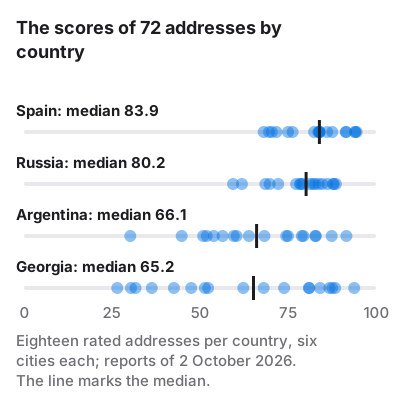
Four countries, one scale: Moscow against Valencia
Can an address in Moscow be compared with one in Valencia? The median of 18 rated addresses is 83.9 in Spain and 65.2 in Georgia. What lies behind it.
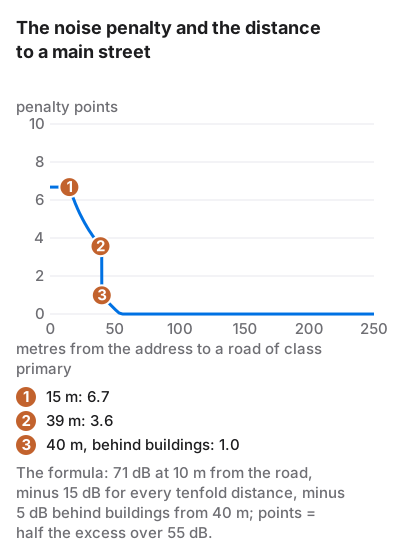
A loud street under the window: what it costs in points
In Buenos Aires, Caballito loses 7.7 points to its avenue and misses the top band; Belgrano loses none. The noise formula and how to check an address.
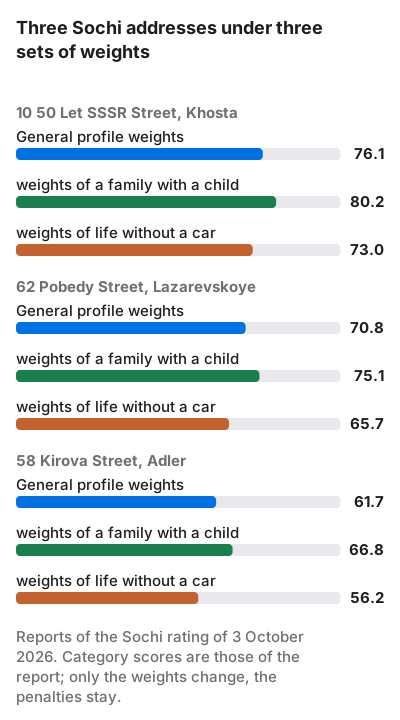
One address, three scores: what the weights change
58 Kirova Street in Adler scores 61.7 with standard weights, 66.8 with a family's and 56.2 with those of life without a car. Set the weights to your life.