
A loud street under the window: what it costs in points
In Buenos Aires, Caballito loses 7.7 points to its avenue and misses the top band; Belgrano loses none. The noise formula and how to check an address.
Contents 7 sections
Two addresses with the same list of places
Av. Rivadavia 4800 in Caballito and Juramento 2291 in Belgrano are two Buenos Aires addresses, both beside the Subte, both among shops and schools. Their categories earned almost the same: 91.5 and 92.5 out of 100. Their scores differ: 82.9 and 91.6.
Noise made the difference. It took 7.7 points from the building on Rivadavia and nothing from the one on Juramento. The first stays in the band "Most errands on foot"; the second reaches "Everything on foot", which starts at 90. By the list of places the two lives are the same, yet the scores end up nearly nine points apart.
How the penalty is computed
We do not measure noise with a microphone, and we do not use city noise maps: they exist in some cities, are missing in others, and are made in different ways. A rough rule that is identical everywhere does the work instead. It looks at the class of the road and the distance from the address point to its nearest stretch.
- A main city street (class "primary" in OpenStreetMap) gives 71 decibels at 10 metres, a motorway 78, a trunk road 75, a secondary road 67, a tertiary 63, a residential street 55.
- Each tenfold increase in distance takes off 15 decibels. Closer than 15 metres the distance stops counting: that is the façade.
- From 40 metres, where the area is densely built (at least 40 buildings within 500 metres), another 5 decibels come off for the first row of houses.
- A railway gives 74 decibels at 10 metres, a tram 62. Tunnels do not count.
- Points are half of what exceeds 55 decibels, up to 10.
A road with four lanes or more gets 2 decibels extra; a street limited to 30 km/h gets 2 fewer. Of several roads only the loudest counts, because the map cuts one street into many pieces and adding them up would be unfair.
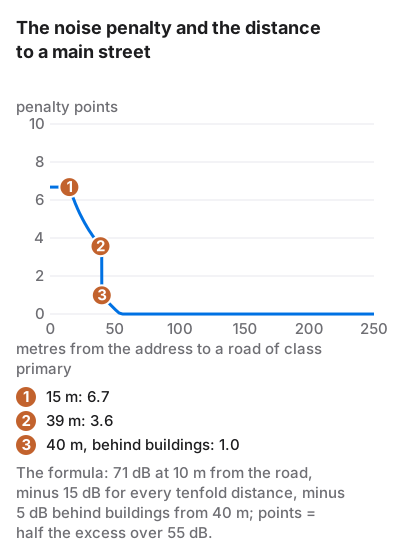
What a main street costs
A main street against the wall costs 6.68 points. Avenida de Mayo 825 in Monserrat got exactly that: the road is 15 metres away, 68.4 decibels. Forty metres back, behind one row of buildings, the same street costs one point, and at fifty-five metres nothing.
Rivadavia in Caballito costs more, 7.7 points. That is what the formula gives for a main street of four lanes or more, which adds 2 decibels. Junín 1760 in Recoleta loses 5.1 points, and Juramento 2291 in Belgrano loses nothing: the big street there is more than fifty-five metres away.
Railways are louder. A main line fifteen metres away costs 8.2 points by the formula, one and a half more than a main street at the same distance. None of our Buenos Aires addresses is that close to the tracks.
Four addresses in Buenos Aires
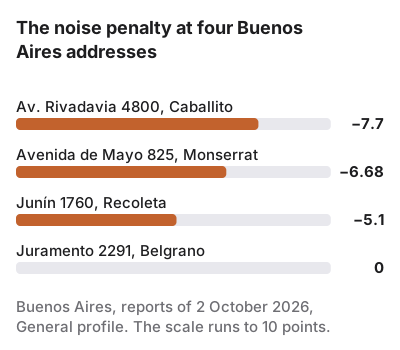
| Address | Earned by categories | Noise | Score |
|---|---|---|---|
| Av. Rivadavia 4800, Caballito | 91.5 | −7.7 | 82.9 |
| Avenida de Mayo 825, Monserrat | 89.1 | −6.68 | 81.5 |
| Junín 1760, Recoleta | 93.4 | −5.1 | 87.4 |
| Juramento 2291, Belgrano | 92.5 | 0 | 91.6 |
Of the 72 addresses in our ratings, 30 have no noise penalty at all. In Buenos Aires that is Juramento 2291, and at 91.6 it is the best of the four. By its places Recoleta is even stronger, 93.4 against 92.5, but the street next to it takes more than the shops and parks give.
What the report shows
In the block "What lowers it here" every line is named: which road, of what class, how many metres away and how many points it took. At Avenida de Mayo 825 it is Avenida de Mayo itself, 15 metres away: 68.4 decibels and 6.68 points. The FC Roca railway 1,011 metres off is listed too, at 38.9 decibels, and it adds nothing to the penalty.
Runways have their own rule. A runway longer than 1,500 metres counts for addresses under its approach, up to 10 kilometres beyond the end and 2 kilometres to the side of the axis, and 8 decibels are added to the level, because the same decibel from an aircraft annoys more than one from a road.
What the rule cannot see
The address point is where the building is drawn on the map, not where your window faces. A flat on the courtyard side of a loud avenue and a flat on the avenue side get the same penalty. Check that on the spot: stand at the window at eight in the morning and at eleven at night.
The rule knows nothing of noise barriers, road surfaces or bars. Night noise from bars is not in the sum at all, because open data does not hold it. Nor does the rule know the traffic. A street mapped as a main road gets its 71 decibels even if one car a minute uses it, so on streets with little traffic the penalty can be harsher than life.
In return, the rule is the same in every city, and you can redo it by hand. Thresholds, the table of levels and the corrections are on the page How it is calculated.
Using it when you choose
When two addresses earn the same by categories, look at the final score. One block back from the avenue changes almost nothing in the minutes to the shop and removes the penalty whole. Blocks in Buenos Aires are short, a little over a hundred metres, so a cross street off Rivadavia or Santa Fe keeps the Subte within the same walk. The rating of Argentine addresses shows the pair Caballito and Belgrano, and the Buenos Aires page adds Recoleta, where Junín 1760 gives up 5.1 points and still scores 87.4.
The reverse also holds. If you like everything about an address except the noise, check which road the penalty comes from. When it is a street the map calls main by mistake, the figure is too high, and a visit will show it.
Questions
How many points can noise take?
Up to 10. Together with air and industry, penalties are capped at 20 points.
Does a quiet address get a bonus?
No. Nothing is added for quiet; the penalty only subtracts.
Do the floor and the side of the building count?
No. The sum runs from the building's point on the map to the nearest stretch of road, so windows on the courtyard side are for you to check.
Related posts
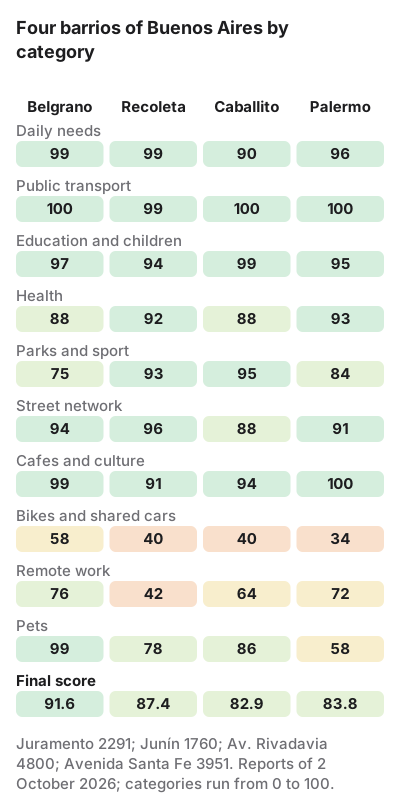
Buenos Aires by barrio: Palermo, Belgrano, Caballito
Four barrios in numbers: Belgrano 91.6, Recoleta 87.4, Palermo 83.8, Caballito 82.9. What the avenues' noise and the Subte lines decide.
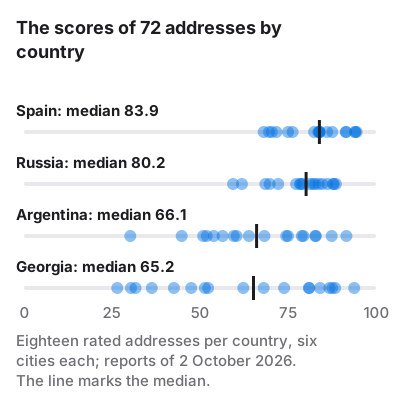
Four countries, one scale: Moscow against Valencia
Can an address in Moscow be compared with one in Valencia? The median of 18 rated addresses is 83.9 in Spain and 65.2 in Georgia. What lies behind it.
How the score is made: formula, weights, penalties
One address step by step: at 13 Tverskaya Street, Moscow, eleven categories earn 93.17, the air takes 5.48 and 87.7 is left. Where each point comes from.