The air at home: checking an address before you move
Air quality by address, with Moscow as the example: four addresses lose 5.5 to 7.5 points. Where the figures come from and how to read them in a report.
Score your own address
Everything this article covers, you can check on your own address: free, in a minute.
Free. The score at once, the full report after an e-mail sign-in.
Contents 8 sections
What exactly we measure
Air in a report comes down to two substances. The first is fine particulate matter, PM2.5: what is left of exhaust, stoves and dust. The second is nitrogen dioxide, NO2, the trace of car traffic. For every address we take the mean of hourly values over the last 365 days, not the air of this morning. A windy day and a smoggy day even out in a yearly average.
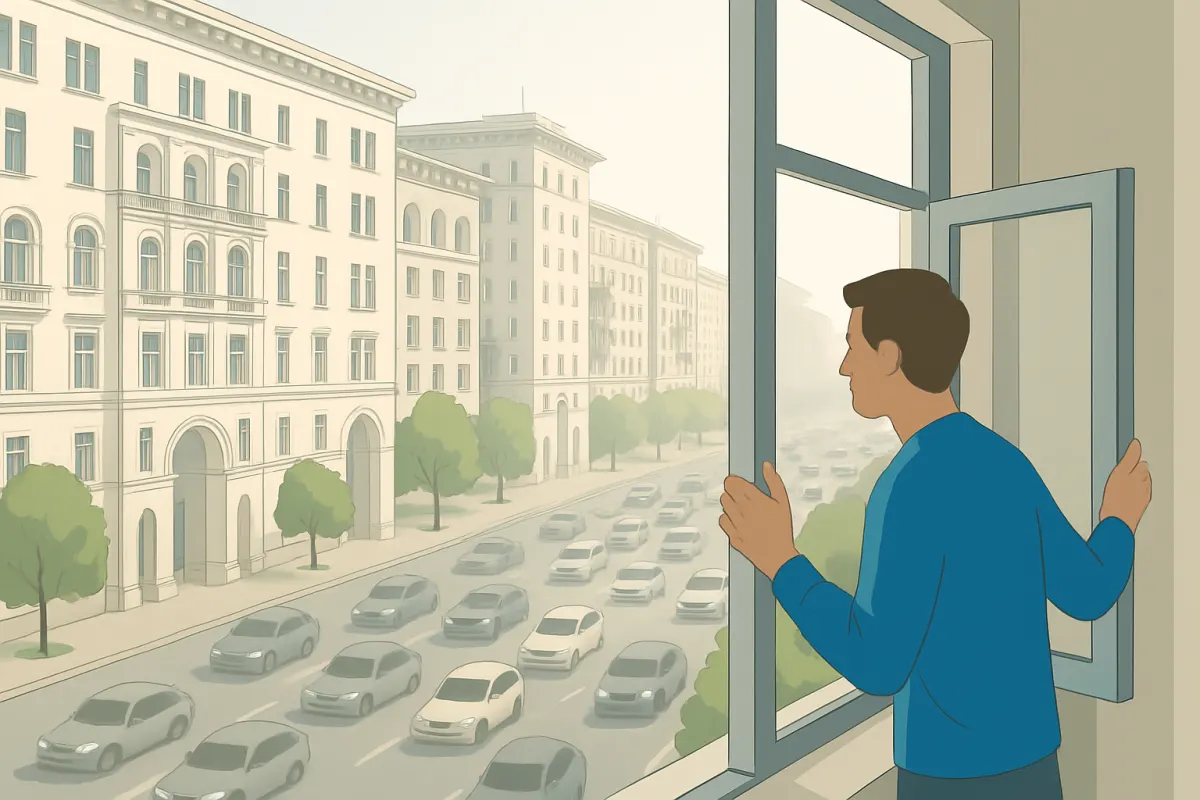
The data come from the open air quality model of Open-Meteo. It is a calculation on a grid, not a sensor on your building, and further down you will see what follows from that.
The scale: upwards from the WHO guideline
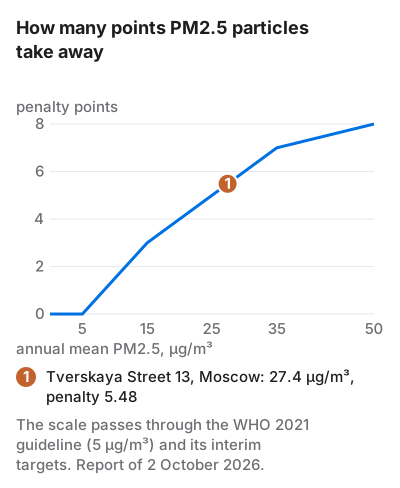
In 2021 the World Health Organization named 5 micrograms per cubic metre as the safe annual level of PM2.5, and 10 for NO2. Above that come interim targets: 10, 15, 25 and 35 for particles, 20, 30 and 40 for nitrogen dioxide. Our scale runs through those points.
| PM2.5, µg/m³ | 5 | 10 | 15 | 25 | 35 | 50 |
|---|---|---|---|---|---|---|
| Penalty, points | 0 | 1.5 | 3 | 5 | 7 | 8 |
Of the two substances, whichever costs more counts. The penalty is capped at 8 points. Ozone and coarse PM10 particles are shown in the report for reference and do not enter the calculation.
Tverskaya 13, step by step
Tverskaya Street 13, Moscow. The annual mean of PM2.5 here is 27.4 micrograms, five and a half times the guideline. On the scale that is 5.48 points. NO2 is 49.6, which gives 3.48. The larger one counts: 5.48. That is the whole penalty of the address: there is no noise penalty, as the address point stands 86 metres from Tverskaya itself, and in the Moscow example the 93.17 earned by the categories becomes 87.7.
Compare it with the WHO targets. Tverskaya meets the first interim target, 35 micrograms, but not the second, 25. For the penalty to drop to zero there would have to be five and a half times fewer particles. The street itself has little to do with it: this is the background level of a large part of the city.
Nitrogen dioxide, at 49.6 micrograms, is high as well: it is the trace of cars, and in central Moscow you expect it. Yet it still costs less than the particles, 3.48 points against 5.48, so it does not become the penalty.
Four Moscow addresses
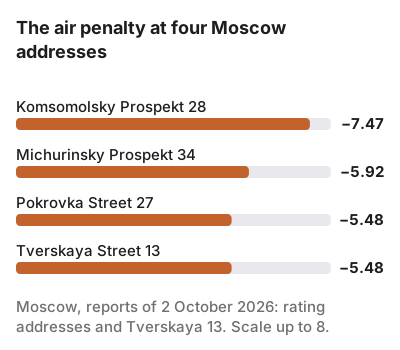
Three addresses of the Moscow rating lost 7.47 points to the air (Komsomolsky Prospekt 28), 5.92 (Michurinsky Prospekt 34) and 5.48 (Pokrovka Street 27). For all three that is more than the noise penalty. Among all 72 addresses of our first ratings, an air penalty above five points occurs only in Moscow.
Noise at the same addresses is more modest: 2.75 points on Pokrovka, almost nothing in Khamovniki and Ramenki. In Moscow the air takes away more than the street does, and a quiet neighbourhood is no escape from it.
Why neighbouring addresses get the same figure
Look at Pokrovka and Tverskaya: both got 5.48. They are about two kilometres apart and, judging by the identical number, fell into the same cell of the model. A cell is bigger than a block, and every address inside one cell gets one value.
Two conclusions follow. The air penalty compares cities and large parts of a city, not a building on a motorway with a building in a courtyard. The local difference is better caught by the neighbouring penalty, for noise: the road under the window is recorded there to the metre, and that road is also the main source of nitrogen dioxide. In Moscow our addresses fell into different cells, which is why Khamovniki, Ramenki and the Basmanny district got three different numbers.
Industry: a third penalty next to the air
The air model sees factories poorly, so they have a rule of their own. If the edge of an industrial zone, a quarry or a landfill is closer than 300 metres, the address loses up to 4 points: the closer, the more, and all four inside the zone.
In our first ratings that applies to 13 addresses out of 72, none of them in Moscow: Tverskaya, Pokrovka, Khamovniki and Ramenki have no industrial zone within 300 metres. In the block "What lowers the score here" the distance to the edge of the zone is given in metres.
How to read this when choosing a flat
Look at the penalty itself first. Up to one and a half points, the air is close to the WHO guideline or its first interim target; most addresses in the ratings are like that. From three points up it is a noticeable load, worth weighing for anyone moving with children or with asthma.
Then open the line with the figures. If NO2 is the main contributor, traffic is to blame, and an address a block away from the main road may breathe easier than the grid shows. If it is PM2.5, as on Tverskaya, the background is shared by a large part of the city, and moving to the next street will not change it.
Finally, compare it with noise. An address where both penalties are large usually stands on a main road. Pokrovka Street 27 loses 2.75 to noise and 5.48 to the air: the categories earned 92.9, and 84.7 is left.
What the calculation leaves out
The model knows nothing of smells, of dust from the building site across the road or of smoke from stove heating in the next street. Seasons are hidden too: winter smog in a hollow and a clean summer give one average figure, while you will have to live through both. The climate of the address is shown separately in the report: frosty and hot days, rainfall over the year.
All the thresholds and the data source are listed on the page How it is calculated. The Moscow addresses from this article are gathered on the Moscow page, and all eighteen Russian ones are in the rating.
Questions
Where do the air data come from?
From the open air quality model of Open-Meteo: hourly PM2.5 and NO2 values over the last 365 days, averaged for the point of the address.
Why do three addresses in one city have the same penalty?
The model works on a grid, and a cell is bigger than a block. The difference between a building on a motorway and one in a courtyard is better shown by the noise penalty.
Can clean air add points?
No. Clean air means a zero penalty; there is no bonus for it.