
Moving abroad: choosing a neighbourhood you have not seen
Five steps from a city to an address when you cannot visit first, worked through in Tbilisi, from Vake to Saburtalo.
Contents 8 sections
Why choosing from a distance so often fails
People choose a district on somebody else's word: an expat group chat, a list of "best neighbourhoods", a friend who lived there three years ago. Every adviser has habits of their own. The one who worked from home in Vake liked Vake. With a child and an office on the left bank of the Mtkvari you may find it awkward.
The listing is the second source of error. Its "five minutes from the metro" is measured in a straight line, at a run. On Freedom Square in Tbilisi the nearest supermarket is 149 metres away on the map and 511 metres and almost seven minutes on foot, because the square has to be walked around.
The five steps below do not replace a visit, but they let you arrive to view three flats rather than thirty.
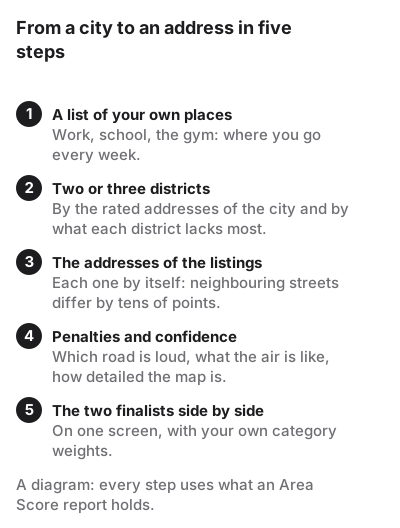
Step 1. A list of your own places
Begin with yourself and not with the city. Write down where you go every week: work, a school or kindergarten, a gym, a doctor you are tied to. Three places are enough.
Separately, write down what you cannot do without. For a family that is a school and a playground. For a person without a car, a metro or tram line. For a dog owner, a park. This list later becomes the ticks marked "Cannot do without" and the weights of the categories.
Step 2. Two or three districts
Now the city. The ratings hold eighteen addresses in six cities for each of four countries, scored by category. They do not describe whole districts, but they show how districts differ.
In Tbilisi four addresses part like this. 12 Shota Rustaveli Avenue: 88.4, with almost no penalties. Marjanishvili Square: 84.1, the best schools and doctors of the four. 1 Ilia Chavchavadze Avenue in Vake: 83.4, with parks at 93 and education at 67. 22 Pekini Avenue in Saburtalo: 81.1, strong on daily needs and the metro, and 6.54 points lost to noise.
Hold that against your list. You need a school: Chughureti and Saburtalo. You need quiet and a park: Vake, or the side streets of Mtatsminda. Two or three districts are enough for the next step.
Step 3. The addresses of the listings
The district is chosen, but a score belongs to an address. Seven points separate 12 Shota Rustaveli Avenue (88.4) from 22 Pekini Avenue (81.1), and the noise of the avenue makes almost all of the gap: 6.54 points. The next street in the same district can differ more than two districts do.
So each listing is checked by itself. Ask the landlord for the street number, not "near the metro". Open the report and add your three places from step one. It shows walking minutes to each, or a direct public transport line when the walk is too long.
Look past the total at three things: the categories you cannot do without, the minutes to your own places, and the list "What is missing". On Freedom Square in Tbilisi that list starts with public transport and a hospital. At your address it may start with a school.
Step 4. Penalties and confidence
Two numbers in a report are easy to miss, and they change the decision.
Penalties. 22 Pekini Avenue in Saburtalo earns 88.6 by categories and loses 6.54 points to the noise of the avenue. A building on the next street would keep nearly all of it. The block "What lowers it here" names the road and gives the distance to it in metres. If that is a main street fifteen metres away, ask which way the windows face.
Confidence. Every place comes from OpenStreetMap, and the map is drawn in more detail in some cities than in others. Beside the score stands a measure of how far to trust it. Where the map is thin, the score is shown as "at least" and no verdict is given. A low score with low confidence says only that the map around is empty, and nothing about the neighbourhood itself.
Step 5. The two finalists side by side
When two or three addresses are left, put them on the comparison page: two to five addresses next to each other, the best and the worst marked in each category, and a block that explains where the difference comes from.
Then open the weights panel on each and set the same weights: yours. Set to zero what you do not need, add to what matters, tick the essentials. The link keeps the settings, and you can send it to whoever is moving with you.
22 Pekini Avenue shows why this matters. With standard weights it scores 81.9; with the weights of a family that wants a school and a playground nearby, 84.3; with the weights of someone who works from home, 78.1 (rating report of 3 October 2026). The building is the same in all three; only the weights change.
What you will have to check on the spot
From a distance you cannot see what the map does not hold.
- The side of the building. The noise penalty runs from the building's point, not from your window.
- Night life. Bars under the windows are not in the sum.
- The state of the building: damp, heating, the lift.
- Safety. No comparable open data exists, and the score does not measure it.
- The season. A beach district in January and in July is two different places.
Those are the things to check on the trip. The rest you can learn beforehand, from home.
What decides in Tbilisi
In Tbilisi the terrain and the metro lines decide. There are two lines, and a climb enters every minute of the walk: around Freedom Square the streets have an average slope of 4.3%, the steepest 7%. A flat five minutes from a station on the map can be ten up the hill, and the report shows it.
The scale is the same in every city. An 85 in Tbilisi means the same set of places within a walk as an 85 anywhere else, as far as the map allows. A separate post on four countries on one scale explains where the map differs.
Timing helps too. Reports take under a minute each, so five listings with three places on each fit into a quarter of an hour. Do it before you write to landlords, not after: half the listings usually drop out on the first pass, and the questions you send to the rest become specific. Which way does the bedroom face? Is the entrance on the avenue or on the side street?
How minutes, weights and penalties work is explained on the page How it is calculated. A good place to begin is the Tbilisi page and the rating for Georgia.
Questions
Can I choose a neighbourhood without ever having been there?
You can narrow the choice to two or three addresses: categories, minutes to your own places and penalties are visible in advance. The side of the building, night noise and the state of the flat need a visit.
Where do I start if I do not know the city at all?
With the country's rating: eighteen addresses in six cities, scored by category. It shows how districts differ.
What does a score shown as "at least" mean?
The map around the address is thinly drawn and some places may be missing. The real score is not lower than the one shown.
Related posts
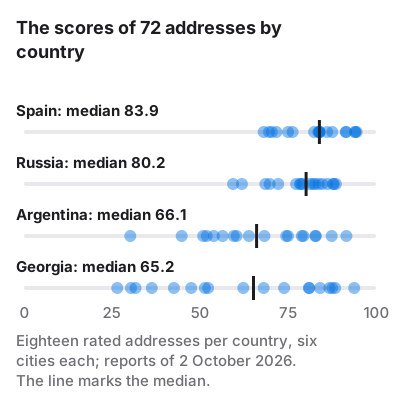
Four countries, one scale: Moscow against Valencia
Can an address in Moscow be compared with one in Valencia? The median of 18 rated addresses is 83.9 in Spain and 65.2 in Georgia. What lies behind it.
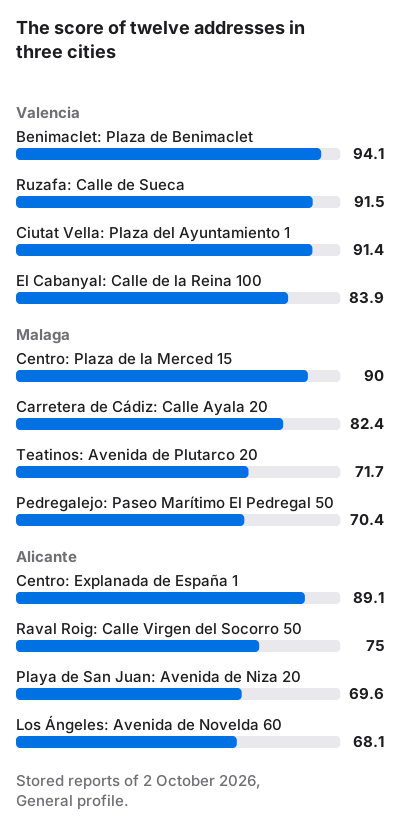
Valencia, Alicante or Malaga: living without a car
Twelve addresses in three Spanish cities: Benimaclet in Valencia scores 94.1, central Malaga 90, central Alicante 89.1. Where a wrong pick costs most.
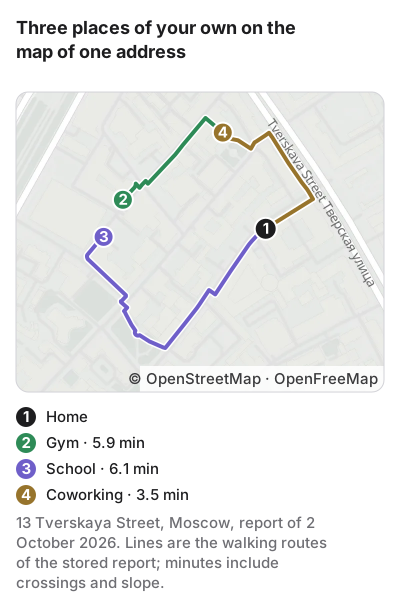
Score a neighbourhood by your own places, not averages
Add your office, gym and school to an address report. On 13 Tverskaya Street three places within seven minutes lift 87.7 to 88.7; elsewhere they cut it.