Two flats in one route table: how to compare them
Compare two flats by their routes: minutes to the shop, school and station times trips a week. A Novosibirsk example: 136 minutes against 336.
Score your own address
Everything this article covers, you can check on your own address: free, in a minute.
Free. The score at once, the full report after an e-mail sign-in.
Contents 8 sections
The score compares neighbourhoods, the table compares your week
When two flats are left, the first thing people compare is the score. That makes sense: the score rolls eleven categories and the penalties into one number. But it answers the question "how convenient is life here for an average person". You need a different answer: how much time your ordinary week will take from each of the two flats.

There is a simple tool for that: a route table. Its rows are the places you go to every week. Its columns are the two flats. Each cell holds walking minutes multiplied by the number of trips. At the bottom is the total: how many minutes a week you will spend getting around from each flat.
Two addresses in Novosibirsk
Take two Novosibirsk addresses from reports of 3 October 2026. 36 Krasny Prospekt, in the Central district, scores 85.8. 6 Ilyicha Street, in Akademgorodok, scores 81.7. The gap is 4.1 points, and both are in the band "Most errands on foot". By the score the two flats are almost equal.
Here are the minutes to the four main places. From 36 Krasny Prospekt it is 5 minutes to a grocery shop, 4 to a school, 1 to a park or square and 5 to Ploshchad Lenina metro station. From 6 Ilyicha Street it is 3 minutes to a shop, 6 to a school, 2 to a park and 24 to Obskoye More station.
How to build a route table
Step one: list the places you go to at least once a week. For our example let us take a family with four regular routes:
- The grocery shop four times a week.
- The school five times a week: taking the child there in the morning.
- The park three times a week, for an evening walk.
- The station five times a week: one of the parents commutes to work.
Step two: take the minutes from each address's report. Step three: multiply them by two, there and back, and by the number of trips. Step four: add them up.
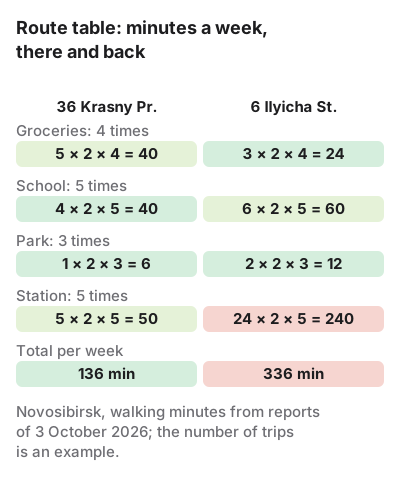
What the total shows
36 Krasny Prospekt: the shop is 5 minutes × 2 × 4 = 40, the school 4 × 2 × 5 = 40, the park 1 × 2 × 3 = 6, the station 5 × 2 × 5 = 50. That makes 136 minutes a week, a little over two hours.
6 Ilyicha Street: the shop is 3 × 2 × 4 = 24, the school 6 × 2 × 5 = 60, the park 2 × 2 × 3 = 12, the station 24 × 2 × 5 = 240. That makes 336 minutes a week, more than five and a half hours.
The score gap is 4.1 points, while the gap in the week is 200 minutes, three hours and twenty minutes. Almost all of it sits in one row: the station, which is a 24-minute walk from Akademgorodok and which this family needs to get to every weekday.
The same table for another family
Now let us change one row. Say the parent works not in the centre but in Akademgorodok, a ten-minute walk from 6 Ilyicha Street. Then the station drops out of the table, and a row called "Work" takes its place: 10 × 2 × 5 = 100 minutes.
For 6 Ilyicha Street the total becomes 24 + 60 + 12 + 100 = 196 minutes. From the flat on Krasny Prospekt this family would have to travel to Akademgorodok every day, and that row would take up more than any other. The same pair of flats, and a different winner.
That is exactly why at the last stage of choosing the table is more useful than the score. The score does not know where you work or which school your child will go to. The table does, because you are the one filling it in.
Where to get the minutes
Every report has the minutes to the nearest places: the first line under each need, with the name of the place, the metres and the walking minutes. The minutes in a report take crossings and slopes into account, so they are more honest than a straight-line distance.
For the minutes to places of your own, use "My places". Add your work, a particular school, a gym, your parents' home. The report will show the walking time and, if the walk is long, the direct transit lines and the travel time. These are usually the rows that settle the outcome.
You can put the two flats side by side on the comparison page: categories, penalties and minutes appear in two columns. Keep the route table next to it, in your notes or in a spreadsheet on your phone.
What the table leaves out
The table counts time, not quality. It will not tell you that one school is stronger than the other, that the square a minute from Krasny Prospekt is by the opera house in the city centre, or that Akademgorodok was built in a forest. These are different walks, and choosing between them is up to you.
Nor does it count what is not a daily trip: noise, air, industry. Those penalties are in the report. Neither of our addresses has a noise penalty, and the air takes the same 0.96 points off both.
And it knows nothing about a car. If you drive to work, the "Station" row is simply not needed, and the flats are almost equal again.
How to compare two flats in ten minutes
- List the places you go to every week, and how many times.
- Open each flat's report and add your own places.
- Multiply the minutes by two and by the number of trips, then add them up.
- See which row makes most of the difference, and ask yourself whether it will really still be like that in a year.
How the minutes are counted, and why a nearby place is worth more than a distant one, is explained on the page How it is calculated. Other Novosibirsk addresses are on the Novosibirsk page and in the rating for Russia.
Questions
How do I compare two flats by location?
List the places you go to every week, take the walking minutes from each address's report, multiply them by two and by the number of trips, and add them up. The smaller total means less time on the way.
Why can a flat with a higher score turn out less convenient?
The score is worked out for an average resident. If your work or your child's school lies in the other direction, one row of the route table will outweigh a gap of a few points.
Where do I get the minutes to work and school?
Add them to the report as your own places. The report will show the walking minutes and, if the walk is long, the direct transit lines.