Locked courtyards and fences: how many minutes they add
The shop across the courtyard looks close, but the courtyard is locked. How fences, gates and private drives lengthen a walk, and how the report shows it.
Score your own address
Everything this article covers, you can check on your own address: free, in a minute.
Free. The score at once, the full report after an e-mail sign-in.
Contents 7 sections
Close on the map, far on foot
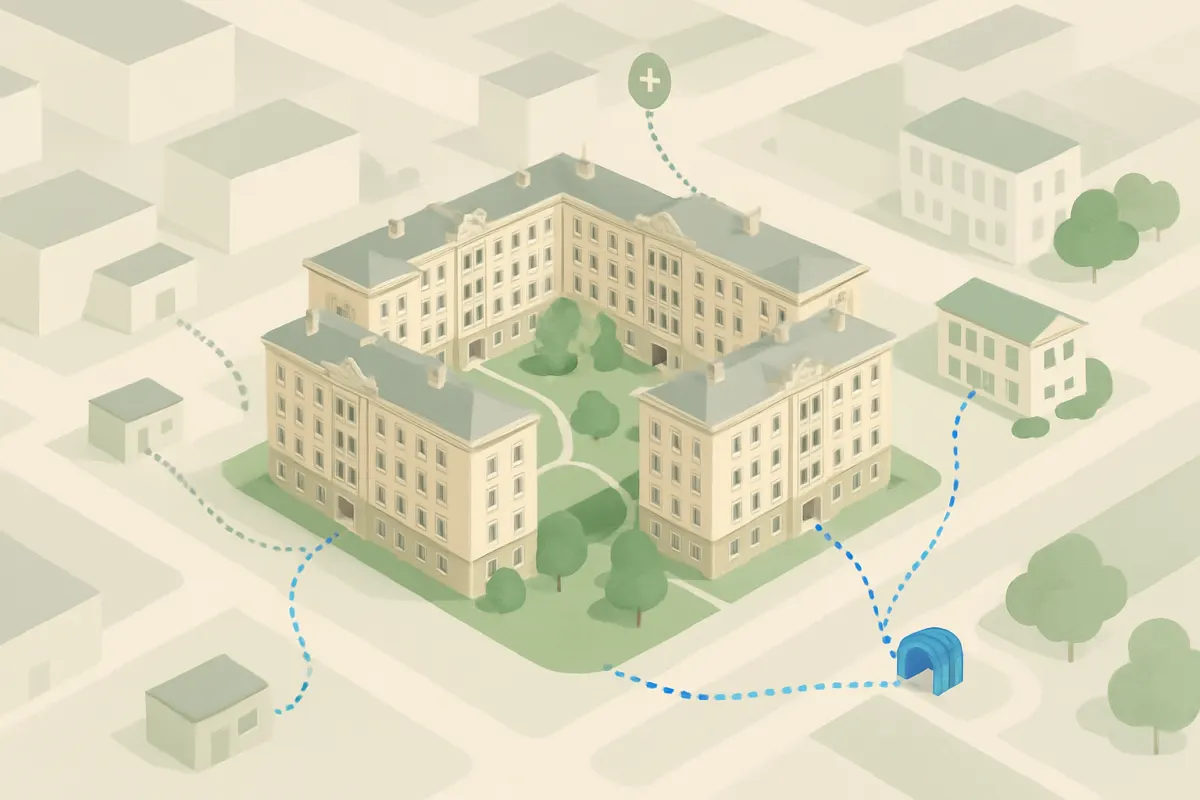
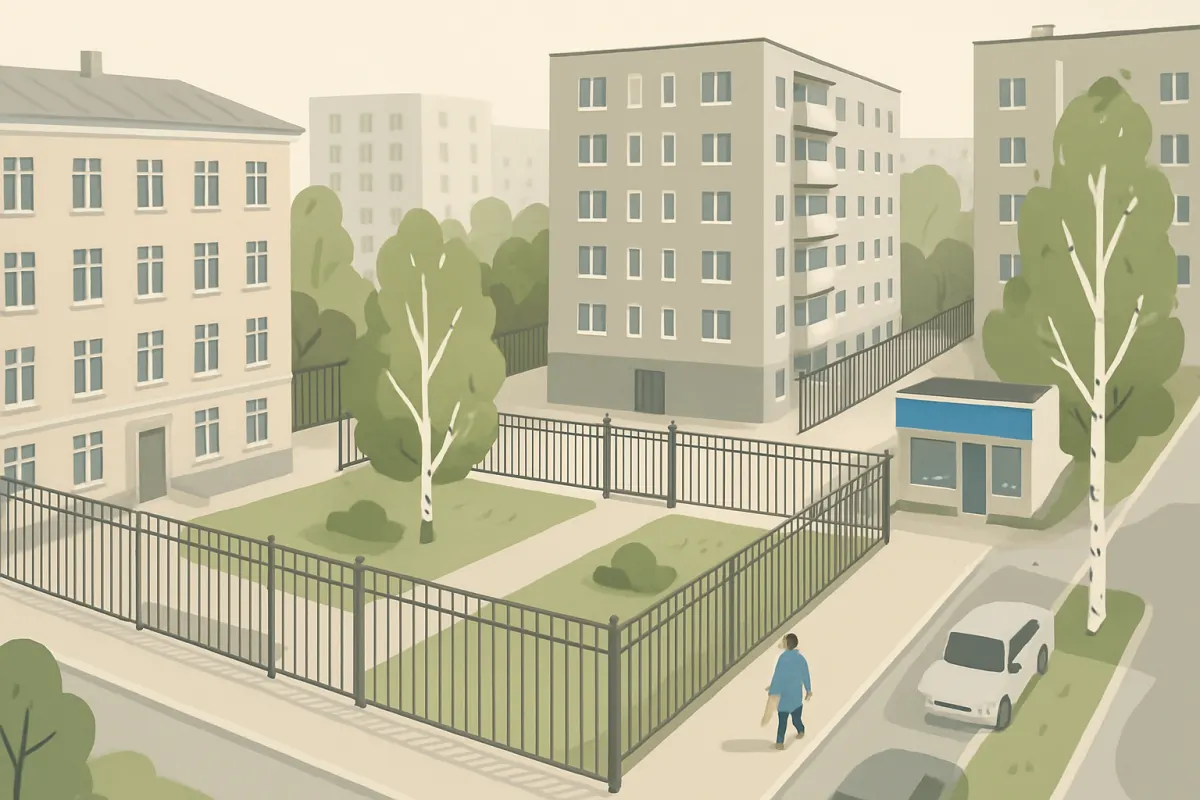
A familiar story: on the map the shop is just behind the next building. You go out, and between you and it there is a fence, a closed courtyard with a barrier and a gate on an entryphone. Five minutes become twelve, because you have to walk round the whole block.
That is why we do not measure distances in a straight line. For every place the report builds a walking route along the streets and paths on the map and counts the minutes along it. But the map makes mistakes too, and the report has a separate block that warns you where a short way may turn out to be locked.
The block "What can get in the way"
Take 13 Tverskaya Street in Moscow, report of 4 October 2026. In the walking area around the building the map knows 772 gates, wickets and barriers and 449 closed ways: private drives and courtyards that outsiders may not enter. For central Moscow, with its courtyards behind gates, that is to be expected.
This block is not part of the score on its own: it is for reference. Its point is that you are not surprised on the spot. The route follows whatever the map considers passable. If a gate is not marked as closed on the map, the route may go through it, and in real life it may be locked. The more such marks there are around, the more carefully you should look at short routes through courtyards.
How many times longer than the straight line
There is also a number that goes straight into the score. In the Street network category the report compares the length of walking routes with the straight-line distance. At 13 Tverskaya the walk is on average 1.36 times the straight line.
This part weighs a quarter of the category. If the walk is no more than 1.25 times the straight line, it scores 100. If it is twice as long, zero. In between the scale is linear: at 13 Tverskaya that gives 85.3. Another 35% of the category comes from the density of intersections, here 277 per square kilometre and a full 100. The remaining 40% is how comfortable the paths themselves are: climbs, crossings, traffic alongside.
| Part of the category | Weight | Value | Score |
|---|---|---|---|
| Intersection density | 35% | 277 per km² | 100 |
| Walk longer than the straight line | 25% | 1.36 times | 85.3 |
| Comfort of the paths | 40% | 97.9% easy walking | 93 |
How many minutes a fence takes
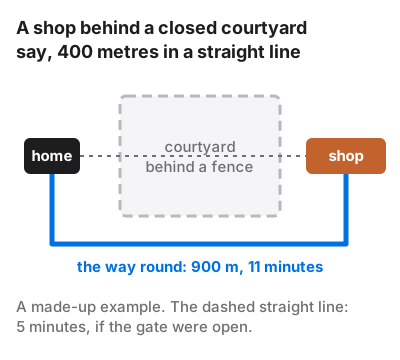
Let us work it out on a made-up example. Say a shop is 400 metres away in a straight line. With a walk 1.25 times the straight line it is 500 metres, a little over six minutes: the place counts almost in full. If there is fenced-off land between you and the walk has to go round the block, the way easily grows to 900 metres and 11 minutes.
For a grocery shop that is already a noticeable difference. Only what is within five minutes counts in full; beyond that the value falls, and by fifteen to twenty minutes the place stops adding anything. One fence can move a shop from "next door" to "I need to get ready".
A big road works like a fence
Some fences have no fence. A wide avenue can only be crossed where there is a crossing, and everything on the other side is at once farther away. In the walking area of 13 Tverskaya the report counted 4.14 kilometres of major roads and 2,624 metres of stairs. Some of the crossings under Tverskaya are underpasses, and the way through them goes down and up steps.
For an adult a staircase costs almost nothing: in the General profile it counts as one and a half times its length. With a pram or for an older person it costs three times as much, and a route through an underpass stops being short. So if you are choosing a flat for a family, look at the report with the family profile: it recalculates the minutes at that cost.
Closed grounds in residential districts
In the centre courtyards get in the way; on the outskirts it is large fenced grounds: campuses, hospitals, industrial zones, building sites. We do not know for sure what lengthens the walk at a particular building, but the difference between neighbours shows in the minutes.
In Ramenki, by the reports of 3 October 2026, 29 Michurinsky Avenue has a shop two minutes away and the metro one, scoring 80.5. At 27 Lomonosovsky Avenue (service road) in the same district the shop is 11 minutes away, Universitet metro station 13, the school 13 as well, and the score is 66.7. Along this part of the avenue stretch the large university grounds. Walking round grounds like these often explains the extra minutes, and it is worth checking on the spot.
How to check an address for fences
- Open the block "What can get in the way" in the report. If it lists hundreds of closed ways and gates, do not trust short routes through courtyards until you have walked them yourself.
- Compare the metres and the minutes for the nearest shop. If it is 300 metres away but eight minutes, the route goes the long way round.
- Look at the line "the walk is N times the straight line". Up to 1.25 the routes are direct; towards 1.5 and above detours become the norm.
- At a viewing, walk from the front door to the shop and the metro. Five minutes on foot will tell you more about fences than any map.
How routes are built and what makes up the Street network category is explained on the page How it is calculated. The measured addresses in Ramenki, Khamovniki and Presnya are on the Moscow page.
Questions
Does the report take fences and closed courtyards into account?
Routes follow the paths that the map considers passable. On top of that the report lists gates, barriers and closed ways in the block "What can get in the way", so that you can check short routes on the spot.
What does "the walk is 1.36 times the straight line" mean?
That on average the way along the streets to places nearby is 36% longer than in a straight line. Up to 1.25 counts as direct routes; twice as long is already bad.
Why do two neighbouring buildings have different minutes to the same shop?
Because of how the streets and passages approach it. If from one building the way is direct and from the other it goes round fenced-off grounds, the difference can be several times over.
Can I trust a route through a courtyard?
If the block "What can get in the way" shows many gates and closed ways, better check it on the spot. The map knows where the gates are, but not always whether they are open during the day.