How to check an address in person: what the score misses
What a district score knows and what you have to check in person: building sites, noise in the flat, opening hours, pavements. Using 13 Tverskaya Street.
Score your own address
Everything this article covers, you can check on your own address: free, in a minute.
Free. The score at once, the full report after an e-mail sign-in.
Contents 6 sections
The score is a map, not a walk
An address's score is built from the map: where the shops, schools, stops and parks are, how you get to them along the streets, what makes noise nearby and what air the building breathes. That is a lot, and when you are choosing from ten listings it is usually enough to rule out seven. But the remaining three addresses have to be walked, because part of life does not show on a map.
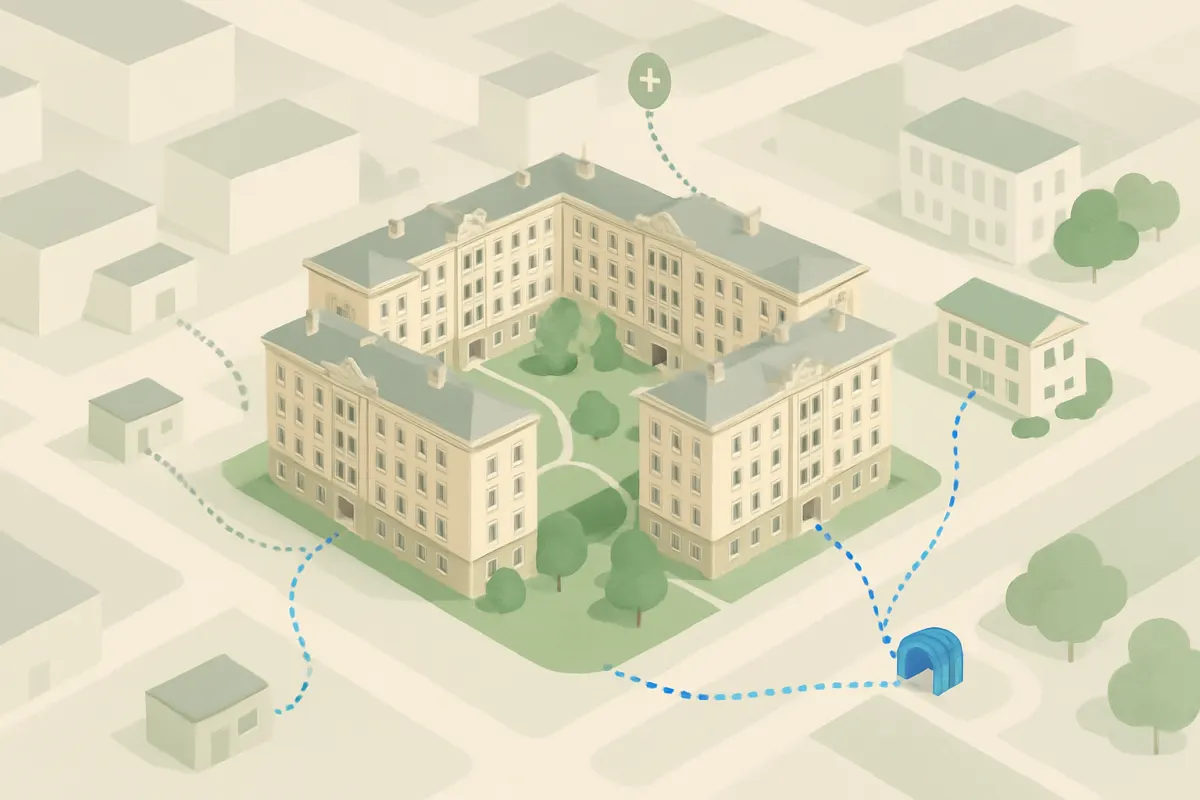
Below we go through what the score knows well, what it does not know at all, and what of this you can see in the report itself. One example: 13 Tverskaya Street in Moscow, report of 4 October 2026, a score of 89.2, in the Most errands on foot band.
What the score knows well
- How long the walk is. A walking route along real streets is built to every place, with climbs, waits at big roads and stretches along heavy traffic.
- How many places there are around, and what kind. At 13 Tverskaya Street the map knows 87 grocery shops within walking distance, 70 pharmacies and 711 cafes and restaurants.
- Which transport lines are nearby: this address has eight metro lines and thirteen bus routes.
- What takes points away: road noise, air, industry. At 13 Tverskaya Street the only penalty is for air, 5.48 points.
How far you can trust the number, the report says itself. This address has a confidence of 0.985: the building was found precisely, the map around it is detailed, and a real route was built to almost every place.
What the score does not see
- The flat. Noise is calculated for the building's point, while in a room it depends on which way the windows face and what glazing they have.
- The quality of places. We have no reviews or prices: to the score a good supermarket and a bad one are the same.
- The state of the pavements. A narrow pavement, cars parked on it, ice in winter and a puddle at the crossing do not make it into the route.
- The entrance and the courtyard. Where you get in, whether there is a ramp, what the stairwell looks like.
- The internet. Home broadband speeds are not in the open data.
- Smells and neighbours. A restaurant extractor under the window or a shop unloading round the clock can only be seen on the spot.
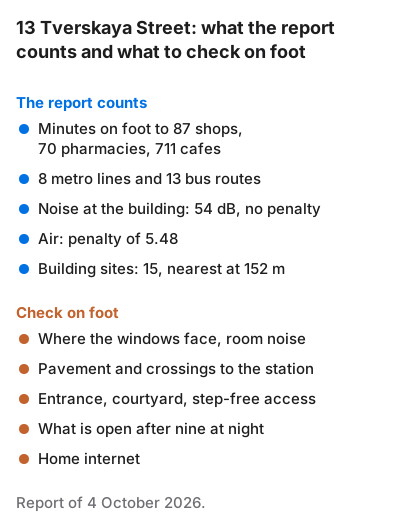
13 Tverskaya Street: what the report shows but the score does not
Besides the score, the report has reference blocks. They do not change the number, but they tell you what to look at on your walk.
Building sites. The report looks for them on the map: buildings within 500 metres, stations and lines within a kilometre and a half. At 13 Tverskaya Street there are 15. The nearest is marked 152 metres away, on the grounds of School No. 1520 named after the Kaptsovs, with two more at 166 and 167 metres. A building site round the corner for a year or two matters more than a couple of points of score: go and see what is being built and how the machinery works.
Noise. Tverskaya Street runs 86 metres from the building's point, the calculated level is 54 decibels, and there is no penalty: it starts at 55. But the 86 metres are measured to the address point. If your windows face straight onto Tverskaya, you will hear it differently. The check is simple: stand in the room for ten minutes with the window open.
Steps and accessibility. On the map, 12% of the places around are marked with whether you can get in without steps. The rest have no mark, and that means nothing. With a pram or an elderly relative, you will have to check the entrance to the pharmacy and the clinic yourself.
Opening hours. For 29 of the 38 grocery shops within a kilometre the hours are known, and all 29 are open at nine in the evening. For Moscow that is good coverage; in other cities it can be three times lower.
Sun. The report counts the hours of sun on each side of the building, with the shadow of its neighbours. At 13 Tverskaya Street the height is known for 35 of the 37 neighbouring buildings, and their shadow is taken into account. But the floor and the side your windows face matter more than the building as a whole.
How to check an address on foot in an hour
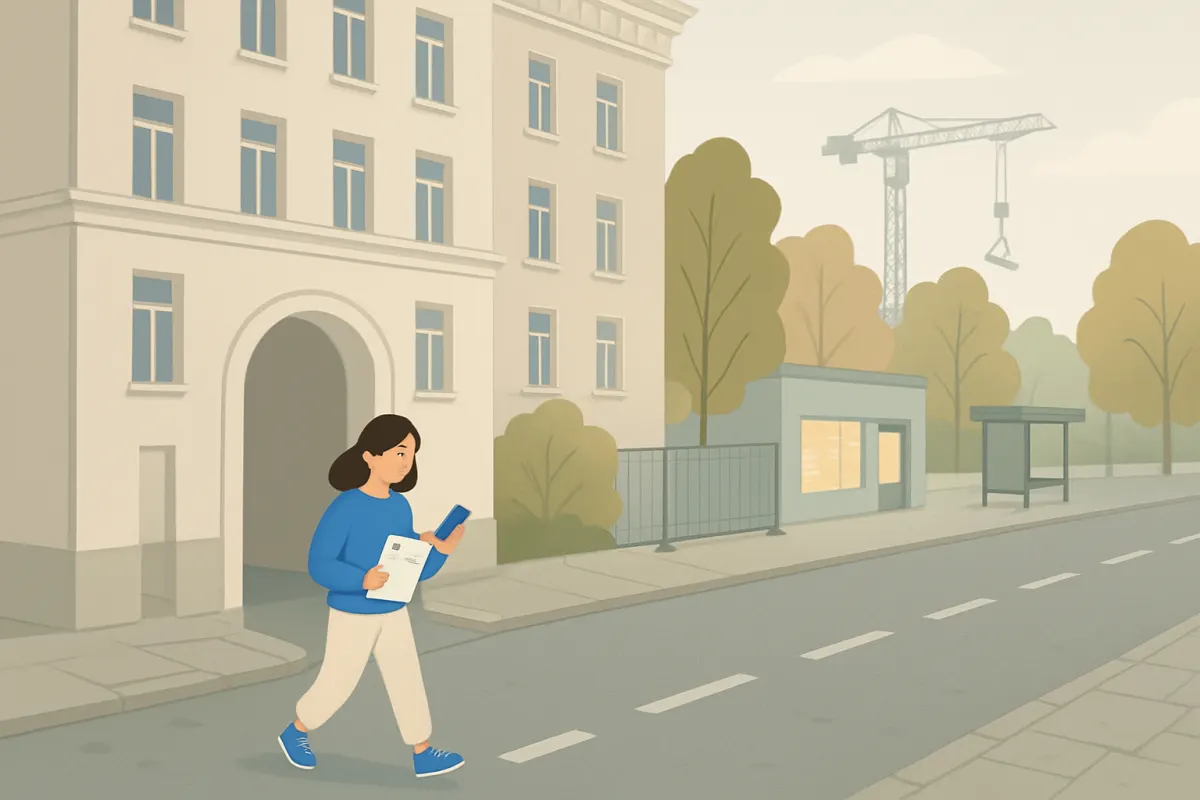
Take the report with you. The walk is not for counting shops again, but for checking what is not in it.
- Walk from the entrance to the nearest grocery shop in the report. Compare your time with its minutes: if it took noticeably longer, look for the reason, such as a crossing, a fence or a building site.
- Walk to the station in the report. Watch the pavement and the crossings, not just the clock.
- Stand by the building and in the flat with the window open. Noise from the street and from the courtyard sounds different.
- Find the building site from the What is being built nearby block and see where it is in relation to your windows.
- Go into the pharmacy and the shop by the building: are they open, is there a step-free entrance?
- Come back on a weekday evening, after nine. A district by day and a district by night can be two different districts.
When the score matters more than the walk
A walk is honest about one place at one moment. You see one Tuesday in October, and if it did not rain that day, the puddle at the crossing goes unnoticed. The score, on the contrary, does not see any particular day, but it counts dozens of places around in the same way and compares addresses on one scale.
So the order is this. First the score rules out addresses where groceries are fifteen minutes away or there is a main road under the window. Then the walk chooses between the two or three that are left. The reverse order costs more: you can spend a weekend viewing a flat that lacks half of what you need.
How the calculation works and where the data come from is described on the How it is calculated page. Other Moscow addresses, by district, are collected on the Moscow page.
Questions
Can you choose a flat by the score alone?
The score is good at ruling out unsuitable addresses, but the flat, the noise in the room, the courtyard and the evening have to be checked in person.
Does the score take nearby building sites into account?
No, but the report shows building sites separately: buildings within 500 metres, stations and lines within a kilometre and a half.
Why can the noise in the flat differ from the report?
Noise is calculated for the building's point from the distance to the road. In a room it depends on which way the windows face and what glazing they have.
What should I take to a viewing?
The report for the address: it has the nearest shop, station and building sites worth walking to, and the minutes to compare your own time with.