Berlin or Munich: 10 districts compared
30 addresses in 10 districts: Munich averages 90.7, Berlin 89.7. Score, noise and minutes to the station, school and park side by side.
Score your own address
Everything this article covers, you can check on your own address: free, in a minute.
Free. The score at once, the full report after an e-mail sign-in.
Contents 8 sections
Munich 90.7, Berlin 89.7: a gap of 1 point
Choosing between Berlin and Munich? Each city has a page of its own: Berlin and Munich. Here their measured districts are side by side: five in each, three addresses per district, 30 reports of 17 and 18 October 2026 in the General profile. A city's figure is the average of its 15 addresses: it describes the five districts we measured, not the whole city.
The scores: depth against a peak
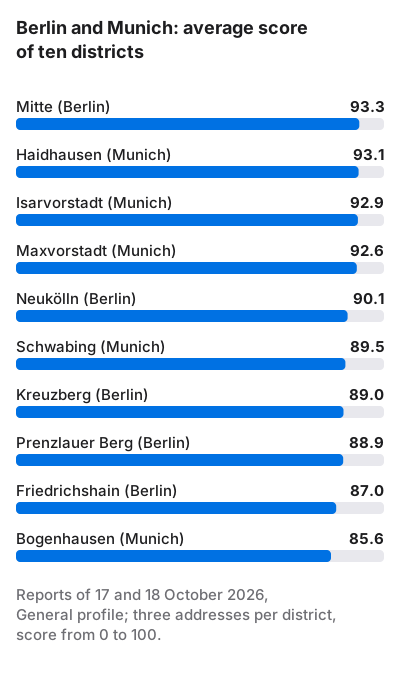
Munich averages 90.7 over its 15 addresses. The best of its five districts is Haidhausen at 93.1, the weakest Bogenhausen at 85.6, a gap of 7.5 points. On average the nearest station is 5.9 min away, a school 5.2 min and a park 4.5 min; road noise takes 0.9 points.
Berlin averages 89.7 over its 15 addresses. The best of its five districts is Mitte at 93.3, the weakest Friedrichshain at 87.0, a gap of 6.3 points. On average the nearest station is 6.3 min away, a school 5.6 min and a park 4.5 min; road noise takes 0.8 points.
Munich's lead is 1 point. It rests on depth: three of its five districts score 92.6 or more, against one of Berlin's five. At the top the two are level: Berlin's best, Mitte at 93.3, is slightly ahead of Munich's best, Haidhausen at 93.1. At the bottom Berlin is ahead: Friedrichshain at 87.0 against Bogenhausen at 85.6.
On foot: a station, a shop, a school, a park
Munich is closer on average to a station (5.9 against 6.3 min), a grocery (3.1 against 3.5) and a school (5.2 against 5.6); the park is the same, 4.5 min. The closest station in both cities is 3.0 min away on average, in Mitte and Isarvorstadt. The farthest grocery and school are in Bogenhausen, 6.0 and 8.7 min.
Noise: Berlin lower, Munich more quiet addresses
Berlin loses less to road noise on average, 0.75 points against 0.94, but 11 of Munich's 15 addresses lose nothing, against 10 of Berlin's. Prenzlauer Berg has no noise penalty at any address, and Munich has two such districts, Haidhausen and Maxvorstadt. The loudest are Schwabing (2.32 points) and Friedrichshain (1.67).
For a family: school and park
On school and park together the closest district of Munich is Haidhausen, 6.3 min, with no road noise; in Berlin it is Neukölln, 8.7 min. Munich's farthest school is in Bogenhausen (8.7 min on average), Berlin's in Friedrichshain (7.0).
The ten districts in one table
Districts are ordered by the average score of their three addresses. Noise and minutes to the station are averages of the three as well.
| District | City | Average | Noise | To station, min |
|---|---|---|---|---|
| Mitte | Berlin | 93.3 | −1.2 | 3 |
| Haidhausen | Munich | 93.1 | 0 | 5 |
| Isarvorstadt | Munich | 92.9 | −1.5 | 3 |
| Maxvorstadt | Munich | 92.6 | 0 | 6 |
| Neukölln | Berlin | 90.1 | −0.5 | 8 |
| Schwabing | Munich | 89.5 | −2.3 | 8 |
| Kreuzberg | Berlin | 89.0 | −0.5 | 4 |
| Prenzlauer Berg | Berlin | 88.9 | 0 | 7 |
| Friedrichshain | Berlin | 87.0 | −1.7 | 9 |
| Bogenhausen | Munich | 85.6 | −0.9 | 7 |
Summing up
Munich leads Berlin by 1 point on average, but the district decides more: Berlin's best and weakest districts are 6.3 points apart, Munich's 7.5. We do not measure safety or rents, so check those separately.
- The highest district score: Mitte, 93.3, then Haidhausen, 93.1.
- More districts at 92.6 or more: Munich, three of five (Haidhausen, Isarvorstadt, Maxvorstadt).
- A station and a shop at the door: Mitte and Isarvorstadt, 3.0 and 2.7 min on average.
- No noise penalty at any address: Prenzlauer Berg, Haidhausen and Maxvorstadt.
- The weakest: Bogenhausen, 85.6, with the school 8.7 and the grocery 6.0 min away on average, and Friedrichshain, 87.0.
How to use the comparison when choosing a flat
Pick the city by what you cannot change, the district by the table, and check the address itself last. The best addresses of the ten districts are close: Auguststraße 50 in Berlin's Mitte scores 94.9, Hans-Sachs-Straße 10 in Munich's Isarvorstadt 94.7. The lowest are Richard-Strauss-Straße 50 in Bogenhausen, 83.5, and Boxhagener Straße 50 in Friedrichshain, 85.0.
Each city has a page of its own: Berlin and Munich. Their districts are taken one by one in Berlin districts ranked by noise and station and Munich districts ranked by noise and station, and the other German cities in Six German cities compared by district scores, Hamburg districts ranked by noise and station, Cologne districts ranked by noise and station and Frankfurt or Düsseldorf: 10 districts compared. All measured districts are on the districts page, the rating shows where the German cities stand, and How it is calculated explains how minutes and penalties turn into a score.
Questions
Berlin or Munich: which has the better districts?
By our 30 addresses Munich: 90.7 on average against 89.7. The best district is Berlin's Mitte at 93.3, ahead of Haidhausen at 93.1; the weakest are Bogenhausen at 85.6 and Friedrichshain at 87.0.
Which is quieter, Berlin or Munich?
Berlin on average, 0.75 points off against 0.94, but 11 of the 15 Munich addresses lose nothing to road noise, against 10 in Berlin. Prenzlauer Berg, Haidhausen and Maxvorstadt have no noise penalty at any address.
Where is a station closer, Berlin or Munich?
Munich: 5.9 min on foot on average against 6.3. The closest districts are Mitte and Isarvorstadt, 3.0 min each; the farthest are Friedrichshain (9.0) and Schwabing (8.0).
Berlin or Munich for a family?
On school and park together the closest districts are Haidhausen (6.3 min) and Neukölln (8.7). Munich averages 5.2 min to a school and Berlin 5.6; the farthest school is in Bogenhausen (8.7 min).