Six German cities compared by district scores
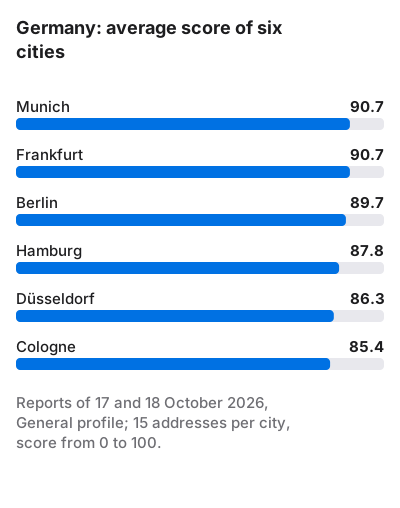
30 districts in six German cities: average score, best and weakest district of each. Munich and Frankfurt lead on 90.7, Cologne trails on 85.4.
Score your own address
Everything this article covers, you can check on your own address: free, in a minute.
Free. The score at once, the full report after an e-mail sign-in.
Contents 7 sections
Munich and Frankfurt lead, Cologne trails
Germany has no single best city for everyone, so we put the same measurements side by side: five districts in each of Berlin, Munich, Hamburg, Frankfurt, Cologne and Düsseldorf, three addresses in each district, 90 reports of 17 and 18 October 2026 in the General profile. A city's figure below is the average of its 15 addresses: it describes the five districts we measured, not the whole city. The full pages of the cities are Berlin, Munich, Hamburg, Frankfurt, Cologne and Düsseldorf.
Munich and Frankfurt on top
Munich averages 90.7 over its 15 addresses. The best of its five districts is Haidhausen at 93.1, the weakest Bogenhausen at 85.6, a gap of 7.5 points. On average the nearest station is 5.9 min away, a school 5.2 min and a park 4.5 min; road noise takes 0.9 points.
Frankfurt averages 90.7 over its 15 addresses. The best of its five districts is Sachsenhausen at 91.6, the weakest Bornheim at 89.5, a gap of 2.1 points. On average the nearest station is 4.7 min away, a school 6.1 min and a park 4.5 min; road noise takes 1.2 points.
Frankfurt has the narrowest gap of the six: all five districts lie between 89.5 and 91.6, 2.1 points apart. Munich's gap is 7.5, because Bogenhausen at 85.6 pulls its figure down; the other four districts are between 89.5 and 93.1. Frankfurt has the shortest walk to a station of the six cities (4.7 min on average), Munich the shortest walk to a school and to a grocery (5.2 and 3.1 min).
Berlin and Hamburg: the same distance, a different spread
Berlin averages 89.7 over its 15 addresses. The best of its five districts is Mitte at 93.3, the weakest Friedrichshain at 87.0, a gap of 6.3 points. On average the nearest station is 6.3 min away, a school 5.6 min and a park 4.5 min; road noise takes 0.8 points.
Hamburg averages 87.8 over its 15 addresses. The best of its five districts is Ottensen at 94.4, the weakest Winterhude at 80.5, a gap of 13.9 points. On average the nearest station is 8.7 min away, a school 6.0 min and a park 4.1 min; road noise takes 1.7 points.
Berlin has the lowest road noise of the six cities, 0.75 points on average, and a gap of 6.3 between Mitte and Friedrichshain. Hamburg holds the best district of the thirty, Ottensen at 94.4, and the second, St. Pauli at 93.6, but also the weakest, Winterhude at 80.5. The gap of 13.9 is the widest of the six.
Düsseldorf and Cologne: the loudest and the farthest from a station
Düsseldorf averages 86.3 over its 15 addresses. The best of its five districts is Unterbilk at 93.2, the weakest Flingern at 81.8, a gap of 11.4 points. On average the nearest station is 6.2 min away, a school 6.2 min and a park 5.9 min; road noise takes 2.4 points.
Cologne averages 85.4 over its 15 addresses. The best of its five districts is Neustadt-Süd at 88.0, the weakest Lindenthal at 81.7, a gap of 6.3 points. On average the nearest station is 14.1 min away, a school 5.7 min and a park 4.9 min; road noise takes 0.9 points.
Düsseldorf is the loudest of the six: road noise takes 2.42 points on average. It holds one very good district, Unterbilk at 93.2, and three below 83: Bilk and Oberkassel at 82.8 and Flingern at 81.8. In Cologne the walk to a station is 14.1 min on average, three times Frankfurt's; Neustadt-Süd is its best district at 88.0, with no road noise at any address.
The six cities in one table
Each row gives the average of 15 addresses, the best and the weakest of the five districts, and the gap between them. The wider the gap, the more the district you pick matters compared with the city.
| City | Average | Best district | Weakest district | Gap |
|---|---|---|---|---|
| Munich | 90.7 | Haidhausen (93.1) | Bogenhausen (85.6) | 7.5 |
| Frankfurt | 90.7 | Sachsenhausen (91.6) | Bornheim (89.5) | 2.1 |
| Berlin | 89.7 | Mitte (93.3) | Friedrichshain (87.0) | 6.3 |
| Hamburg | 87.8 | Ottensen (94.4) | Winterhude (80.5) | 13.9 |
| Düsseldorf | 86.3 | Unterbilk (93.2) | Flingern (81.8) | 11.4 |
| Cologne | 85.4 | Neustadt-Süd (88.0) | Lindenthal (81.7) | 6.3 |
Summing up
The first and the last city are 5.3 points apart, while districts within one city are up to 13.9 apart (Hamburg). The district decides more than the city. We do not measure safety or rents, so check those separately.
- The highest scores: Ottensen (94.4), St. Pauli (93.6) and Mitte (93.3).
- The narrowest spread and fewer surprises: Frankfurt, 89.5 to 91.6.
- The shortest walk to a station: Frankfurt, 4.7 min on average; the longest: Cologne, 14.1.
- The quietest: Berlin, where road noise takes 0.75 points on average; the loudest: Düsseldorf, 2.42.
- The widest choice between districts: Hamburg, from 94.4 in Ottensen to 80.5 in Winterhude.
How to use the comparison when choosing a flat
Pick the city first by what you cannot change, then the district by the table, and check the address itself last: two addresses in one district can be more than 10 points apart. In Cologne's Lindenthal, Dürener Straße 150 scores 74.6 and Kerpener Straße 30 86.1; in Düsseldorf's Flingern, Birkenstraße 50 scores 77.2 and Hermannstraße 20 88.0.
Each city has its own page: Berlin, Munich, Hamburg, Frankfurt, Cologne and Düsseldorf. The biggest cities are taken district by district in Berlin districts ranked by noise and station, Munich districts ranked by noise and station, Hamburg districts ranked by noise and station and Cologne districts ranked by noise and station, Berlin and Munich head to head in Berlin or Munich: 10 districts compared, and all 30 districts are sorted by a single question in German districts without a car: station and shop, German districts for a family: school, park, noise and Quiet districts in Germany: road noise in 30 districts. All measured districts are on the districts page, the rating shows where the German cities stand, and How it is calculated explains how minutes and penalties turn into a score.
Questions
Which German city has the best districts?
By our 90 addresses, Munich and Frankfurt: 90.7 on average over their five districts, ahead of Berlin (89.7), Hamburg (87.8), Düsseldorf (86.3) and Cologne (85.4). Five districts per city are a sample, not the whole city.
Where is the difference between districts largest?
In Hamburg: 13.9 points between Ottensen (94.4) and Winterhude (80.5). Frankfurt has the smallest gap, 2.1.
Berlin or Munich: which scored higher?
Munich: 90.7 against 89.7 on average. The best districts are close, Mitte at 93.3 and Haidhausen at 93.1; the weakest are not, Friedrichshain at 87.0 and Bogenhausen at 85.6. Road noise is lower in Berlin (0.75 points against 0.94).
Which German city is the quietest?
Berlin, where road noise takes 0.75 points on average, followed by Munich (0.94) and Cologne (0.95). Düsseldorf is the loudest at 2.42.