German districts without a car: station and shop
Station and shop on foot in 30 districts of six German cities: 40 of 90 addresses have a station within 5 min, Cologne has 11 beyond 10.
Score your own address
Everything this article covers, you can check on your own address: free, in a minute.
Free. The score at once, the full report after an e-mail sign-in.
Contents 9 sections
- A station within 5 min at 40 of 90 addresses
- Frankfurt, Munich, Düsseldorf and Berlin: between 4.7 and 6.3 min
- Hamburg: a high score is not a close station
- Cologne: where the station is far
- A shop close by almost everywhere
- A close station and a high score together
- The ten districts with the closest station
- Summing up
- How to use the comparison when choosing a flat
A station within 5 min at 40 of 90 addresses
Living without a car in Germany comes down to two walks: to a station and to a shop. We compared them across five districts in each of Berlin, Munich, Hamburg, Frankfurt, Cologne and Düsseldorf: three addresses per district, 90 reports of 17 and 18 October 2026 in the General profile. The minutes are on foot to the nearest station and the nearest grocery. The full pages of the cities are Berlin, Munich, Hamburg, Frankfurt, Cologne and Düsseldorf.
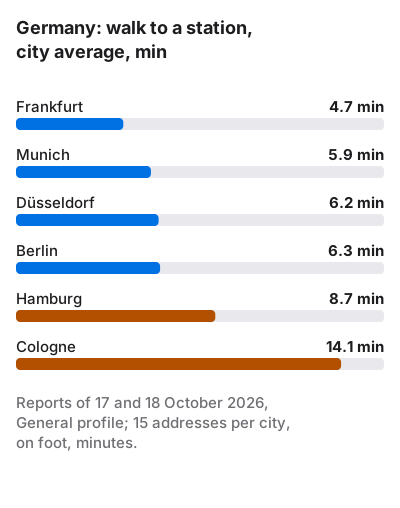
Frankfurt, Munich, Düsseldorf and Berlin: between 4.7 and 6.3 min
Frankfurt averages 4.7 min to a station and 3.3 min to a grocery over its 15 addresses. The shortest walk to a station is in Bornheim (2.0 min on average), the longest in Nordend (6.3).
Munich averages 5.9 min to a station and 3.1 min to a grocery over its 15 addresses. The shortest walk to a station is in Isarvorstadt (3.0 min on average), the longest in Schwabing (8.0).
Düsseldorf averages 6.2 min to a station and 3.3 min to a grocery over its 15 addresses. The shortest walk to a station is in Oberkassel (3.3 min on average), the longest in Unterbilk (8.7).
Berlin averages 6.3 min to a station and 3.5 min to a grocery over its 15 addresses. The shortest walk to a station is in Mitte (3.0 min on average), the longest in Friedrichshain (9.0).
A station is close in most of these districts. Bornheim is first of the thirty: 2.0 min to a station on average, 1 to 3 min at every address. Mitte and Isarvorstadt follow with 3.0, then Oberkassel with 3.3. A close station does not promise quiet, though: in Bilk a station is 4.0 min away and road noise takes 4.18 points on average.
Hamburg: a high score is not a close station
Hamburg averages 8.7 min to a station and 3.5 min to a grocery over its 15 addresses. The shortest walk to a station is in Eimsbüttel (4.0 min on average), the longest in Winterhude (12.7).
St. Pauli scores 93.6, yet its stations are 9 to 13 min away, 10.7 on average, and in Winterhude 12.7. The close one is Eimsbüttel at 4.0 min, with a station 1 min from Osterstraße 100, but road noise takes 3.30 points there.
Cologne: where the station is far
Cologne averages 14.1 min to a station and 3.5 min to a grocery over its 15 addresses. The shortest walk to a station is in Ehrenfeld (5.7 min on average), the longest in Lindenthal (18.3).
11 of the 15 Cologne addresses are more than 10 min from a station, and Neustadt-Süd, Sülz and Lindenthal are 18.3 min away on average each. Ehrenfeld is the exception: 5.7 min on average, 4 to 8 at every address, and no road noise.
A shop close by almost everywhere
The walk to a grocery is more even than the walk to a station: 81 of the 90 addresses have one within 5 min, and city averages run from 3.1 min in Munich to 3.5 in Berlin, Hamburg and Cologne. Haidhausen and Maxvorstadt have a grocery 2.0 min away on average; the farthest is Bogenhausen, 6.0 min on average and 10 at Möhlstraße 20.
A close station and a high score together
Seven districts combine a station within 6 min on average and a score of 90 or more: Mitte 93.3, Haidhausen 93.1, Isarvorstadt 92.9, Maxvorstadt 92.6, Sachsenhausen 91.6, Bockenheim 90.7 and Westend 90.5.
The ten districts with the closest station
Districts are ordered by the average walk to a station and, where that is equal, by the walk to a grocery. The minutes are the average of the district's three addresses.
| District | City | To station, min | To grocery, min | Average |
|---|---|---|---|---|
| Bornheim | Frankfurt | 2.0 | 2.7 | 89.5 |
| Mitte | Berlin | 3.0 | 2.7 | 93.3 |
| Isarvorstadt | Munich | 3.0 | 2.7 | 92.9 |
| Oberkassel | Düsseldorf | 3.3 | 3.7 | 82.8 |
| Bockenheim | Frankfurt | 4.0 | 2.7 | 90.7 |
| Eimsbüttel | Hamburg | 4.0 | 3.7 | 82.8 |
| Bilk | Düsseldorf | 4.0 | 4.0 | 82.8 |
| Kreuzberg | Berlin | 4.3 | 2.3 | 89.0 |
| Haidhausen | Munich | 5.3 | 2.0 | 93.1 |
| Sachsenhausen | Frankfurt | 5.3 | 3.0 | 91.6 |
Summing up
A station within 5 min is common but not the rule: 40 of 90 addresses, and rare in Cologne (3 of 15) and Hamburg (4 of 15). But a close station says little about the rest: Bilk and Eimsbüttel, both with a station at 4.0 min, score 82.8 each, because road noise takes 4.18 and 3.30 points. We do not measure safety, so ask the people who live on the same street.
- The closest station of all: Bornheim, 2.0 min, score 89.5.
- Station and shop at the door with the highest score: Mitte, 3.0 and 2.7 min, 93.3.
- A grocery in 2 min and a station in 5 to 6, with no road noise: Haidhausen (5.3) and Maxvorstadt (5.7).
- A station in 4 min and a quiet street: Kreuzberg, 4.3 min, road noise takes 0.45 points on average.
- Neustadt-Süd, Sülz and Lindenthal only if you do not need the walk to a station every day: 18.3 min on average.
How to use the comparison when choosing a flat
Enter the address from the listing and read the minutes to the station first, then to the grocery. Two Hamburg addresses show the range: Osterstraße 100 in Eimsbüttel is 1 min from a station and 2 from a grocery, Dorotheenstraße 50 in Winterhude is 14 min from a station and 5 from a grocery, so shopping on foot is easy there and the way to a station is not.
Each city has its own page: Berlin, Munich, Hamburg, Frankfurt, Cologne and Düsseldorf. The cities as a whole are compared in Six German cities compared by district scores, and the biggest ones district by district in Berlin districts ranked by noise and station, Munich districts ranked by noise and station and Hamburg districts ranked by noise and station. For families with children, the same 30 districts are sorted by school and park in German districts for a family: school, park, noise. All measured districts are on the districts page, and How it is calculated explains how minutes and penalties turn into a score.
Questions
Which German district has the closest station?
By our 90 addresses, Bornheim in Frankfurt: 2.0 min on foot on average, 1 to 3 min at every address. Mitte in Berlin and Isarvorstadt in Munich follow with 3.0.
Can you live in Cologne without a car?
It depends on the district: in Ehrenfeld the station is 4 to 8 min away, but in Neustadt-Süd, Sülz and Lindenthal it is 18.3 min on average, and 11 of the 15 Cologne addresses are more than 10 min from a station.
Which German city has the shortest walk to a station?
Frankfurt: 4.7 min on average over its 15 addresses, then Munich 5.9, Düsseldorf 6.2, Berlin 6.3, Hamburg 8.7 and Cologne 14.1.
How far is a grocery in these districts?
Almost everywhere within 5 min: 81 of the 90 addresses, city averages between 3.1 min in Munich and 3.5 in Berlin, Hamburg and Cologne. Haidhausen and Maxvorstadt have 2.0 on average, Bogenhausen up to 10.