Why distance is counted in walking minutes, not metres
Why we measure access in minutes on foot rather than metres: the route instead of a straight line, slopes, crossings and pace. 13 Tverskaya as an example.
Score your own address
Everything this article covers, you can check on your own address: free, in a minute.
Free. The score at once, the full report after an e-mail sign-in.
Contents 7 sections
500 metres to the metro: how long is that?
Listings say “500 metres to the metro”. But 500 metres in a straight line, 500 metres along a quiet boulevard and 500 metres across an avenue with an underpass are three different walks. The first cannot actually be walked, the second takes six minutes, the third longer, and you will not want to repeat it twice a day.
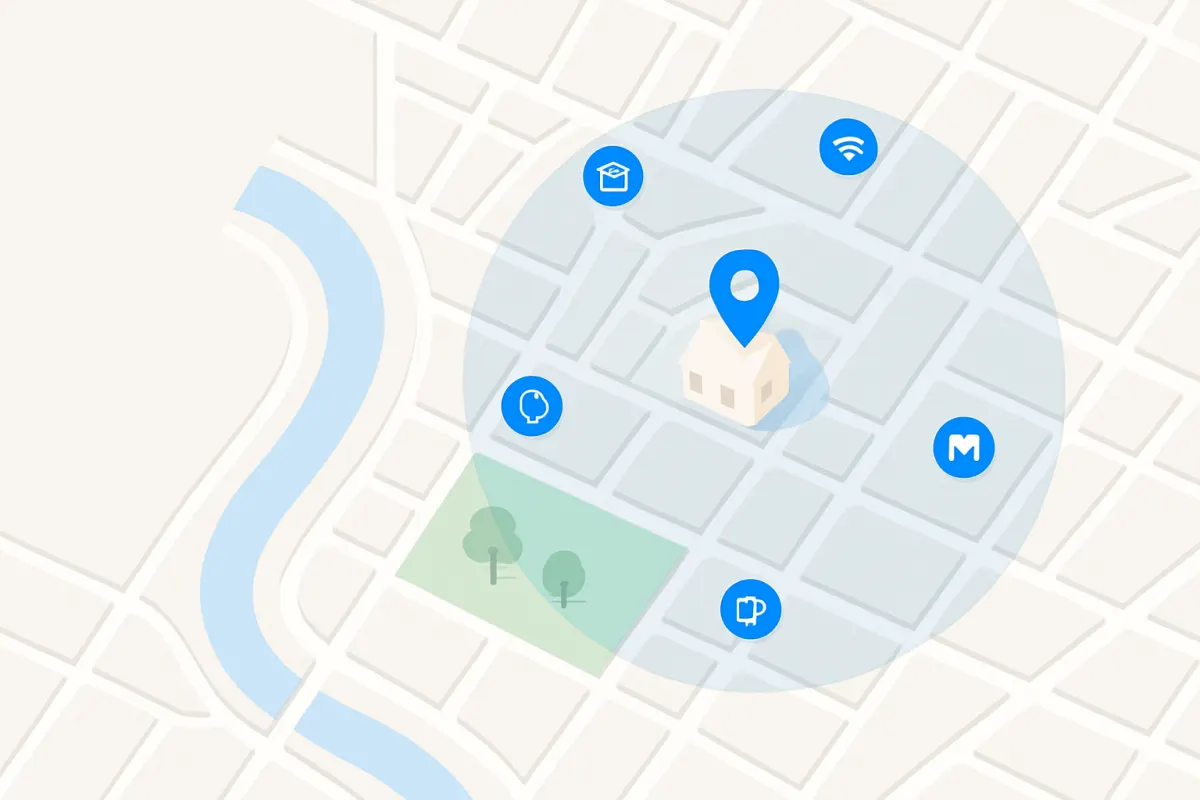
That is why our score counts time, not distance. And not even clock time, but how long the way feels. Below is the whole path from metres to points on a single address: 13 Tverskaya Street in Moscow, report of 4 October 2026, General profile.
Step one: a real route instead of a straight line
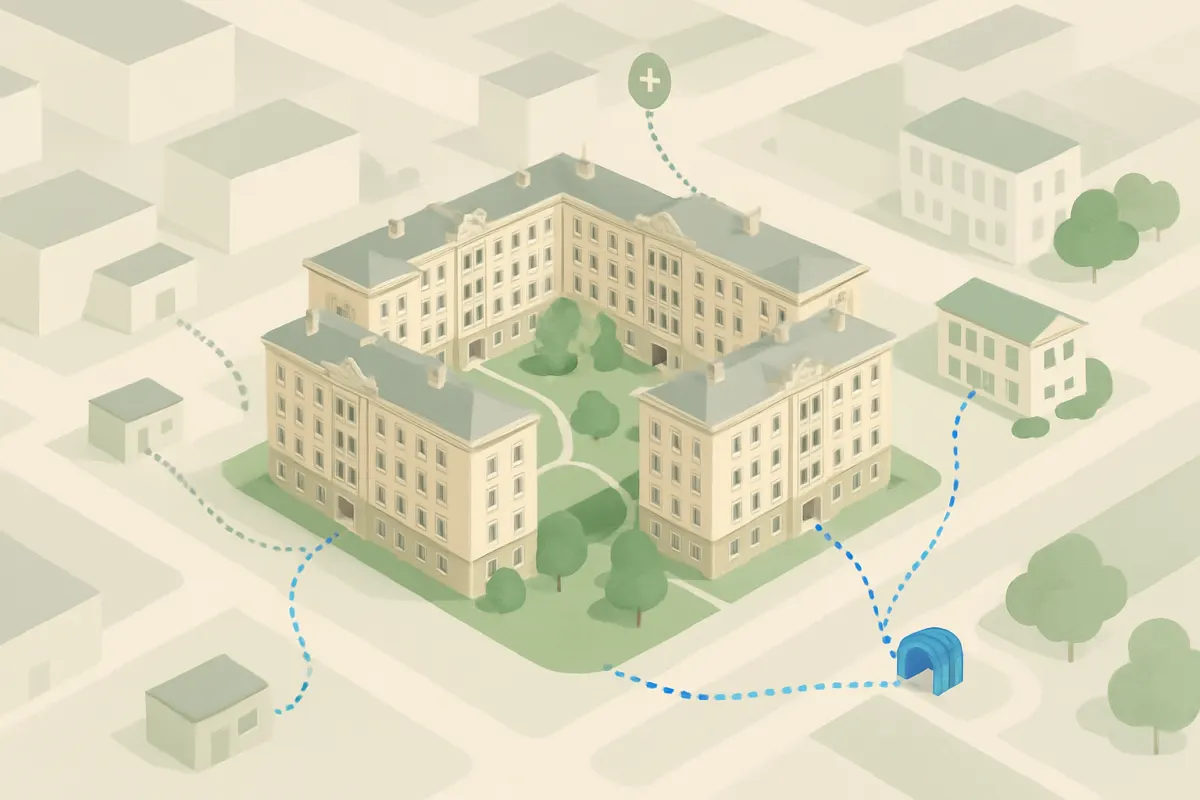
A walking route along streets, pavements and paths is built to every place. A straight line on the map runs through buildings, fences and courtyards you cannot enter; the route goes around them.
Around 13 Tverskaya, the way on foot is on average 1.36 times the straight line. Say a shop is 400 metres away as the crow flies: you will have to walk about 545 metres to it. This ratio itself goes into the Street network category: at 1.25 that part counts in full, at 2 not at all.
Step two: metres turn into minutes
In the General profile the pace is 4.8 kilometres an hour, 80 metres a minute. The Magnolia supermarket 307 metres from 13 Tverskaya is 3.8 minutes away. For the Family with a child profile the pace is 3.9 kilometres an hour, for an older person 3.6. The same metres give them different minutes.
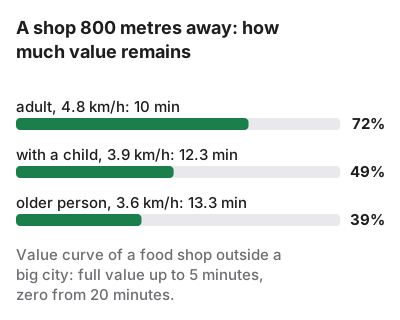
Let us count on a round example. A shop 800 metres of walking away takes an adult 10 minutes, a parent with a child 12.3, an older person 13.3. The metres are the same, but the shop is worth something different to each of the three.
Step three: what is added to the minutes
A flat way without traffic lights is rare. On top of the walking minutes come the climb, the wait at crossings over big roads and a surcharge for stretches along traffic without a pavement. All of this is shown in the report for every place.
- A crossing. A VTB bank branch 156 metres away: 1.95 minutes of walking and 20 seconds of waiting at a crossing, 2.3 minutes in total.
- A climb and a crossing. The Petrovsky Passage is 925 metres away, 11.6 minutes. Eight metres of climb and 22 seconds at a crossing bring it to 12.1.
- Only a climb. The Alexander Garden is 1006 metres away, 12.6 minutes on the flat. Fourteen metres of climb add half a minute: 13.1.
Stairs count as longer than they are: one and a half times in the General profile, three times for a family with a pushchair and an older person. Slopes cost differently too: a street with a 10% gradient costs an ordinary walker a fifth more than a flat one, a family a third more, an older person 40% more. Waiting at crossings is 20% longer for a family and 30% longer for an older person.
The result is called “counts as”. It is the number by which the value of a place is then read.
Step four: minutes turn into value
A place within five minutes counts in full. Beyond that, the value falls smoothly, without a cliff, and fades out by 15 or 20 minutes, depending on what kind of place it is. In a big city with a metro this limit is 1.25 times farther, but no more than 25 minutes. Moscow is just such a city.
At 13 Tverskaya the third supermarket, a Spar, is 648 metres and 8.2 minutes away: it keeps 92.6% of its value. An eye hospital 1066 metres away counts as 13.7 minutes and gives 71.8%. The only vet clinic within walking distance is 1582 metres away, which is 20.3 minutes and 14.4%. In metres the hospital and the clinic differ one and a half times; in value, five times.
The curve has this shape because this is how people walk. An extra minute right by the door changes nothing: a pharmacy six minutes away is no worse than one five minutes away. In the middle, where a walk turns into “I'd rather not”, the value drops fastest.
Why minutes are more honest than metres
Two shops 500 metres from home can be worlds apart. One is reached along a flat pavement, the other across an avenue with a crossing and uphill. In metres they are equal, in minutes they are not, and you will go to the first. Metres do not see this; minutes do.
Minutes make the scale the same for different cities. 400 metres uphill and 400 metres along a promenade take different times, and the score accounts for that difference rather than averaging it away.
What minutes do not know: the weather, snowdrifts on the pavement, a dark courtyard in the evening. That has to be checked on the spot, ideally at the time of day when you will be walking yourself.
How to read the minutes in a report
- Every place has two numbers: the walking minutes and “counts as”. If the second is noticeably larger, there is a climb, stairs or a long crossing on the way.
- Open the report with your own profile. With a child or an older parent, the minutes will be more honest than in the General profile.
- Add your own places: work, school, the gym. The report will count the minutes to them by the same rules.
The curve formula, walking paces and surcharges for every profile are on the page How the score is calculated. More Moscow addresses with minutes to the metro, school and park are on the Moscow page.
Questions
What walking speed is used?
4.8 km/h in the General profile, 3.9 for a family with a child, 3.6 for an older person. Slopes, stairs and waiting at crossings are added on top.
Why can “500 metres to the metro” take more than eight minutes?
Listings often give the straight-line distance, and the way on foot is longer. Around 13 Tverskaya it is 1.36 times longer: 500 metres in a straight line become about 680 metres of walking and 8.5 minutes, and a crossing or a climb adds more.
What does “counts as N minutes” mean?
It is the walking time plus surcharges for slopes, stairs, crossings and stretches along traffic. The value curve of a place is read by it.
Are underpasses taken into account?
Stairs on the route are: in the General profile they count as one and a half times longer, for a family and an older person three times.