The morning route: home, kindergarten, school, stop
How to judge a family morning route: kindergarten, school and the station on the way to work. Minutes at nine St Petersburg addresses and a child's pace.
Score your own address
Everything this article covers, you can check on your own address: free, in a minute.
Free. The score at once, the full report after an e-mail sign-in.
Contents 6 sections
Four points that repeat every morning
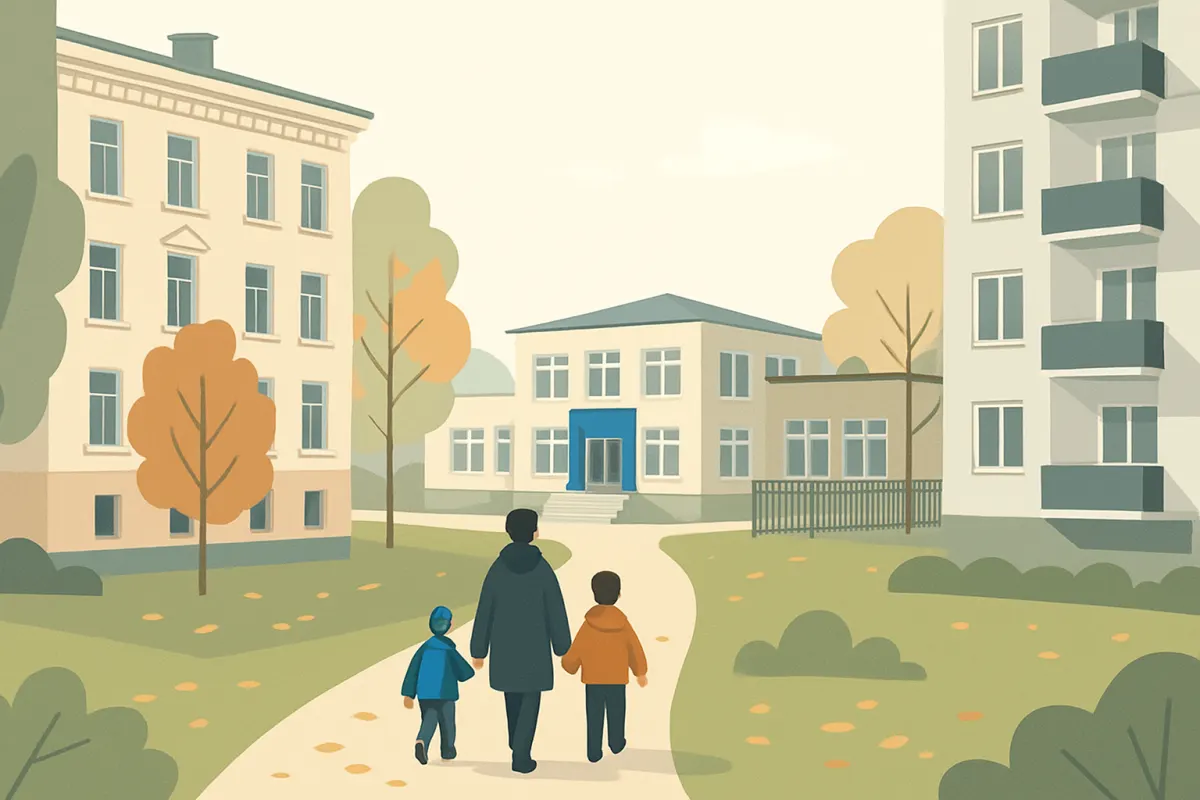
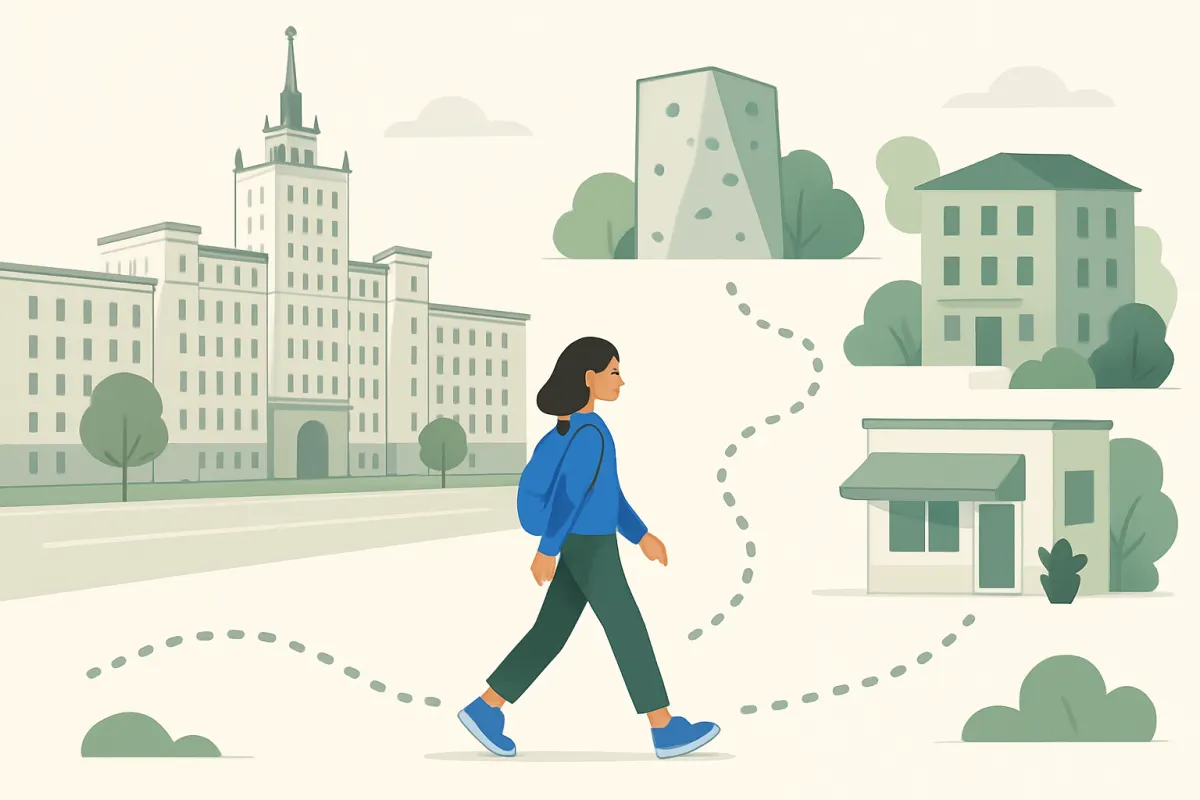
For a family with children, the morning works like a route. Leave home, take the younger one to kindergarten, the older one to school, and then walk to the stop or the metro yourself. Each point may be close on its own, but you will not walk to them one by one: you will walk them as a chain, holding a child's hand, at the same time every day.

Let us see how to judge such a morning in advance, from a listing. The examples are nine St Petersburg addresses in the Central, Petrogradsky and Vasileostrovsky districts, measured on 3 October 2026 with the General profile: for each, the minutes to the school and to the metro station are known.
The score counts from the door, but the morning is a chain
An address's score rates each place from the front door. A school counts in full up to five minutes on foot and loses its value by twenty, in a big city by twenty-five. A kindergarten counts up to five minutes and loses its value by fifteen, in a big city by 18.75. A playground has to be right next door: in full up to three minutes, zero from ten.
What the score does not know is the order. Say the school is five minutes north and the station five minutes south. From the school to the station you have to walk back past home, and the morning takes 5 + 10 = 15 minutes. If the school and the station are in the same direction, the school may be a couple of minutes from the station, and the whole morning fits into seven.
So the sum of the minutes “to school” and “to the station” is not the length of the morning, but its lower bound with a lucky layout. How small it is already says a lot about the address.
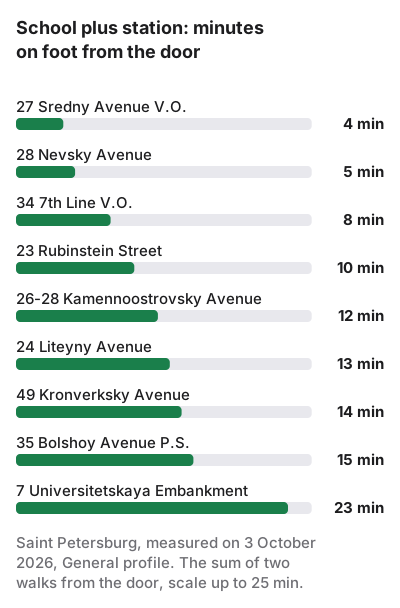
Nine St Petersburg addresses: where the morning is shortest
The shortest morning is at 27 Sredny Avenue on Vasilyevsky Island: the school is two minutes away, Vasileostrovskaya station two as well. Next comes 28 Nevsky Avenue: the school four minutes away, the station one. At 34 7th Line of Vasilyevsky Island it is four minutes each, at 23 Rubinstein Street five each.
24 Liteyny Avenue shows how a single point lengthens the morning. The school is three minutes away, but Chernyshevskaya is ten. On the Petrograd Side the school is 5–7 minutes away, the station 5–9.
The longest morning is at 7 Universitetskaya Embankment: the school is 12 minutes away, the station 11. Even in the ideal order that is 23 minutes, and in real life more.
After school you need a playground or a park. Here the leaders are different: a park one minute away at 26-28 Kamennoostrovsky Avenue, two minutes at 23 Rubinstein Street and 49 Kronverksky Avenue. On Sredny Avenue, where the morning is shortest, the park is seven minutes away.
| Address | School | Station | Sum | Park |
|---|---|---|---|---|
| 27 Sredny Avenue, Vasilyevsky Island | 2 min | 2 min | 4 min | 7 min |
| 28 Nevsky Avenue | 4 min | 1 min | 5 min | 5 min |
| 34 7th Line, Vasilyevsky Island | 4 min | 4 min | 8 min | 9 min |
| 23 Rubinstein Street | 5 min | 5 min | 10 min | 2 min |
| 26-28 Kamennoostrovsky Avenue | 7 min | 5 min | 12 min | 1 min |
| 24 Liteyny Avenue | 3 min | 10 min | 13 min | 3 min |
| 49 Kronverksky Avenue | 5 min | 9 min | 14 min | 2 min |
| 35 Bolshoy Avenue, Petrograd Side | 6 min | 9 min | 15 min | 5 min |
| 7 Universitetskaya Embankment | 12 min | 11 min | 23 min | 6 min |
A child's pace: the same metres, more minutes
The minutes above are for an adult without a child, 80 metres a minute. In the Family with a child profile the pace is 3.9 km/h, or 65 metres a minute. The same metres take about a quarter longer.
Let us count at 7 Universitetskaya Embankment. Twelve minutes to school on a flat route become almost fifteen, eleven to the station thirteen and a half. On top of that, the family profile counts waiting at crossings as 20% longer, stairs as three times longer and slopes as more costly.
The weights change too. Education weighs 22 points instead of 10, parks and sport 16 instead of 14, transport 13 instead of 18. A school, a playground and a park become essentials: if any of them is not within walking distance, the category loses its weight and another 40% of what remains.
Where the kindergarten fits in the chain
The district measurements do not include kindergartens; their minutes are in the full report for the address. The nearest kindergarten gives 80% of the need's score, the second 20%. A childcare group that is not tagged as a kindergarten on the map counts with a quality of 0.8.
The nearest kindergarten is not necessarily the one that will take your child. So it is better to add the kindergarten, the school and your work to the report by hand, in My places. The report will show the minutes to each, and the route map will show whether they lie on the same side of home or on different sides.
How to check the morning route before you move
- Open the report with the family profile straight away: the minutes will be closer to the ones you will walk with a child.
- Add the kindergarten, the school and your work, or the station you will travel from, to My places.
- Look at the route map. If the kindergarten and the school are on opposite sides of home, add up the way there and back, not two distances from the door.
- Check the crossings. A big street between home and school means crossing it twice a day.
- Walk the route once at eight in the morning. Queues at the lights and crowds at the metro are not part of the calculation.
You can compare two addresses with the family profile on the comparison page. All the settings of the Family with a child profile are on the page How the score is calculated, and more addresses in the city are on the St Petersburg page.
Questions
How many minutes to school is normal?
Up to five minutes a school counts in full; beyond that its value falls smoothly and fades out by twenty minutes, in a big city by twenty-five.
Does the score take the way from kindergarten to school into account?
No. Each place is counted from the front door. The order of the morning shows on the route map if you add the kindergarten and the school to My places.
What pace is used for walking with a child?
3.9 km/h instead of 4.8. Waiting at crossings is 20% longer, and stairs count as three times longer.
Why is there no kindergarten in the table?
The district measurements include only the food shop, the station, the school and the park. The full report for an address shows the minutes to kindergartens.