What a minute to the sea costs: rent and distance
Renting by the sea in Batumi: 57 metres from the beach scores 62.3, 474 metres scores 93.8. What the seafront costs you and how to price a minute.
Score your own address
Everything this article covers, you can check on your own address: free, in a minute.
Free. The score at once, the full report after an e-mail sign-in.
Contents 7 sections
The seafront costs more, but what exactly do you pay with
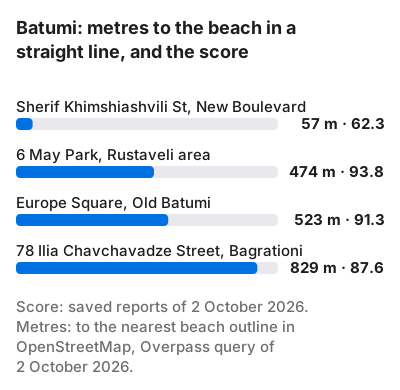
A flat right on the beach costs more than the same flat ten minutes away, and the price gap is plain in the listings. It is harder to see how the first line differs from ten minutes inland in everything except the sea. We took four seaside addresses in Batumi from the rating, from the seafront to blocks eight hundred metres from the shore, and measured the straight-line distance from each to the nearest beach.
There are no rents in this article: we found no open source with a clear licence for our countries. Instead there is a formula you can fill in with two prices from listings of your own.
Four addresses in Batumi
| Address | To the beach, m | Score | Noise |
|---|---|---|---|
| Sherif Khimshiashvili Street, New Boulevard | 57 | 62.3 | −7.53 |
| 6 May Park, Rustaveli area | 474 | 93.8 | 0 |
| Europe Square, Old Batumi | 523 | 91.3 | — |
| 78 Ilia Chavchavadze Street, Bagrationi | 829 | 87.6 | −4.33 |
The address 57 metres from the beach scored 62.3; the three addresses 474–829 metres away scored from 87.6 to 93.8. Four addresses are not statistics yet, and we do not call this a rule. But each of them shows where the difference comes from.
What the seafront pays with
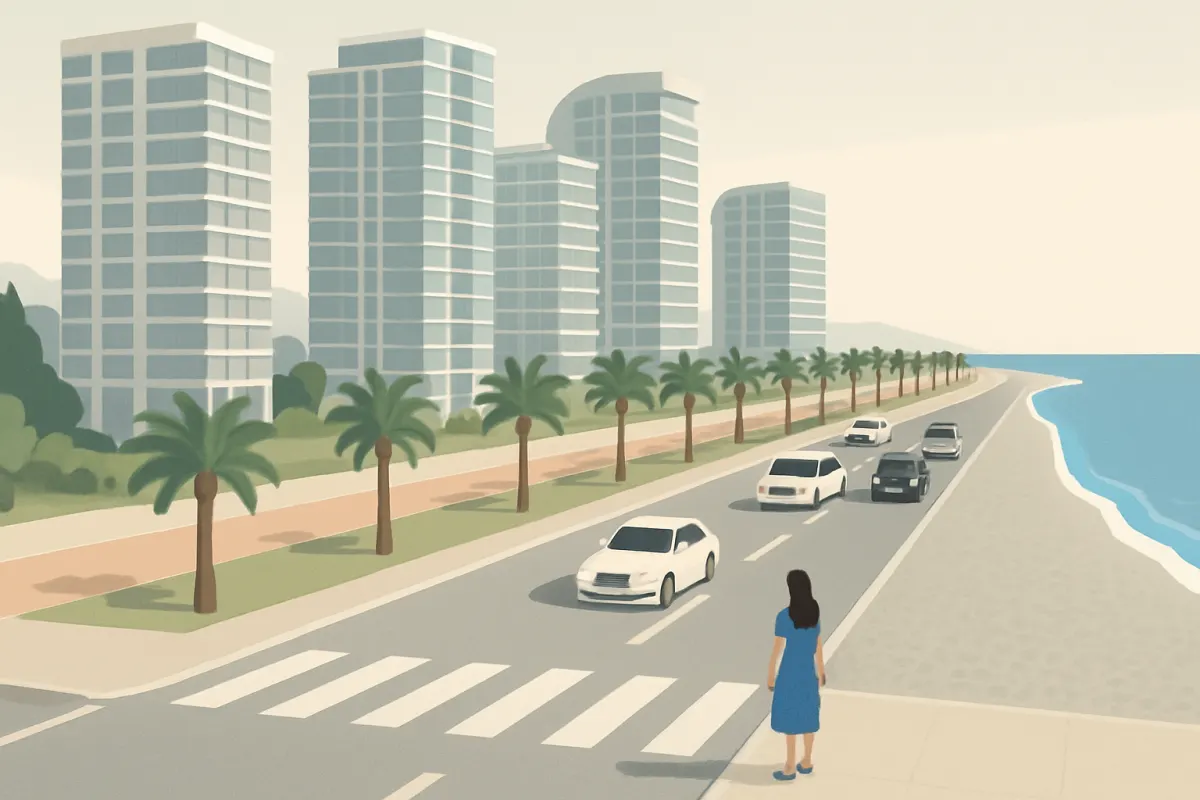
New Boulevard, 57 metres. Tower blocks along the sea, the beach across the road. Parks and sport 93, but health 24, transport 48, education 65, and 7.53 points off for the noise of the road along the shore.
Many flats on the boulevard are let by the day, and in winter the buildings empty out. The report does not see that. What it does see is that schools, doctors and transport lines within walking distance are few here, and the season will not change that.
The Parks and sport category of the seafront is lifted by the sea and the boulevard. The rest of the city does not reach the shore. Schools, clinics and transport lines are where people live all year round.
The second line: ten minutes away and a different city
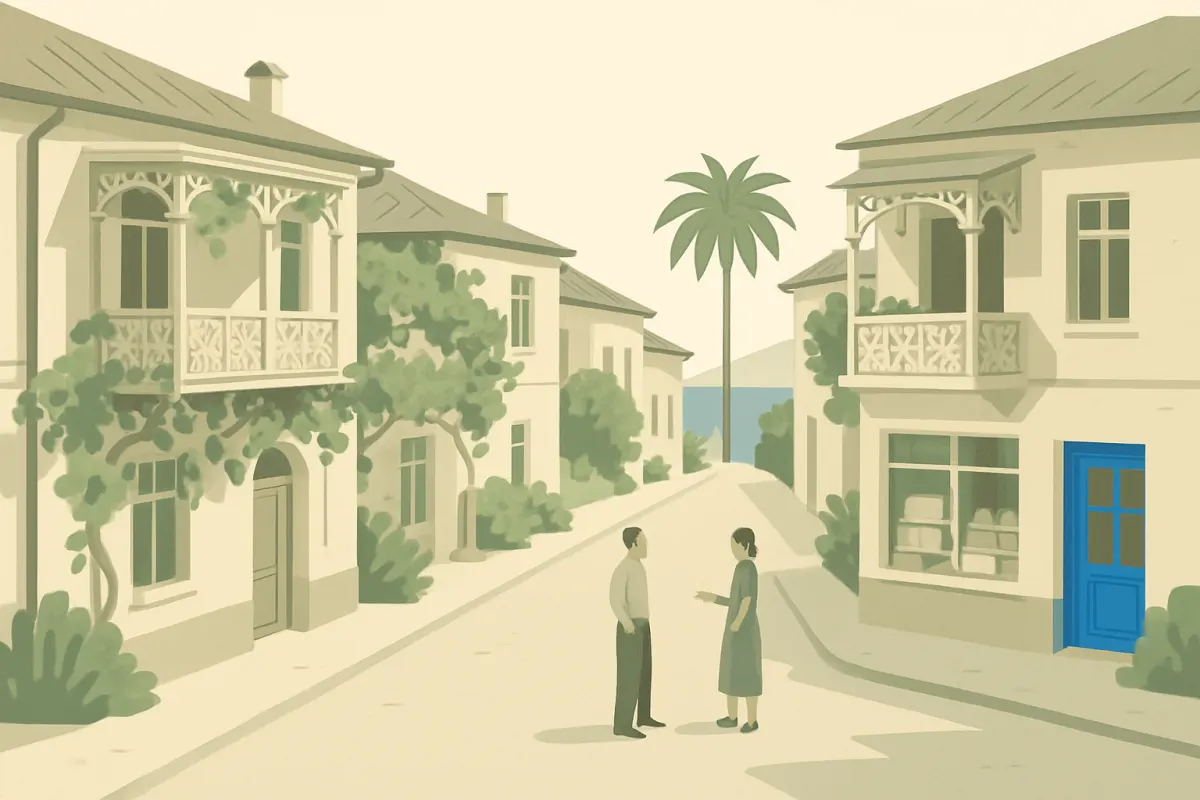
6 May Park in Batumi, 474 metres from the beach. Health 100, education 100, transport 87, no noise penalty. A score of 93.8, the best among our Georgian addresses.
Europe Square in Old Batumi, 523 metres. Low-rise blocks by the port: health 100, parks and sport 99, street network 98, a score of 91.3.
78 Chavchavadze Street in Batumi, 829 metres. Daily needs 97, education and health 100 each. A score of 87.6 even with a noise penalty of 4.33.
The sea has not gone anywhere, though. A beach five minutes' walk away counts in full in the report, at ten minutes 72%, at fifteen 24%. Between the seafront and 400 metres there is almost no difference for the score: 400 metres take five or six minutes to walk.
Noise: the shore as a road
Two addresses of the four have a noise penalty of more than four points. On New Boulevard a big road runs right along the shore: 7.53. Chavchavadze Street loses 4.33. 6 May Park got no noise penalty at all.
By the sea, it is the road that makes the noise. The main street often runs along the promenade, so the seafront is the front line both to the sea and to the traffic.
When renting by the sea, check this first. The block “What lowers it here” names the road and the distance to it. Windows on the sea often mean windows on a promenade with traffic.
The formula: the price of one minute
For the sum you need two prices from listings and two reports.
Step one: the difference in time. Take the minutes on foot to the water from the two reports. For example: a building 57 metres away and one 829 metres away in a straight line. That is about ten minutes' walk each way, twenty there and back.
Step two: how often. Write down how many times a month you actually go to the beach. In summer, say, twenty. In winter, perhaps four walks along the promenade.
Step three: multiply. Twenty trips of twenty minutes make 400 minutes a month, under seven hours. In winter, 80 minutes.
Step four: divide the monthly difference in rent by those minutes. You get the price of one minute saved on the way to the sea. Compare it with what a minute of travel is worth to you in any other case, for instance the price of a taxi.
Then do the reverse sum. The second line has the school, the doctor and the stop closer. Count the minutes the seafront takes from you: the way to the clinic, to the shop, to the bus. Quite often they outweigh the ones won on the beach.
When the seafront is right after all
The sum is not always against it. If you have come for a month for the sea, work from the flat and cook little, you do not need the categories where the seafront loses. Set them to zero in the weights panel, and New Boulevard with its 62.3 comes much closer to the second line than the general score suggests.
The report does not rate the view from the window. Nor does it rate a child being able to go to the beach alone. That is your own correction to the formula, and a legitimate one.
How exactly water enters the score is described on the page How the score is calculated and in the article on the walk to the promenade. More Batumi addresses are on the Batumi page and in the rating for Georgia.
Questions
How much does the sea raise an address's score?
A beach five minutes' walk away closes up to half of what the Parks and sport category was missing to reach 100. At Barceloneta, that adds 2.5 points to the overall score.
Why do addresses right by the beach score lower?
Not because of the sea. Their health, education and transport are weaker, and the road along the shore often brings a noise penalty.
How do I work out whether the seafront is worth paying extra for?
Divide the monthly difference in rent by the minutes you will save on the way to the sea, and compare with the minutes you will lose on the way to the shop, the doctor and the stop.