Living without a car: what a walkable area saves
What living without a car saves: we count trips and hours at Yekaterinburg addresses, from the centre to Akademichesky. How to plug in your own prices.
Score your own address
Everything this article covers, you can check on your own address: free, in a minute.
Free. The score at once, the full report after an e-mail sign-in.
Contents 6 sections
Savings without a car: what to count
A car costs money every month, even when it sits in the courtyard: insurance, servicing, parking, depreciation. Giving it up looks like pure savings. But part of that money comes back in another form: a taxi to the doctor, grocery deliveries, an extra half hour on the road every day. How much comes back depends on the address.
We do not publish prices for petrol, taxis or rent: we have no open source with a clear licence for Russian cities. So we will count in trips and hours, and you will put a price on each line yourself. Our example is Yekaterinburg, with its compact centre and the new Akademichesky district in the south-west.
Two jobs a car does: errands and the commute
In a city, a car does two different jobs. The first is everyday errands: the shop, the pharmacy, the clinic, the school. The second is a regular trip to the other end of town, usually to work. A walkable district takes care of the first job. Only public transport takes care of the second, and that is where districts differ the most.
Nine Yekaterinburg addresses, scored on 3 October 2026, show the difference well. A grocery shop is close almost everywhere: 2 to 8 minutes on foot. The walk to a metro station, though, ranges from 2 minutes in the centre to 34 in Akademichesky.
| Address | Shop | School | Metro | Score |
|---|---|---|---|---|
| Lenin Avenue 51 | 5 | 3 | 12 | 90.7 |
| Vaynera Street 9 | 3 | 6 | 4 | 90.3 |
| 8 Marta Street 46 | 8 | 9 | 2 | 84.3 |
| Akademika Shvartsa Street 17 | 2 | 14 | 4 | 85.6 |
| Rodonitovaya Street 12 | 4 | 7 | 12 | 84.5 |
| Krestinskogo Street 46 | 8 | 4 | 16 | 64.6 |
| Vilgelma de Gennina Street 37 | 3 | 6 | 34 | 78 |
| Krasnolesya Street 133 | 2 | 9 | 34 | 76.9 |
| Akademika Sakharova Avenue 53 | 2 | 10 | none | 75.5 |
Akademichesky: errands on foot, work by transport
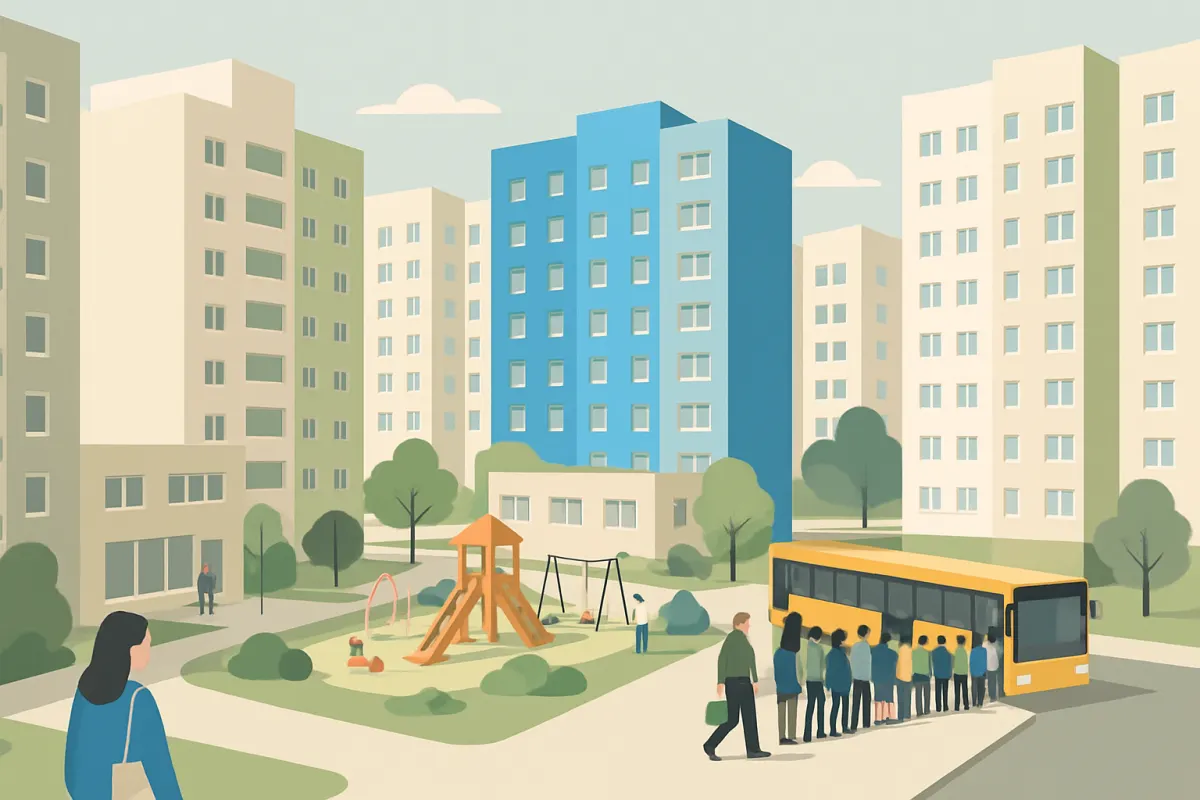
Akademichesky was built with schools, nurseries and shops inside its blocks from the start. The figures show it: at three addresses the shop is 2–3 minutes away and the school 6–10. You do not need a car for errands here. The rating address at Vilgelma de Gennina Street 40 scores 100 for groceries and 99.1 for education.
But there is no metro. From de Gennina Street 37 and Krasnolesya Street 133 it is 34 minutes on foot to Chkalovskaya station. Transport at the rating address scores 35.9 out of 100. People get to the centre by tram, bus or car.
Let us do the maths. Say you work in the centre five days a week and walk to the metro. 34 minutes there and 34 back make 68 minutes a day and 5 hours 40 minutes a week just getting to the station. So without a car, life in Akademichesky hinges on trams and buses: if they run conveniently to your work, the district saves you money; if not, the savings go on the commute.
The centre: both jobs on foot
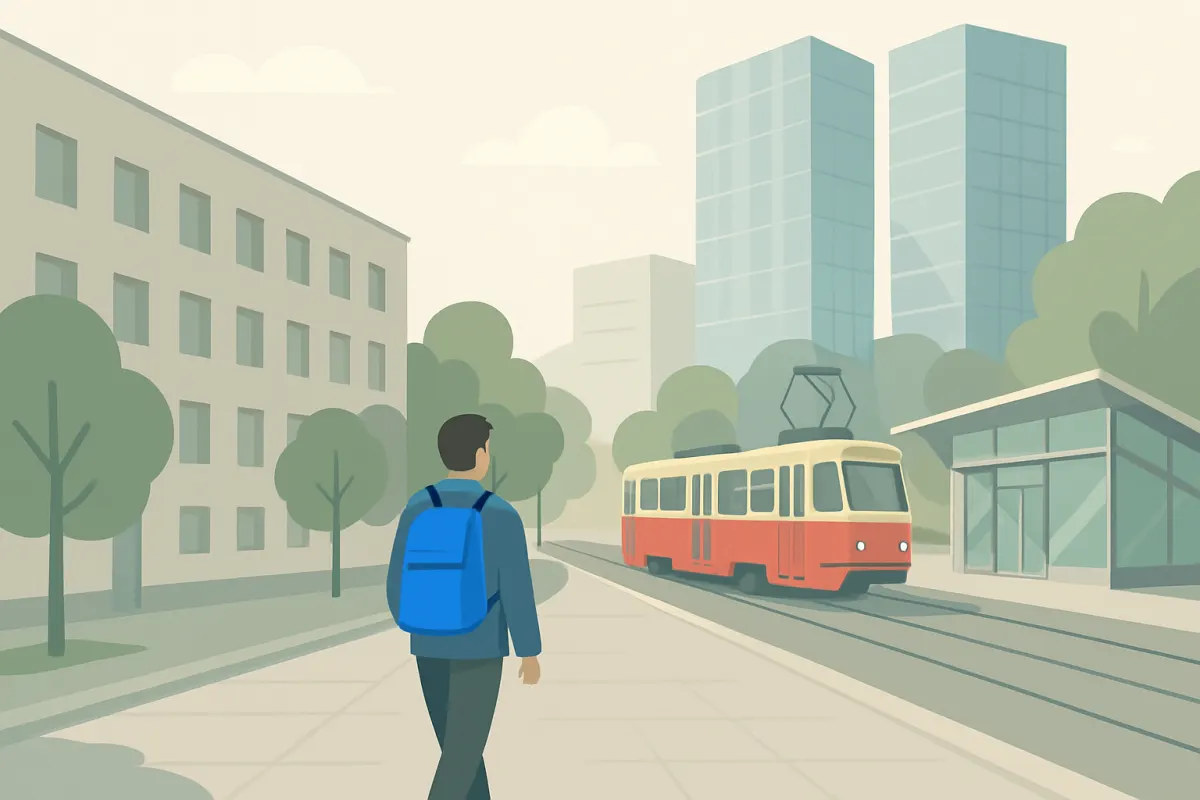
8 Marta Street 46 in Leninsky district: Geologicheskaya station is 2 minutes away, a park 2 minutes too. Vaynera Street 9: the metro in 4, a shop in 3. Lenin Avenue 51, the site's Yekaterinburg example: a Pyatyorochka supermarket in 5 minutes, a pharmacy in 3, the Operny Teatr stop in 2, a clinic and a school 3 minutes each.
Here you need a car neither for errands nor for a job in the centre. If you sell it, you keep almost all of the savings: what replaces it is the occasional taxi ride, not a daily one.
What the “Without a car” profile shows
The report can work out this difference for you. The “Without a car” profile gives transport 28 points out of 100 instead of 18, and weak transport pulls down the whole score: with zero transport it is multiplied by 0.75. We recalculated three rating addresses the way the report's weights panel does it.
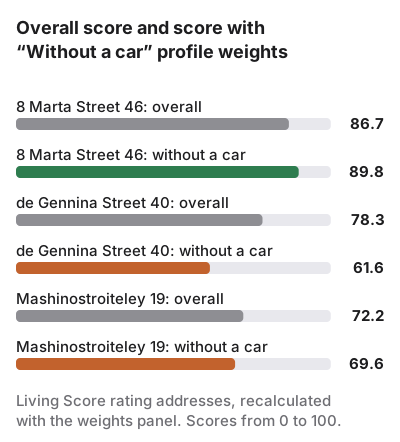
8 Marta Street 46 rises from 86.7 to 89.8. De Gennina Street 40 falls from 78.3 to 61.6: almost 17 points. The gap between them grows from 8.4 to 28.2 points. Mashinostroiteley Street 19 in Uralmash barely moves, from 72.2 to 69.6: its transport scores 77.5.
Those 28 points are what a walkable district saves a person without a car. Not in roubles, but in how many things you can get done without getting behind the wheel.
How to work out your own savings
Open the report for an address and write down the categories that scored below 50. For each one, decide what will replace it without a car, and how often.
- Transport below 50: the daily commute. Multiply the fare by 40–44 trips a month.
- Daily needs below 50: shopping. A delivery or a taxi once a week.
- Healthcare below 50: doctor's visits. Count how many you had last year.
- Everything above 75: on foot, costs nothing.
Add up the monthly amounts and subtract them from what your car costs you. If the result is positive, the address lets you live without a car and come out ahead. If it is negative, keep the car or choose another address.
The nine addresses in this article are collected on the Yekaterinburg page, and all Russian addresses are in the rating. The How it is calculated page explains the “Without a car” profile weights and the transport multiplier.
Questions
How much can you save by living without a car?
It depends on the address. In central Yekaterinburg the shop, pharmacy and metro are 2–5 minutes away, and you hardly need anything to replace the car. In Akademichesky the metro is 34 minutes away, and the savings go on getting around.
How can I tell whether a particular address needs a car?
Open the report with the “Without a car” profile. If the score drops sharply compared with the overall one, as at de Gennina Street 40 from 78.3 to 61.6, life there without a car is hard.
Does the score take the cost of living into account?
No. The report has no taxi, petrol or rent prices. It shows how many things you can do on foot, and you plug in the cost of replacing the car yourself.
Which Yekaterinburg district works well without a car?
Among our addresses, the centre: at 8 Marta Street 46 and Vaynera Street 9 the metro is 2–4 minutes away and a shop 3–8. With the “Without a car” profile weights, 8 Marta Street 46 gets 89.8.