Score profiles: family, older people, remote work
How the Family with a child, Older person and Remote worker profiles differ from General: weights, pace, the cost of steps. Three Kazan addresses.
Score your own address
Everything this article covers, you can check on your own address: free, in a minute.
Free. The score at once, the full report after an e-mail sign-in.
Contents 7 sections
One building, different residents
The score of an address in a report is always computed for someone. By default that is the General profile: an adult with no special needs who walks at 4.8 km/h. But a flat is often chosen for somebody else: for a family with a six-year-old, for a mother moving closer, or for yourself working remotely.
There are six profiles: General, Family with a child, Without a car, Older person, Remote worker and Pet owner. Here we go through the three that change the picture most, and look at them on three addresses in Kazan.
What a profile changes besides the weights
The most visible part of a profile is the category weights. But the way the minutes themselves are counted changes too. All the figures below come from the score published on the page How it is calculated.
| Profile | Pace, km/h | Steps | Climb | Essential nearby |
|---|---|---|---|---|
| General | 4.8 | ×1.5 | 3.5 | groceries, pharmacy |
| Family with a child | 3.9 | ×3 | 5 | groceries, pharmacy, school, playground, park |
| Older person | 3.6 | ×3 | 6 | groceries, pharmacy, clinic, park |
| Remote worker | 4.8 | ×1.5 | 3.5 | groceries, pharmacy |
The pace changes the minutes. Take a pharmacy 500 metres away. In the General profile it is 6.3 minutes, for a family 7.7, for an older person 8.3. The distance is the same, but for an older person the pharmacy is already beyond the five minutes within which a place counts in full.
Steps and climbs change the route. Twenty metres of stairs count as thirty metres of level ground in the General profile, and as sixty for a family and an older person. With a pram or bad knees, the short cut through an underpass stops being short.
Crossings and traffic cost more too. The wait at crossings over big roads is multiplied by 1.2 for a family and by 1.3 for an older person. Stretches along traffic without a pavement are multiplied by 1.3 for both.
Family with a child: the school outweighs transport
In the family profile education weighs 22 points out of 100, parks 16, health 11. Transport shrinks from 18 to 13, cafes and culture from 8 to 4. The school, the playground and the park become essential: if one of them is not nearby, the category loses not only its share but another 40% of what remains. Inside the category the school weighs 2.5, the kindergarten 2, the playground 1.5, classes, colleges and universities 1, and the playground counts in full only within three minutes of the door.
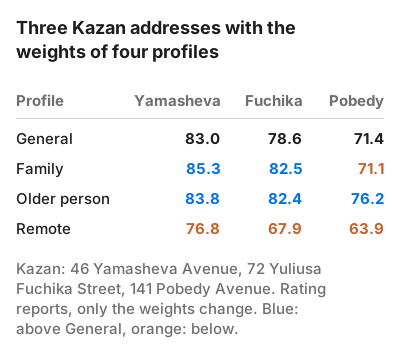
72 Yuliusa Fuchika Street in Privolzhsky district gains from the family weights: from 78.6 to 82.5. Its parks and sport score 96, education 89. 141 Pobedy Avenue in Sovetsky district gains nothing: 71.4 against 71.1. Its education is 63, parks 48, and shifting weight onto them does not help.
Older person: the clinic and benches
For an older person health weighs 18 points, the street network 18, groceries 11. Remote work drops to zero, education falls to two. The clinic and the park are essential. And only in this profile do benches count towards the score: they are counted by number within five minutes of the door.
141 Pobedy Avenue, weak for a family, gains 4.8 points for an older person: 76.2 instead of 71.4. The address scores 97 for health and 95 for services nearby, and these are exactly the categories that weigh more here. 72 Fuchika Street goes up as well, to 82.4.
It is a good example of why you should not choose an area for your parents by your own score. An address that looks average to you may turn out convenient for someone who needs a clinic, a pharmacy and a level path to them.
Remote worker: a coworking space and cafes nearby
In the Remote worker profile the Remote work category weighs 13 points instead of one, and cafes and culture 11. Education and transport shrink. The pace and the cost of steps are the same as in General.
Here all three Kazan addresses drop. 72 Fuchika Street drops most: 67.9 instead of 78.6, minus 10.7 points. Its work category is 18, cafes and culture 44. 46 Yamasheva Avenue loses 6.2 points, 141 Pobedy Avenue loses 7.5. Residential districts are good for living, but the map finds almost no places to work outside the flat in them.
Without a car and Pet owner, in brief
The two remaining profiles work on the same principle. Without a car gives transport 28 points out of 100 and services nearby 14. With these weights 141 Pobedy Avenue goes up to 74.6, 72 Fuchika Street to 80.6, and 46 Yamasheva Avenue goes down to 82.5. A real report with this profile is stricter: when transport is weak it cuts the whole category sum by up to a quarter.
The Pet owner profile gives parks 19 points and the Pets category 10 instead of one. At all three Kazan addresses that category is middling, 42 to 51, so the scores fall: 80.2, 76.3 and 68.5. A dog owner should check separately where the nearest vet is.
Sliders or a profile: which to choose
In the table above we changed only the weights, the way the "Your weights" sliders in a report do. The category scores and the penalties stayed as they were. A real report with a profile recomputes the minutes as well: with a slower pace, costlier steps and essential places. That is why for a family and an older person it is usually stricter than our recalculation.
The sliders are handy for a quick "what if". To decide on a flat, open the report with the profile of whoever will live in it. The addresses in this article and other districts are on the Kazan page.
Questions
Which profile should I choose if several people will live in the flat?
The one for whoever has it hardest: the child or the older parent. If an address is good for them, it usually suits an adult with no special needs too.
How does a profile differ from the weight sliders?
The sliders only change how much the categories matter. A profile also changes the walking pace, the cost of steps and climbs and the set of essential places, so the report is computed again.
Why do benches count only for an older person?
For them a chance to sit down on the way can decide whether they walk to the shop at all. In the other profiles benches are shown for information and do not count towards the score.