Playground or kindergarten: which matters more nearby
Kindergarten or playground near home with a toddler? Minutes with a child at six Russian addresses, and why the score wants the playground closer.
Score your own address
Everything this article covers, you can check on your own address: free, in a minute.
Free. The score at once, the full report after an e-mail sign-in.
Contents 6 sections
- Kindergarten or playground: what the question is really about
- How the score counts the kindergarten and the playground
- In the family profile the playground is essential and the kindergarten is not
- Six addresses: metres and minutes with a child
- What matters more nearby: a kindergarten or a playground
- What the map will not tell you about a kindergarten and a playground
Kindergarten or playground: what the question is really about
A family with a toddler is choosing a flat and arguing: what matters more, a kindergarten nearby or a good playground? The kindergarten is needed twice a day, but for three or four years and only if it has a place. The playground is needed every day from the first walks in the pram, and nobody goes there on a schedule; it is "let's pop out for half an hour".
Our score settles the argument clearly: it wants the playground closer and judges it more strictly. Below we show how that works and, for six addresses in different Russian cities, how many minutes the walk takes with a child.
How the score counts the kindergarten and the playground
Both needs live in the Education and children category, together with the school and children's classes. The weights inside the category: school 2.5, kindergarten 2, playground 1.5, classes, college and university 1.
- Kindergarten: full value up to five minutes on foot, zero from fifteen. In a city with a metro the limit is 18.75 minutes. The nearest kindergarten gives 80% of the need's score, the second 20%. A childcare centre counts with a quality of 0.8.
- Playground: full value up to three minutes, zero from ten. This is the shortest window in the whole calculation, and a metro does not widen it. The nearest playground gives 70% of the score, the second 30%.
The difference in windows is deliberate. You go to the kindergarten with a purpose and on time, and ten minutes is a normal walk for that. You pop out to the playground in between other things, and if it is more than five to seven minutes away, you stop going.
In the family profile the playground is essential and the kindergarten is not
The Family with a child profile changes the calculation. The walking pace is 3.9 km/h, 65 metres a minute instead of 80. The Education and children category weighs 22 points out of 100 instead of 10. And a list of essentials appears: groceries, a pharmacy, a school, a playground and a park. The kindergarten is not on it.
If an essential need is not within walking distance, the category loses its weight and another 40% of what remains. Let us count on a notional address where everything else is perfect.
- No kindergarten: the category loses the kindergarten's weight, 2 of 7, and scores 71.4. In the family score that is minus 6.3 points.
- No playground: the category loses 1.5 of 7, and another 40% of the rest, and scores 47.1. In the family score that is minus 11.6 points.
The playground weighs less than the kindergarten, yet its absence costs almost twice as much. In this way the score says what parents learn from experience: you can pick a kindergarten two stops away, but nothing replaces a playground round the corner.
Six addresses: metres and minutes with a child
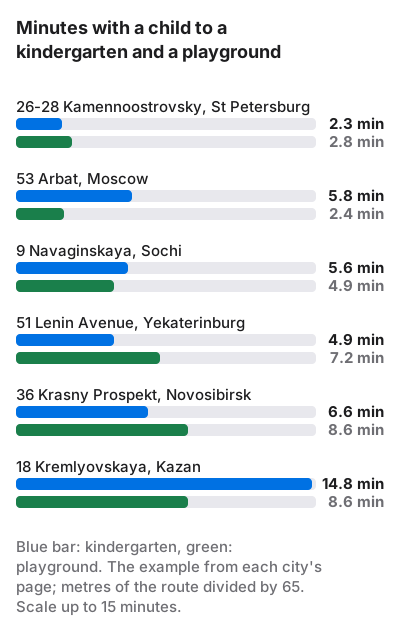
Let us take the examples shown on the pages of six Russian cities. The reports give the length of the walking route to the nearest places. Divide it by the family pace and you get minutes on level ground, without crossings or slopes.
| Address | To kindergarten | With a child | To playground | With a child |
|---|---|---|---|---|
| 26-28 Kamennoostrovsky Avenue, Saint Petersburg | 147 m | 2.3 min | 184 m | 2.8 min |
| 53 Arbat Street, Moscow | 376 m | 5.8 min | 155 m | 2.4 min |
| 9 Navaginskaya Street, Sochi | 363 m | 5.6 min | 321 m | 4.9 min |
| 51 Lenin Avenue, Yekaterinburg | 316 m | 4.9 min | 466 m | 7.2 min |
| 36 Krasny Prospekt, Novosibirsk | 426 m | 6.6 min | 562 m | 8.6 min |
| 18 Kremlyovskaya Street, Kazan | 963 m | 14.8 min | 556 m | 8.6 min |
For kindergartens, five addresses out of six have the minutes: even with a child they are within six or seven minutes and count almost in full. The exception is 18 Kremlyovskaya Street in Kazan: the nearest kindergarten, Nyanya Mari, is 963 metres away. With a child that is almost fifteen minutes, and only about a fifth of its value is left.
Playgrounds are another story. At 26-28 Kamennoostrovsky Avenue and 53 Arbat a playground is two or three minutes away and counts in full. At 9 Navaginskaya in Sochi it is 4.9 minutes, 80% of its value. At 51 Lenin Avenue in Yekaterinburg the playground is 466 metres away: an adult gets there in 5.8 minutes and it is worth 61%, but with a child it is 7.2 minutes and 33%. At 36 Krasny Prospekt and 18 Kremlyovskaya the playgrounds are 8.6 minutes away with a child and worth about 12%.
So the centre of a big city nearly always covers the kindergarten and by no means always the playground. A dense historic centre usually has fewer playgrounds than new estates, and not all of them are on the map.
What matters more nearby: a kindergarten or a playground
If your child is under three, start with the playground and the park. Look for a playground three to five minutes away with a pram, that is 200–300 metres, and a park within ten minutes. By then the kindergarten can be fifteen minutes away: it is the same walk every day, and easy to plan.
If your child already goes to a kindergarten and you do not want to change it, look at the walk to that one. Add it to the My places section: the report will count the minutes to it at your pace and show them separately from the nearest kindergarten on the map.
Weigh the school on a par with the kindergarten. In the family profile it is essential, with full value up to five minutes and zero from twenty, and in a few years it will become the family's main route.
What the map will not tell you about a kindergarten and a playground
- Whether the kindergarten has places and how to get in. That is decided not by distance but by the waiting list and the local rules.
- What age the playground is for. A slide for five-year-olds and a sandpit for toddlers look the same on the map.
- Whether the playground is fenced, whether it has shade and what it looks like after rain.
- What the crossing on the way to the kindergarten is like. The report adds the wait at big roads to the minutes, but a light without a button or a narrow pavement with a pram only show on the spot.
How the need windows, the profile weights and the essentials rule work is described on the page How it is calculated. Saint Petersburg addresses by district are on the Saint Petersburg page, and the six cities together in the rating for Russia.
Questions
How close should a playground be?
In the score a playground counts in full up to three minutes on foot, and its value is gone by ten minutes. With a child that is about 200 and 650 metres.
How far can a kindergarten be?
Up to five minutes a kindergarten counts in full, and it is zero from fifteen minutes, or from 18.75 in a city with a metro. With a child full value lasts up to 325 metres and is gone by 975 metres, or by 1220 in a city with a metro.
Why is the kindergarten not essential in the family profile?
A kindergarten is needed for a few years and chosen by where there are places. A playground, a school and a park are needed by every family every day, so without them the category loses another 40%.