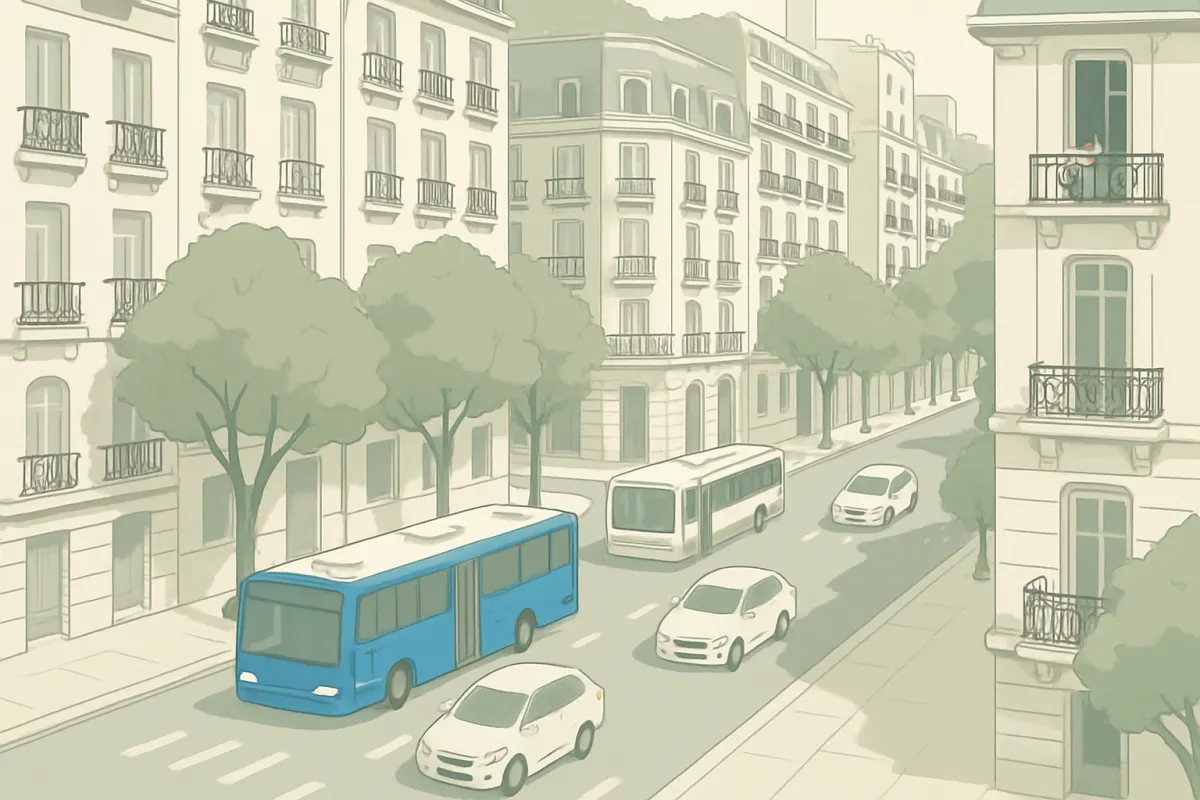
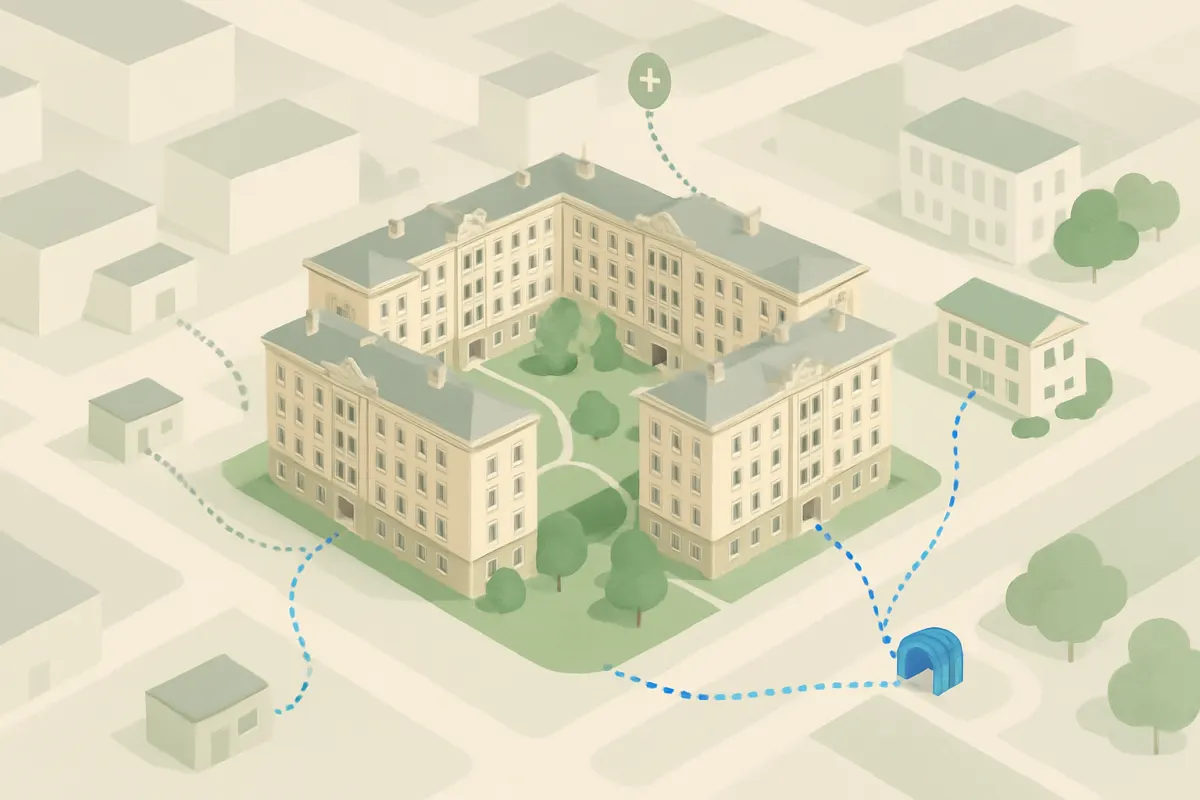
What to check right by your door: crossing, traffic, noise
The first crossing by your door is part of every route. How the report counts waiting, traffic alongside and noise, at Avenida de Mayo 825.
Score your own address
Everything this article covers, you can check on your own address: free, in a minute.
Free. The score at once, the full report after an e-mail sign-in.
Contents 6 sections
Every route starts at your front door
Looking at a map, people measure the distance to the shop, the school, the metro. They think less often about what all those routes have in common: the front door, the pavement outside it and the first crossing. If that stretch is hard going, it is added to every trip from home, dozens of times a week.
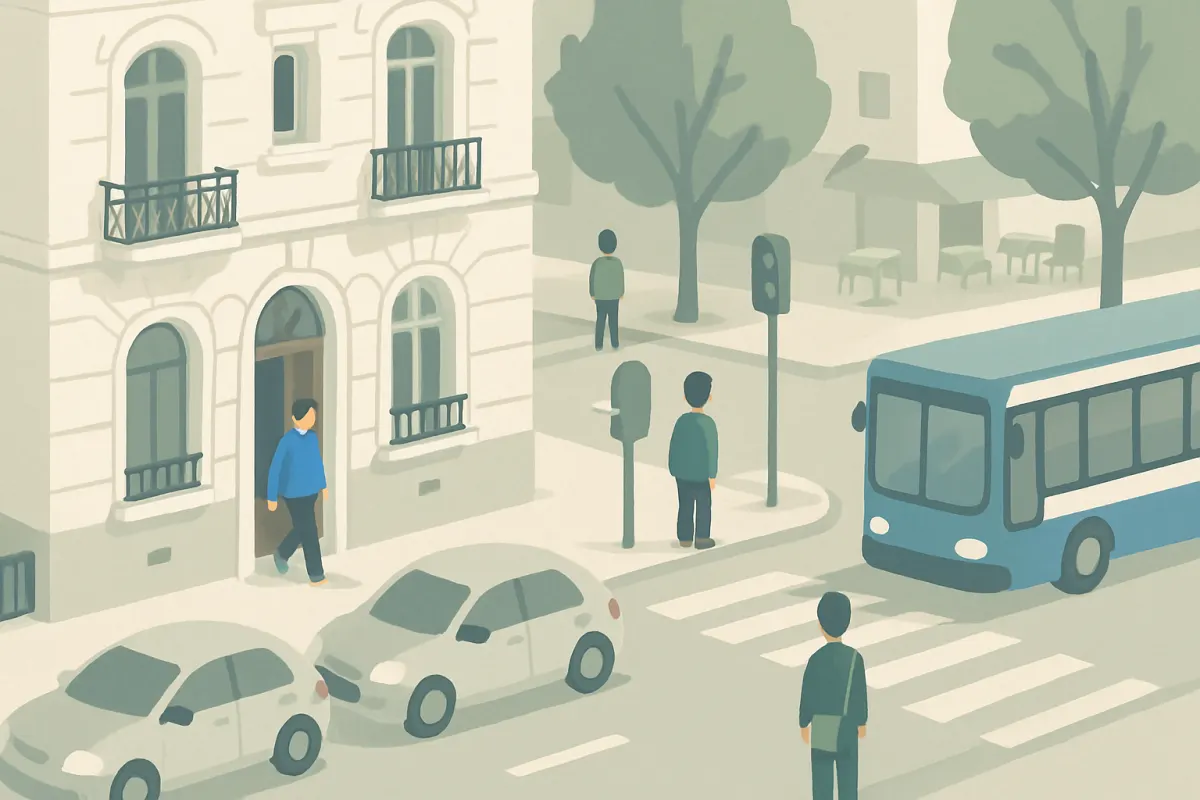
Let us see how this looks in a report. The address is Avenida de Mayo 825 in central Buenos Aires, report of 4 October 2026. It scores 83.3, in the band "Most errands on foot". The metro, Piedras station, is 46 metres from the door. Around it there are more than two hundred grocery shops and almost ninety pharmacies.
"Counts as" minutes
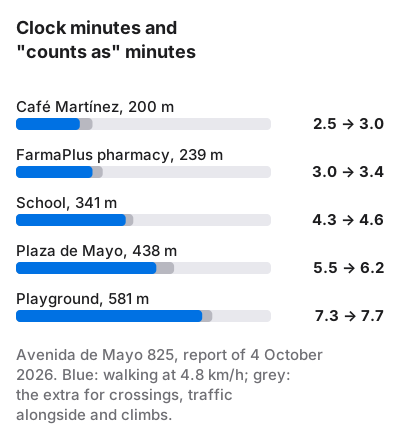
For every place the report builds a walking route along the streets and shows two numbers. The first is clock minutes at 4.8 km/h. The second, "counts as", includes what makes a walk longer than it is: climbs, waiting at crossings over big roads and stretches alongside traffic with no pavement.
Take Plaza de Mayo, 438 metres away. That is five and a half minutes of walking, but it counts as 6.2. On top come 27 seconds alongside traffic and 11 seconds of waiting at a crossing. A playground 581 metres away counts as 7.7 minutes instead of 7.3, and for a playground that is a lot: it counts in full only up to three minutes and is worth nothing at ten.
The same 15 seconds
Scroll through the list of places in the report and one number stands out. The Anahid bakery 193 metres away, a laundry 288 metres away, a school at 341, the Club Pelota y Esgrima sports club at 531: every route has exactly 15 seconds of waiting at crossings. It looks like one and the same crossing near the building that almost every route goes through.
Fifteen seconds seem a trifle. But they come with every outing: for bread, to school, to training. Say you leave home four times a day and come back as many times. That is two minutes a day at one crossing, about an hour a month.
In the section "How walkable is it here" the report sums this up in one line. At Avenida de Mayo 825, 94.3% of the time on the routes that count is ordinary walking on the flat. The rest goes on waiting at crossings, 6.6 minutes, climbs, 1.7, and traffic alongside, 1.1. Waiting is the largest of the extras here.
The last metres work the other way too. The entrance to Piedras metro station is 27 metres on foot from the door, less than half a minute. No waiting, no stretch alongside cars: public transport is closer here than the nearest cafe. The address scored 100 out of 100 for transport.
Fifteen metres to the roadway
The second thing the last metres decide is noise. The penalty is based on the class of the nearest road and the distance to it from the building's point. Avenida de Mayo is mapped as a main city street, and it is 15 metres from the address point. The estimated level is 68.4 decibels, and the penalty is 6.68 points out of a possible 10.
Without that penalty the address would score almost exactly 90, right on the edge of the band "Everything on foot". With it, the address stays in "Most errands on foot". One more line from the report: the nearest bar is 33 metres away, and of the four bars nearby one stays open late.
Noise is calculated for the building's point, not for a flat. If the bedroom windows face the courtyard, the room may be much quieter than the penalty suggests. Those are the last metres inside the building, and the report cannot see them: ask the landlord.
What to check in the last hundred metres
These things are in the report, but they are easy to miss if you look only at the score.
- Repeated waiting. If the nearest places show the same seconds at crossings, there is a crossing somewhere near the building that you will always have to use.
- The "traffic alongside" mark on the first places in the list. It means the way has a stretch along the flow of cars without a proper pavement. With a child or a pram that is worse than an extra minute.
- The distance from the building's point to the road in the noise block. Less than 20 to 30 metres to a main street almost always means a noticeable penalty.
- The address point on the map. If the entrance faces another street or a courtyard, the first metres of every route will be different, and it is worth opening a report for the neighbouring house number.
When the last metres matter most
For people who leave home many times a day: with small children, with a dog, working remotely with walks between calls. For people who walk slowly, because in the family and older person profiles waiting at crossings and stretches alongside cars cost more. And for anyone who sleeps badly with noise.
How "counts as" minutes and penalties work is described on the page How it is calculated. Addresses in the centre and other districts are collected on the Buenos Aires page.
Questions
What does "counts as" mean in the report's minutes?
It is the walking minutes plus an extra for climbs, waiting at crossings over big roads and stretches alongside traffic. This number decides how much a place is worth in the score.
Why does the noise penalty depend on the building's point and not on the flat?
The building's point is known for any address, while the side the windows face and the glazing are not. So for a flat facing the courtyard the real noise may be well below the penalty.
How do I find the crossing that slows down every route?
Look at the waiting seconds of the nearest places. If many show the same number, the way out of the building almost always goes through one crossing.
Can a nearby shop count for less than a distant one?
Yes, if the way to it goes through a long crossing or alongside traffic while the way to the distant one runs along a quiet street. The report compares places by "counts as" minutes, not by metres.