New build: what to check in the area before you move
Buying in a new build: how to check the area first. Akademichesky, Yekaterinburg: schools 99 of 100, transport 35.9, the metro a 34-minute walk.
Score your own address
Everything this article covers, you can check on your own address: free, in a minute.
Free. The score at once, the full report after an e-mail sign-in.
Contents 11 sections
- The building is new, the area is still growing
- Akademichesky: strengths and weak spots
- Transport: the most common gap in a new district
- What to check around a new build
- 1. Transport lines, not stops
- 2. School and kindergarten: built or promised
- 3. Groceries and a pharmacy
- 4. Construction around you
- 5. Industry and noise
- 6. How well the map knows the new district
- How to read the score of a new district
The building is new, the area is still growing
With a new build you can see a lot in advance: the layout, the floor, the view, the completion date. What you see less well is what will be outside the front door. A new district often takes years to finish, and in the first years it has buildings and car parks, while bus and tram lines, cafes and jobs arrive later or never arrive at all.
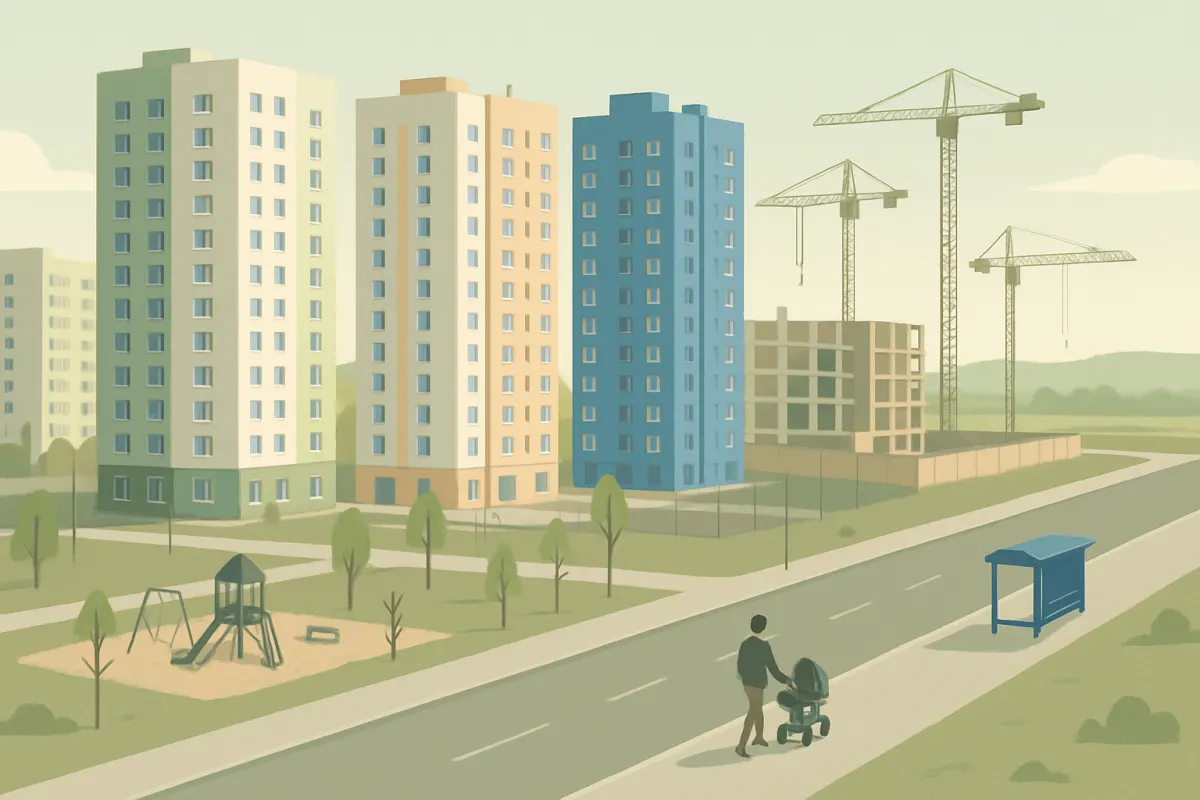
A report on an address shows the area as it is today. For a new build that matters: the developer's brochure and the real minutes to the nearest stop are two different things. Below we go through what to check, using the Akademichesky district of Yekaterinburg as the example, a large new district in the south-west of the city.
Akademichesky: strengths and weak spots
In the rating report of 3 October 2026, 40 Wilhelm de Gennin Street scores 78.3, in the band "Most errands on foot". Inside the score you see the picture typical of a new district.
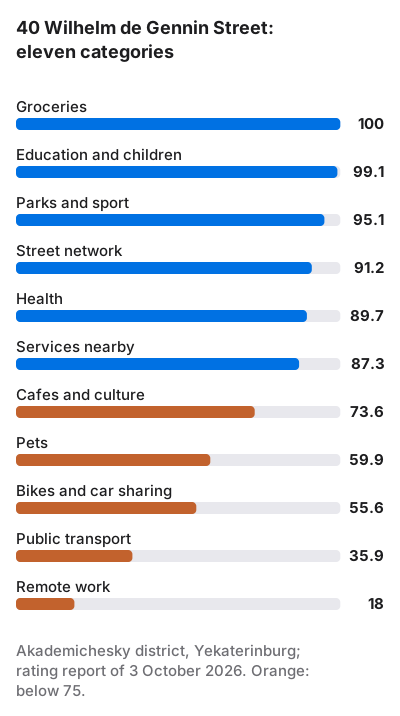
Groceries score 100, education and children 99.1, parks and sport 95.1, the street network 91.2. Shops, schools and kindergartens here were built together with the blocks, and the streets are easy to walk.
Three categories are weaker. Cafes and culture get 73.6, clearly less than in the centre. Remote work gets 18: there is hardly anywhere nearby to work outside your flat. And most important of all, public transport gets 35.9.
Transport: the most common gap in a new district
Three Akademichesky addresses from the reports of 3 October 2026 tell the same story. From 37 Wilhelm de Gennin Street and from 133 Krasnolesya Street the nearest metro station, Chkalovskaya, is a 34-minute walk. For 53 Akademika Sakharova Avenue no metro station within walking distance was found at all.
The district does have buses and trams, but what the calculation weighs is the lines and how often they run, not the number of stops. For someone who rides into the centre every day without a car, a score of 35.9 means changes and waiting. In the Without a car profile transport weighs 28 points, and when transport is weak the other categories shrink too, by up to a quarter.
For comparison, in the centre of Yekaterinburg, at 46 8 Marta Street, transport scores 100: Geologicheskaya station is two minutes away (rating report of 3 October 2026). Education there, though, is 57.8, far lower than in Akademichesky.
What to check around a new build
Here are six checks you can run on the building's address before you sign anything. If the building is not finished yet, use the address of a completed block next door or the nearest crossroads.
1. Transport lines, not stops
A stop outside the door is not yet transport. Look in the report at which lines leave from it and how often. Add your work or place of study as one of your own places: the report will show the direct lines and the travel time. If getting to work takes a change, count that time twice a day, five days a week. Twenty extra minutes each way add up to more than three hours a week.
2. School and kindergarten: built or promised
Akademichesky does have schools and kindergartens: from 37 Wilhelm de Gennin Street a school is 6 minutes away, from 133 Krasnolesya nine, from 53 Akademika Sakharova Avenue ten. The report sees what is already on the map. A school the developer promises to build in the second phase will not appear in it, and that is more honest than an advert.
3. Groceries and a pharmacy
In new districts the ground floors usually go to shops, and groceries here are two or three minutes away. But in the very newest blocks the ground floors sometimes stand empty for a year or two. Check the name of the nearest shop and pharmacy in the report: if they are in another block and your building is on the edge, the minutes will be different.
4. Construction around you
Next to a new build there is almost always the next one going up. The report has a section on construction nearby: how many sites are marked on the map around the building. Dust and machinery under your window for several years are not part of the score, but it is better to know about them before you buy.
5. Industry and noise
New districts are often built on former industrial land or next to working sites. The industrial penalty takes off up to 4 points if the edge of the zone is less than 300 metres away. The noise penalty takes off up to 10 points if it is louder than 55 decibels at the building. None of the three Akademichesky addresses has industry nearby, and noise takes off no more than 0.62 points.
6. How well the map knows the new district
The report takes every place from an open map. In new districts the map sometimes lags behind: a shop has already opened but is not on the map yet. Next to the score there is a confidence level, and when it is low the score is shown as "at least". For a new build, low confidence more often means a fresh map than an empty district, and it is worth checking on the spot.
How to read the score of a new district
The score of a new build is a snapshot of today. In five years Akademichesky may get a station or new lines, and transport will go up. Or it may not. You can buy a flat counting on something that does not exist yet, but then it is worth knowing how many points of the score you are betting on a promise.
A simple way: recompute the score without the weak category. If transport does not matter to you because you have a car, set it to zero in the weights panel. If it does matter, look at the Without a car profile: it shows how the district looks to someone who travels only by public transport.
The profile weights and the penalty thresholds are on the page How it is calculated. Other Yekaterinburg addresses, from the centre to Uralmash, are on the Yekaterinburg page and in the rating for Russia.
Questions
What should I check around a new build before buying?
The transport lines and how often they run, the school and kindergarten, the nearest shop and pharmacy, construction sites and industry nearby, and the report's confidence: the map of a new district can lag behind.
Can I check the area if the building is not finished yet?
Yes. Use the address of a completed block next door or the nearest crossroads: the report is computed from a point on the map.
Does the report count schools the developer promises?
No. The report only sees what is already on the map. A promised school appears in it once it is built.
Why does a new district score low on transport?
Most often the metro and frequent lines have not reached it yet. In Akademichesky, Yekaterinburg, transport scores 35.9 and the nearest metro station is a 34-minute walk.