No metro nearby: how to judge the bus and the tram
Is transport good at a home with no metro? Count lines, not stops, then check frequency and minutes on foot. Examples from Córdoba.
Score your own address
Everything this article covers, you can check on your own address: free, in a minute.
Free. The score at once, the full report after an e-mail sign-in.
Contents 7 sections
Not every city has a metro, but every city has transport
Listings say "five minutes to the metro", and that phrase makes flats easy to compare. Yet most cities have no metro at all, or it runs nowhere near the neighbourhood you want. People get to work by bus, trolleybus or tram, and the question "is transport any good here" gets harder to answer.

A stop under the window promises nothing by itself. It may be served by one line every half hour or by twenty lines every five minutes. Let us go through what to look at, using Córdoba in Argentina: the country's second-largest city, which has no metro at all.
Count lines, not stops
Our calculation scores public transport by the lines you can catch on foot. Each line gets a weight by mode: bus and trolleybus 1, tram and commuter rail 1.5, light rail 2, metro 3. A minibus counts as half a bus.
Distance matters too, and for a bus the window is short. A stop up to three minutes on foot counts in full; by twelve minutes its value drops to zero. Seven minutes from home a bus line is worth about half, nine minutes away about a quarter. For comparison, a metro station counts in full up to five minutes and falls to zero at eighteen.
The third adjustment is frequency. A line running every ten minutes counts as one. A frequent line can be worth up to one and a half, an infrequent one as little as half. Where the map does not know the frequency, we do not guess: the report shows a dash for that line.
How many lines a good score takes
The weights of all the lines near a home are added up, but the score saturates. The first lines add a lot, each further one less. Six bus lines right at the door, every ten minutes, give 63 out of 100; twelve give 86; eighteen give 95.
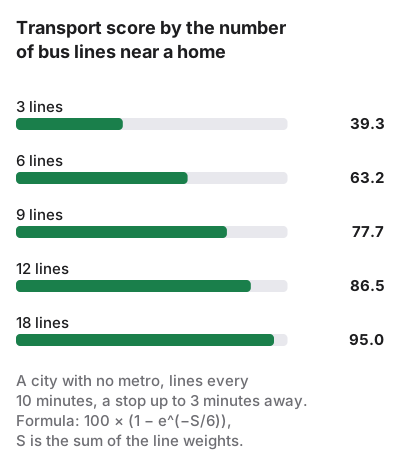
The practical lesson follows. The gap between three and six lines is huge, almost 24 points. Between twelve and eighteen it is under nine. If one building has three lines and another has twelve, they are completely different addresses. Twelve against twenty is a difference you will hardly feel.
Córdoba: 100 out of 100 without a metro
The example on the Córdoba page, Avenida Hipólito Yrigoyen 511 in Nueva Córdoba, scores 100 out of 100 for transport. The nearest stop, Palacio Ferreyra, is a minute from the door, and 88 lines run within a walk. A score like that needs no metro: a dense bus network is enough.
The rating shows the same. Obispo Trejo 242 in the centre gets 100 for transport, Belgrano 800 in Güemes 99.7. At the addresses in Güemes and Nueva Córdoba measured on 3 October 2026, the nearest stop is one to three minutes on foot.
There is an opposite lesson too. Avenida Rafael Núñez 4000 in Cerro de las Rosas scores 91.9 for transport, almost as much as the centre, yet only 52.3 overall. Groceries there score 44.7, services nearby 49.3, parks 30.6. A good bus will take you to the shop, but it does not replace a shop round the corner.
If you are choosing between a home by a tram and a home by a bus, compare the sum, not the mode. One tram line is worth one and a half bus lines, but two frequent bus lines are worth more than one tram line. The tram has something the calculation cannot see: it often runs on its own lane and gets stuck in traffic less.
The flip side: bus noise
Where there are many lines, there are big streets for them to run on. In Córdoba this shows in the penalties. On Avenida Hipólito Yrigoyen, measured on 3 October, noise takes 8.2 points out of ten, on Belgrano in Güemes 5.28, on Obispo Trejo y Sanabria 5.14. The example on the same avenue, Avenida Hipólito Yrigoyen 511, carries a penalty of 7.79.
That is no reason to rule out an address on an avenue. It is a reason to check which way the windows face. A flat deep inside the block, two or three minutes from the stop, loses a little on transport and can gain a lot in quiet.
How to judge the bus and the tram at a flat
- The number of lines within a walk. Fewer than three means weak transport; ten or more is good, even without a metro.
- Minutes to the stop. Up to three minutes a stop counts in full; at seven it is already worth half. Beyond ten minutes people walk there only when they have to.
- Frequency. Look at the frequency column in the report. If it shows dashes, check the timetable at the stop or in the operator's app.
- Where the lines go. Add your work or school to My places, and the report will show whether there is a direct line or a change.
- Evenings and weekends. Go to the stop at eight in the evening on a weekday and on a Sunday morning. The calculation sees the line but does not know whether it runs at night.
What the calculation does not know
There are no open timetables for the whole world. Where the map gives a frequency, we use it. Where it does not, ten rare minibuses can count as ten trunk lines. So in cities where minibuses are mapped without intervals, the transport at an address may be overrated.
A stop with no lines described is not lost either: it counts as one line at half value. That is better than nothing, but worse than knowing. If transport is what matters most to you, check it with your own eyes.
The weights of each mode and the saturation formula are on the page How it is calculated. The Córdoba addresses are collected on the city page, and the best addresses in Argentina are in the rating.
Questions
How do I judge transport when there is no metro nearby?
Count the lines within a walk, not the stops, and look at how often they run. Six frequent lines at the door give 63 out of 100, twelve give 86.
How many minutes to a bus stop is normal?
In our calculation a stop up to three minutes on foot counts in full, at seven minutes about half, and from twelve minutes not at all.
Is a tram better than a bus?
A tram line weighs 1.5 bus lines, light rail 2, a metro 3. A frequent bus line can be worth more than an infrequent tram.
Can an address without a metro score 100 for transport?
Yes. Avenida Hipólito Yrigoyen 511 in Córdoba scores 100: 88 lines within a walk, the nearest stop a minute away.