Courtyard or street windows: what noise changes
Courtyard or avenue: how much quieter a courtyard flat is by the noise formula, and why a building gets one figure. Six St Petersburg addresses.
Score your own address
Everything this article covers, you can check on your own address: free, in a minute.
Free. The score at once, the full report after an e-mail sign-in.
Contents 7 sections
One building, two flats
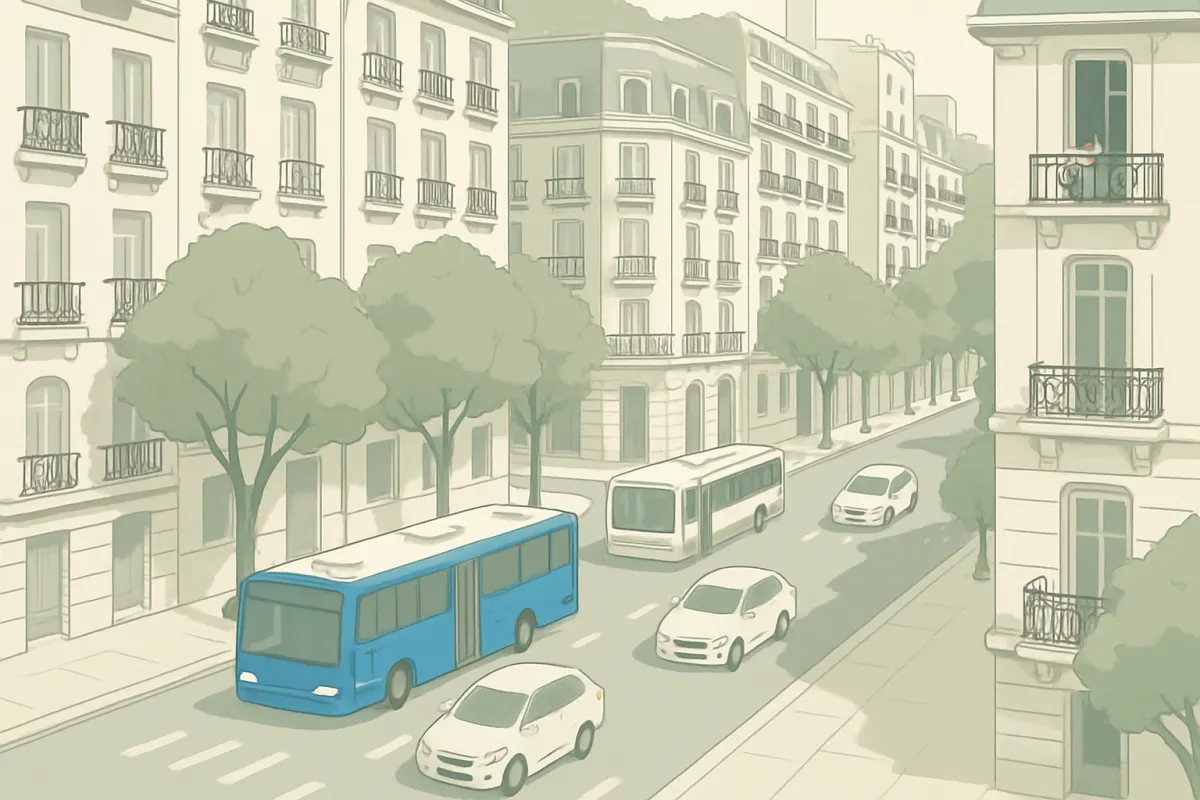
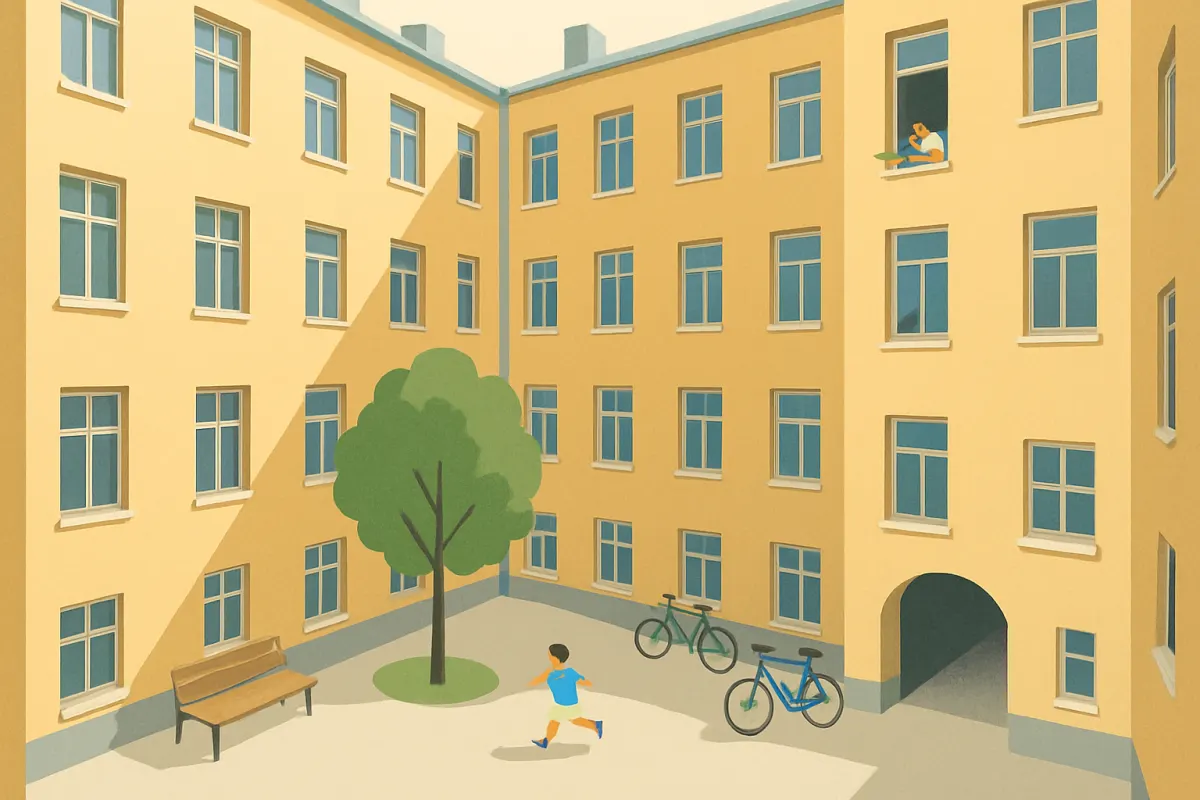
A St Petersburg building on an avenue usually has two kinds of flats. Some look out onto the avenue: trams, buses and cars until late at night. Others face the courtyard, sometimes a narrow well of a courtyard, where you hear the neighbours but not the street. They often cost the same, but life in them is different.

A Living Score report gives a building one noise figure. Below we look at where it comes from, what the same formula would give a courtyard and how to use this when you are choosing a flat rather than a building.
How noise is calculated for a building
The formula looks at the loudest road near the building's point on the map. A main city street gives 71 decibels at 10 metres, a district street 67, a local street 63. A road of four lanes or more gets plus 2 decibels, a street with a 30 km/h limit minus 2.
Every time the distance grows tenfold the level drops by 15 decibels. Distances under 15 metres are not counted: that is already the facade. From 40 metres, if the area is densely built, another 5 decibels come off for the first row of buildings. Each decibel above 55 costs half a point, up to a maximum of 10 points.
Facade and courtyard by the same formula
Now take a main street with no corrections and work out what the formula would give a window on the facade and a window on the courtyard. At the facade, 15 metres away, the level is 68.4 decibels and the penalty 6.68 points. At 25 metres the penalty is 5.02. A courtyard behind the first row of buildings, 40 metres away, gets 57 decibels and less than a point, 0.98. At 60 metres there is no penalty at all.
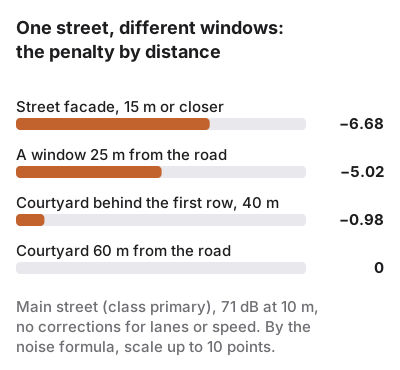
The gap between facade and courtyard is almost six points, and nearly half of it comes not from distance but from the building itself. Five decibels for a row of buildings is a rough correction: it knows nothing of wall thickness or the height of the courtyard. But the direction is right: one row of buildings cuts as much as moving twice as far from the road.
Why a building gets one figure
Noise is calculated for the building's point on the map, not for your window. The point goes where the address search found the building, so windows on the courtyard and on the street get the same figure. In the report a flat above the avenue and a flat above the courtyard well of the same building look alike.
So the noise penalty is an upper bound for the building. If it is high, the street-facing flats are probably noisy, while the courtyard flats may be noticeably quieter. If the penalty is zero, there is no loud road nearby at all, and the side of the building hardly matters.
Six St Petersburg addresses
Here is how it looks at addresses in three districts, calculated on 3 October 2026. Petrogradsky, Vasileostrovsky and Tsentralny are districts of old buildings with courtyards, and their noise varies a great deal.
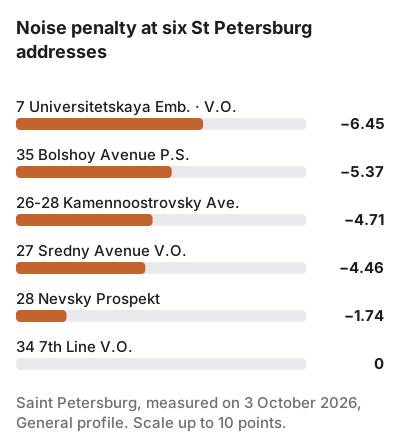
7 Universitetskaya Embankment loses 6.45 points: by the formula that is almost 68 decibels at the building's point. 35 Bolshoy Avenue of the Petrograd Side loses 5.37, 26-28 Kamennoostrovsky Avenue 4.71, 27 Sredny Avenue of Vasilyevsky Island 4.46. That is 64–66 decibels. For flats facing these avenues the figures look about right; for courtyard flats, judging by the calculation above, they are too high.
34 7th Line, in the same district as Sredny Avenue, loses nothing. There is no road nearby that the formula rates louder than 55 decibels. 49 Kronverksky Avenue and 23 Rubinstein Street also got zero: the word "avenue" in an address does not make a building noisy on its own; what counts is the class of the road and the distance to it. The three quiet addresses end up at 86.9, 89.5 and 88.2.
28 Nevsky Prospekt loses only 1.74 points, about 58.5 decibels. That happens when the building's point is a few dozen metres from the carriageway or there is a row of buildings in between. It is a reminder that the penalty depends on where the point sits on the map, and for a large building it is worth checking which road the report has tied it to.
| Address | District | Noise | Total |
|---|---|---|---|
| 7 Universitetskaya Embankment | Vasileostrovsky | −6.45 | 60.4 |
| 35 Bolshoy Avenue P.S. | Petrogradsky | −5.37 | 81.7 |
| 26-28 Kamennoostrovsky Avenue | Petrogradsky | −4.71 | 81.3 |
| 27 Sredny Avenue V.O. | Vasileostrovsky | −4.46 | 82 |
| 28 Nevsky Prospekt | Tsentralny | −1.74 | 86.5 |
| 34 7th Line V.O. | Vasileostrovsky | 0 | 86.9 |
How to choose a flat with quiet windows
- Look at the noise penalty in the report. If it is above four points, a street-facing flat will be noisy, and which side of the building you live on becomes the main question.
- In the block "What lowers the score" find which road is noisy and how many metres away it is. That is the side of the building to avoid.
- Ask which way the bedroom windows face. A kitchen on the avenue is easier to live with than a bedroom.
- Come to viewings twice: in the morning rush hour and late in the evening. Open a window and listen.
- Check the windows. Good double glazing changes the level inside the flat more than an extra ten metres from the road.
What the calculation does not see
The formula does not know the floor: high above an avenue the noise differs from the second floor. It does not know the traffic volume or the tram timetable, and a street marked on the map as a main one gets its decibels even with little traffic. A courtyard well with a restaurant's ventilation or a late-night bar also counts as quiet for the formula.
The table of levels, the corrections and the thresholds are listed on the page How it is calculated. Other addresses in the city are on the Saint Petersburg page, and all Russian addresses are in the rating.
Questions
How much quieter is a flat facing the courtyard?
By the noise formula, a courtyard behind the first row of buildings 40 metres from a main street gets about 57 decibels against 68.4 at the facade. That is a penalty of 0.98 points instead of 6.68.
Does the report take into account which way the windows face?
No. Noise is calculated for the building's point on the map, so courtyard and street windows get the same figure. You have to check the side of the building yourself.
What noise penalty counts as high?
From four or five points: that is 63–65 decibels at the building. The penalty is capped at 10 points, which corresponds to 75 decibels and above.