A flat for older parents: what to have within five minutes
Choosing a flat for older parents: a pharmacy, a shop, a clinic and a square within five minutes of their pace. Why it is 300 metres, not 400, in Moscow.
Score your own address
Everything this article covers, you can check on your own address: free, in a minute.
Free. The score at once, the full report after an e-mail sign-in.
Contents 7 sections
Your parents' five minutes are shorter than yours
When people look for a flat for their elderly parents, they usually check the floor, the lift and the renovation. The neighbourhood gets a glance at the map: a shop not far away, a clinic a couple of blocks off. But "not far" on a map is measured by your stride, and they are the ones who will walk it.
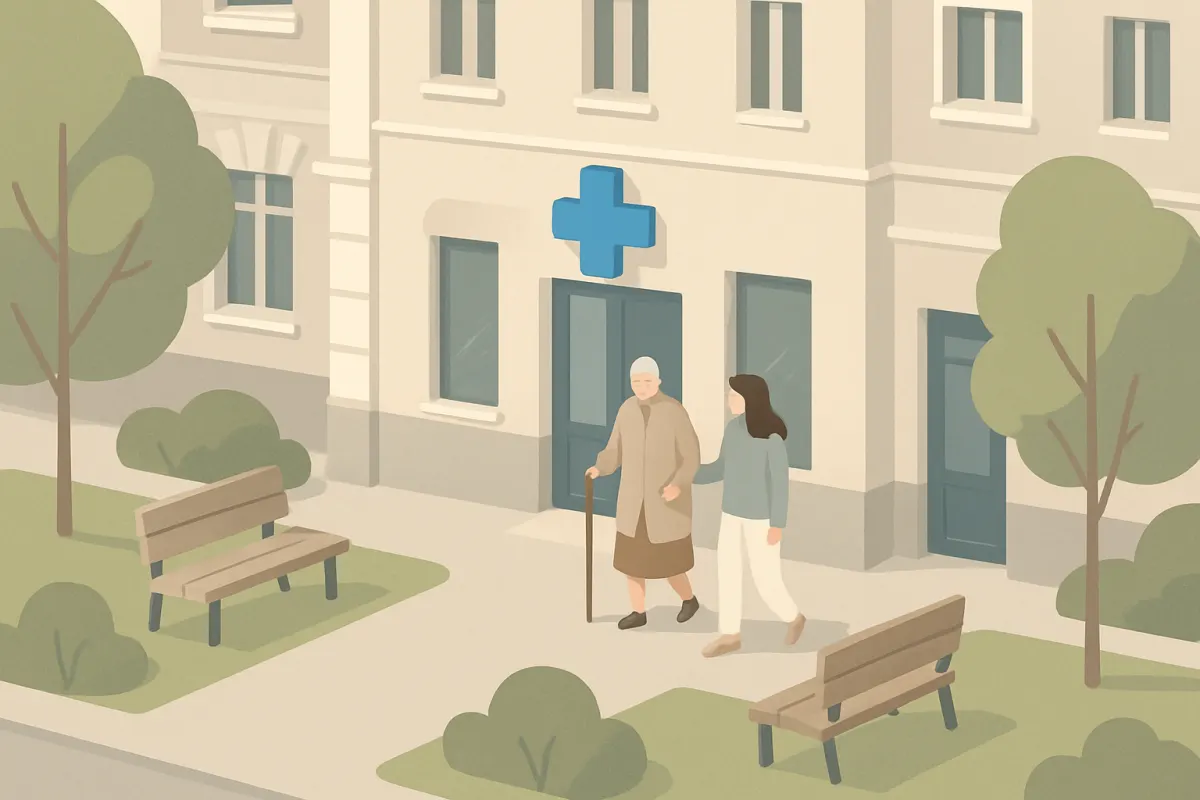
In the Living Score method an ordinary pedestrian covers 80 metres a minute, or 4.8 km/h. In the Older person profile the pace is 60 metres a minute, 3.6 km/h. Five minutes mean 400 metres for an adult and 300 for an older person. A shop 400 metres away is round the corner for you; for your mother with a shopping bag it is almost seven minutes each way.
Below: which places should fit into those five minutes, what the Older person profile changes in the calculation, and how to check a specific address before you buy or rent.
Four places they cannot do without
The General profile has two essential needs: a grocery shop and a pharmacy. The Older person profile has four: a clinic or doctor and a park or square join the shop and the pharmacy. If any of them is out of walking reach, its category loses that need's own share plus another 40% of what is left.
- Groceries. The most frequent errand, sometimes daily, and the way back is with a bag.
- Pharmacy. A prescription, blood pressure, a medicine that "ran out in the evening".
- Clinic or doctor. Tests, routine appointments, certificates: frequent visits, often in the morning.
- Park or square. A walk with places to sit down: for this profile benches count too.
A shop, pharmacy, clinic or park keeps its full value up to five minutes on foot. After that the value falls gradually: to zero at twenty minutes for the shop, pharmacy and clinic, and at fifteen for the park. The minutes are counted at the profile's own pace.
What the Older person profile changes
Weights. Health weighs 18 points out of 100 instead of 9, the street network 18 instead of 14. Groceries 11 instead of 9, services nearby 14 instead of 13, parks and sport 15 instead of 14. Education drops from 10 to 2, cafes and culture from 8 to 5, remote work to zero.
Pace. 3.6 km/h, a quarter slower than usual. The wait at crossings over big roads counts as 30% longer, and stretches along traffic with no pavement also cost more. Steps count as three times their length, and slopes cost more in this profile than in any other.
Public transport weighs 15 points instead of 18. It matters for getting to a hospital or to the children, but daily life depends on it less than on the pharmacy round the corner.
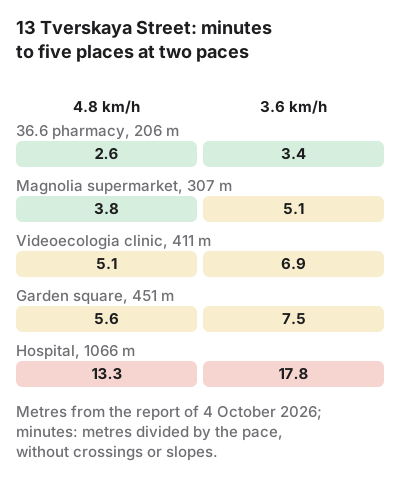
13 Tverskaya Street: same metres, other minutes
Take an address in central Moscow where everything is close: 13 Tverskaya Street, report of 4 October 2026. The nearest pharmacy, a 36.6, is 206 metres away, the Magnolia supermarket 307, the Videoecologia clinic 411, a garden square 451. The nearest hospital, the Ophthalmological Clinical Hospital, is 1066 metres away.
Do the sums yourself: metres divided by speed. For an ordinary pedestrian the pharmacy is 2.6 minutes away, the shop 3.8, the doctor 5.1, the square 5.6. For an older person the pharmacy is 3.4 minutes away, the shop 5.1, the doctor 6.9, the square 7.5. Crossings and slopes are left out, so the report's minutes are slightly longer.
Even in the centre of Moscow only the pharmacy fits into five minutes at an older person's pace, and the shop sits right on the line. That is not a bad address: a clinic seven minutes away and a square eight away still keep a good part of their full value. But the gap between "close" and "close for Mum" shows already here.
Benches score 100 in this report: the map has plenty of them along the streets around the building. In the General profile benches are not part of the score; in the Older person profile they are, because a place to sit on the way is part of the walk.
A residential district: where the minutes go
In Ramenki, at 8 Mosfilmovskaya Street, the grocery shop is 8 minutes away on foot and the station 24. Those are an ordinary pedestrian's minutes from the report of 3 October 2026, with a total score of 60.0. At 27 Lomonosovsky Prospekt the shop is 11 minutes away.
Convert them to an older person's pace: time grows by 80/60, a third. Eight minutes become almost eleven, eleven almost fifteen. In the calculation such a shop loses much of its value; in life it means fewer trips for groceries and heavier ones home.
For comparison, at 28 Komsomolsky Prospekt in Khamovniki the shop is 4 minutes away, and the park and the metro station one minute (report of 3 October 2026). Health there scores 97.6 out of 100, at 34 Michurinsky Prospekt in Ramenki 98.5 (rating reports of 3 October 2026). Doctors are almost everywhere in Moscow; the difference is in the shops and how far they are.
How to choose a flat for older parents
- Run the report with the Older person profile from the start. With the General profile the minutes are a quarter too optimistic.
- Check four lines: groceries, pharmacy, clinic, park. Anything over ten minutes at their pace becomes a reason to stay in.
- Look at the gradient. You will not notice a slope of a few per cent; for this profile it costs more than for any other.
- Look at the crossings. A wide street without traffic lights between home and pharmacy lengthens every trip.
- Add your own places: the clinic your parents are registered with, and your home if you will visit them on foot.
The last point matters. The nearest doctor in the report shows that health care is close, but your parents may be registered with a different clinic. The My places block shows the minutes to it, and the transport lines if it is too far to walk.
What the report does not know
The report cannot see the lift, a ramp at the entrance, the height of the porch steps or the state of the pavement in winter: those are checked only on site. Whether the nearest clinic accepts your parents' insurance also has to be found out separately.
Noise and air are in the report, and for someone who spends nearly all day at home they matter more than for someone at work. In Khamovniki the air penalty is 7.47 points, in Ramenki 5.92 (reports of 3 October 2026): these are yearly averages for the area around the building, not for a particular courtyard.
The weights of all six profiles and the rules for essential needs are on the page How it is calculated. The Moscow addresses used here are on the Moscow page and in the rating for Russia.
Questions
What should be near a flat for an older person?
A grocery shop, a pharmacy, a clinic and a square with benches. In the Older person profile all four are essential, ideally each within five minutes at their pace.
How far does an older person walk in five minutes?
In our calculation about 300 metres: the profile's pace is 3.6 km/h. An ordinary pedestrian covers 400 metres in the same time.
How does the Older person profile differ from General?
Health weighs 18 points instead of 9, the street network 18 instead of 14, the pace is a quarter slower, slopes and steps cost more, and a clinic and a park become essential.
Does the report take the lift and a ramp into account?
No. The report measures the way from the front door to the places around; the entrance and the flat need checking on site.