Barcelona: Eixample or Gràcia, which is easier to live in
Eixample or Gràcia: six Barcelona addresses in minutes on foot. Average scores of 90.0 and 90.4. How the metro, parks and Passeig de Gràcia noise differ.
Score your own address
Everything this article covers, you can check on your own address: free, in a minute.
Free. The score at once, the full report after an e-mail sign-in.
Contents 7 sections
The grid and the village
Eixample and Gràcia are neighbours, and yet it is hard to find two more different districts. Eixample is Ildefons Cerdà's grid: identical blocks with chamfered corners, wide straight streets, Passeig de Gràcia with its shops and Gaudí buildings. Gràcia sits higher up the slope, a former separate village: narrow streets, small squares, bars under the plane trees. The districts page lists every place where we scored addresses.
Everyone who moves to Barcelona argues about what living in them is like. We scored three addresses in each district. All reports are of 3 October 2026, General profile.
The short answer: by score the districts are almost equal, 90.0 for Eixample and 90.4 for Gràcia on average. Four of the six addresses are in the Everything on foot band, the other two just below, at 86.5 and 89.6. What sets them apart is not the score but what it is made of.
Eixample: the metro by the front door
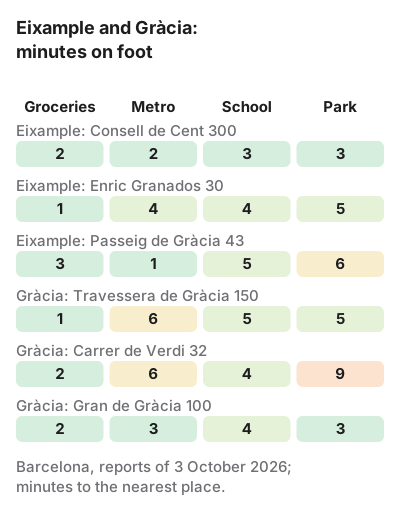
Carrer del Consell de Cent 300 gets 92.4, the best of the six. Groceries 2 minutes away, Passeig de Gràcia metro 2, a school 3, a park 3. There is no noise: part of Consell de Cent has been given over to pedestrians in recent years, and there are noticeably fewer cars on it.
Carrer d'Enric Granados 30 scores 91.1. Groceries a minute away, Provença station four, a school four, a park five. Enric Granados is quiet too, with cafes and trees, and has no noise penalty.
Passeig de Gràcia 43 gets 86.5. By the minutes it is the best: the metro one minute away, groceries three. But the boulevard is a stream of cars, and noise takes off 4.52 points.
The sample report for the same building shows what Eixample lacks. Transport 100, work outside the home 96, bikes 86, but parks and sport 78.7. The nearest small square is 424 metres away, and there is no large park or woodland within walking distance of the boulevard at all. Cerdà's grid was designed with green courtyards inside the blocks, but most of them have been built over or closed off.
Gràcia: squares instead of avenues
Travessera de Gràcia 150 gets 91.1. Groceries a minute away, a school five, a park five, Fontana station six. Carrer de Verdi 32 scores 90.5: groceries two minutes away, a school four, but the metro is six minutes away and the park nine.
Carrer Gran de Gràcia 100 gets 89.6. It is the district's main street, transport runs along it, and noise takes off 1.68 points. On the other hand, the metro is three minutes away and a park three.
The rating report for Plaça de la Virreina, one of Gràcia's main squares, breaks the score down by category. Education and children 100, remote work 99.7, cafes and culture 99.7, pets 98.4. The weakest are parks and sport, 83.3, and services nearby, 86.4. Final score 90.6, no noise.
The metro against the squares
The main difference between the districts shows in the minutes to the metro. In Eixample the station is one, two and four minutes away. In Gràcia, three, and six twice. Gràcia's metro runs along its edges and under the main street, and there are few stations inside the district.
For those who commute every day, that is two to four extra minutes each way. Twice a day, five days a week, it adds up to twenty to forty minutes a week. Not much, but it is a difference in Eixample's favour.
Otherwise, Gràcia is stronger where squares and short distances matter: playgrounds, schools, cafes, places to work. Noise in both districts depends on the street. There are quiet streets in each, while Passeig de Gràcia and Gran de Gràcia lose points on noise.
Parks: the weak spot of both districts
None of the six addresses scores as much for parks as for transport or cafes. On Passeig de Gràcia the category is 78.7, at Plaça de la Virreina 83.3. These are dense districts where greenery comes down to small squares and street trees.
If you need a large park for running or walking the dog, add it as one of your places and look at the minutes. For Gràcia that could be Park Güell further up the slope, for Eixample the Parc de la Ciutadella. The climb into Gràcia and above is taken into account in the report: every uphill minute counts for more.
| Address | District | Score | Noise | Metro, min |
|---|---|---|---|---|
| Carrer del Consell de Cent 300 | Eixample | 92.4 | 0 | 2 |
| Carrer d'Enric Granados 30 | Eixample | 91.1 | 0 | 4 |
| Passeig de Gràcia 43 | Eixample | 86.5 | −4.52 | 1 |
| Travessera de Gràcia 150 | Gràcia | 91.1 | 0 | 6 |
| Carrer de Verdi 32 | Gràcia | 90.5 | 0 | 6 |
| Carrer Gran de Gràcia 100 | Gràcia | 89.6 | −1.68 | 3 |
Eixample or Gràcia: which to choose
- Taking the metro across the city every day: Eixample, an address near a station, but not on Passeig de Gràcia or other big streets.
- With children: Gràcia, a quiet street by a square. Schools, playgrounds and nurseries are denser there.
- Working from home: both districts work. Places to work outside the home score over 95 at Plaça de la Virreina and on Passeig de Gràcia.
- Quiet: a narrow street in Gràcia or the pedestrian part of Consell de Cent, not the boulevard.
The spread within each district is more noticeable than between them. Passeig de Gràcia 43 and Consell de Cent 300 are both by Passeig de Gràcia station, yet they differ by almost six points. So look at the specific building and its street.
How to check a flat in Barcelona
Take the address from the listing and look in the report at the noise penalty and the minutes to the metro station. Add your own places: the office, a school, a large park. Put the two finalists side by side on the comparison page.
Other Barcelona districts, from Poblenou to Sarrià, are collected on the Barcelona page and in the rating for Spain. The How it is calculated page explains how noise, transport and climbs are counted.
Questions
Where is it better to live in Barcelona: Eixample or Gràcia?
By score the districts are almost equal: 90.0 for Eixample and 90.4 for Gràcia on average across our addresses. Eixample has the metro closer; Gràcia has schools, playgrounds and cafes more densely packed.
Is it noisy to live on Passeig de Gràcia?
The address Passeig de Gràcia 43 loses 4.52 points on noise. The neighbouring Eixample streets, Consell de Cent and Enric Granados, lose nothing.
Are there parks in Eixample and Gràcia?
Few large ones. The parks category is 78.7 on Passeig de Gràcia and 83.3 at Plaça de la Virreina: the greenery is mostly in small squares.