Traffic and air: how to check a street before moving
How a busy street affects the air and noise at home: in Madrid the noise penalty runs from 0 to 5.64 points on nearby streets. What to read in a report.
Score your own address
Everything this article covers, you can check on your own address: free, in a minute.
Free. The score at once, the full report after an e-mail sign-in.
Contents 7 sections
Two traces of one street
Cars under the window leave two traces: noise and exhaust. In a report they sit on separate lines and are measured in different ways. Air comes from an air quality model on a grid; noise is worked out from a specific road to the point where the building stands. To know what a busy street will cost you, read both lines and know what each of them can and cannot see.
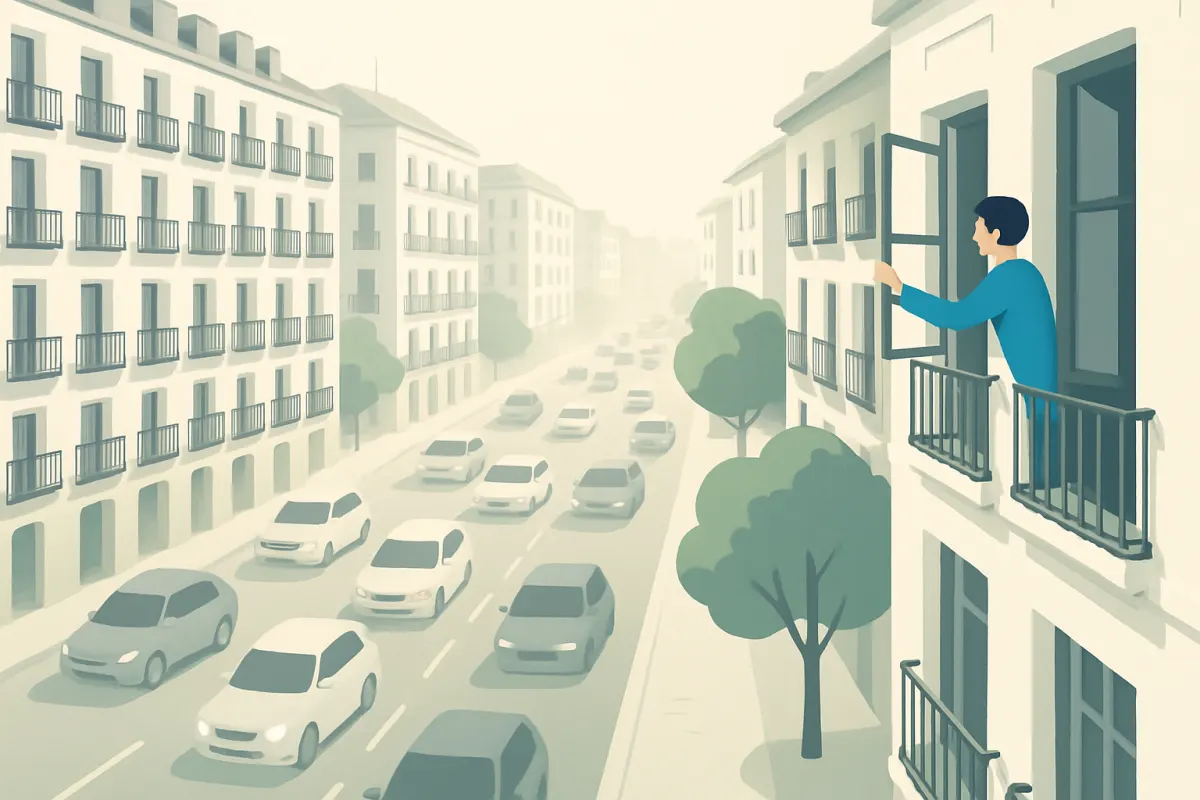
Madrid makes a good example. In our measurements the air is the same at every address in the city, while the noise changes from street to street. That shows clearly which of the two lines actually picks up your street.
Air: nitrogen dioxide from cars
For air the report looks at two pollutants: fine particles, PM2.5, and nitrogen dioxide, NO2. NO2 is almost entirely a trace of road traffic. Each pollutant has a scale. PM2.5 up to 5 micrograms per cubic metre costs nothing, and 10 costs 1.5 points. NO2 up to 10 micrograms costs nothing, 20 costs 1 point and 40 costs 3. Between those points the penalty grows in a straight line, and the larger of the two numbers is the one that counts.
Take Gran Vía, 28 in the report of 4 October 2026. The annual mean of PM2.5 there is 9.1 micrograms, which is 1.23 points. NO2 is 23.6 micrograms, which is 1.36 points: 1 for the first 20 micrograms and another 0.36 for the 3.6 above them. Nitrogen dioxide gives the larger number, so the address's air penalty is 1.36. In Madrid it is traffic, not background dust, that does most of the damage to the air.
| Pollutant | Annual mean, µg/m³ | Penalty, points |
|---|---|---|
| PM2.5 | 9.1 | 1.23 |
| NO2 | 23.6 | 1.36 |
The same 1.36 appears at all seven Madrid addresses of our neighbourhood measurements of 3 October: on noisy Velázquez and in a quiet side street of Chamberí alike. The model works in cells larger than a block, and it cannot tell one street inside a cell from another. So the air line speaks about the city and a large part of it, not about your building.
Noise: the road and the metres to it
The report computes noise from the class of the nearest road and the distance to it. A main city street 10 metres away gives 71 decibels by the formula, a local street 63 and a residential street 55. Every tenfold increase in distance takes 15 decibels off the level. The penalty is half a point for each decibel above 55, capped at 10 points.
At Gran Vía, 28 the nearest road is Gran Vía itself, 17 metres away. On the map this stretch is tagged as a local street, and the formula gives 61.6 decibels: a penalty of 3.31 points. The figure depends on how the street is tagged on the map, not on how many cars use it. Keep that in mind both ways: a quiet street with a loud class, and a busy one with a quiet class.
Salamanca: three streets, three different penalties
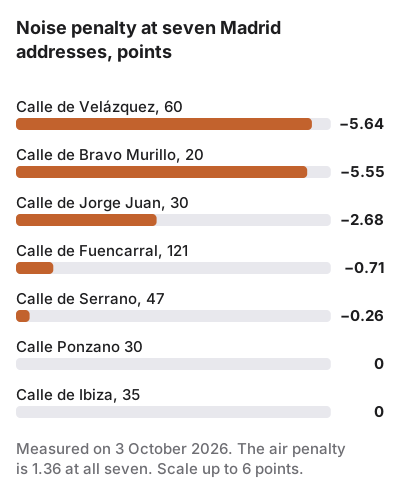
The Salamanca district looks uniform: a regular grid, shops and clinics on the ground floors. Yet on noise our three addresses there are far apart. Calle de Velázquez, 60 loses 5.64 points, about 66 decibels by the formula. Calle de Jorge Juan, 30 loses 2.68, about 60. Calle de Serrano, 47 loses only 0.26: about 55.5 decibels by the formula, right on the threshold.
The final scores follow this order only in part: 85.3 for Velázquez, 88.4 for Jorge Juan, 87.9 for Serrano. The places around each address differ, and noise is just one of the reasons. Still, the 5.64 points lost on Velázquez are more than the whole gap between the first and the last of these addresses in the final score.
Chamberí and Retiro: a quiet side street next to an avenue
Chamberí tells the same story. Calle de Bravo Murillo, 20 stands on a wide street and loses 5.55 points. Calle de Fuencarral, 121 loses 0.71, and Calle Ponzano 30 loses nothing. Ponzano scores 92.3, the best result in the district in our measurements, and Bravo Murillo 85.2. One district, a gap of seven points, and most of it comes from noise.
Calle de Ibiza, 35 in Retiro loses nothing to noise and scores 95, the best final result among our Madrid addresses. Its air penalty is the same 1.36 as everywhere else. So in Madrid the difference between a quiet street and a noisy one is made by the noise line, not by the air line.
How to check a street before you move
Open the report for the address and find the block "What lowers the score". It names the road the noise is counted from, its class, the distance in metres and the decibels. Then go through four steps.
- See what drives the air penalty: particles or nitrogen dioxide. If it is NO2, the source is traffic, and a building deep inside a block breathes easier than its cell suggests.
- Compare the road class with what you see on the spot. A street tagged as a main road gets its decibels even at night with no cars on it.
- Check which side of the building the flat faces. The calculation starts from a point on the map, and windows onto a courtyard can be much quieter than windows onto an avenue.
- Visit twice: at rush hour and late in the evening. Neither the model nor the formula knows the timetable of the buses or the bin lorries.
What the calculation cannot see
Open data has no traffic volumes, so the noise rule looks at the class of the road. It knows nothing about jams, traffic lights or cars accelerating away from them either. The air model does not know that your building stands in a quiet courtyard while the one next door is on a junction: they share a cell.
On the other hand, both figures work the same way in every city and can be checked by hand. If the noise penalty looks too high, check the class of the street on the spot. If the air penalty is high across the whole city, moving one street over will not change it, while choosing a quieter part of town changes the final score at once.
The air scales, the road levels and the corrections are described on the page How it is calculated. All the Madrid addresses in this article are on the Madrid page, and the other Spanish addresses are in the rating for Spain.
Questions
How can I tell whether the air on a street is polluted?
Open the report for the address: the air line shows the annual means of PM2.5 and NO2 and the penalty. If NO2 gives the larger number, the main source is road traffic.
Why do different streets in one city get the same air penalty?
The model works in cells larger than a block. The seven Madrid addresses in our measurements share one penalty, 1.36 points.
How many points does a noisy street take off?
Up to 10 points. At our Madrid addresses it ranges from 0 to 5.64: half a point for every decibel above 55.
Is the number of cars taken into account?
No. Noise is computed from the class of the road on the map and the distance to it, so it is worth seeing the street at rush hour.