How long the walk to a stop across the road is: crossings
A stop "right across the road" can be a 440-metre walk if the crossing is far away. How the score counts crossings and what to check before a viewing.
Score your own address
Everything this article covers, you can check on your own address: free, in a minute.
Free. The score at once, the full report after an e-mail sign-in.
Contents 7 sections
"Bus stop right across the road"
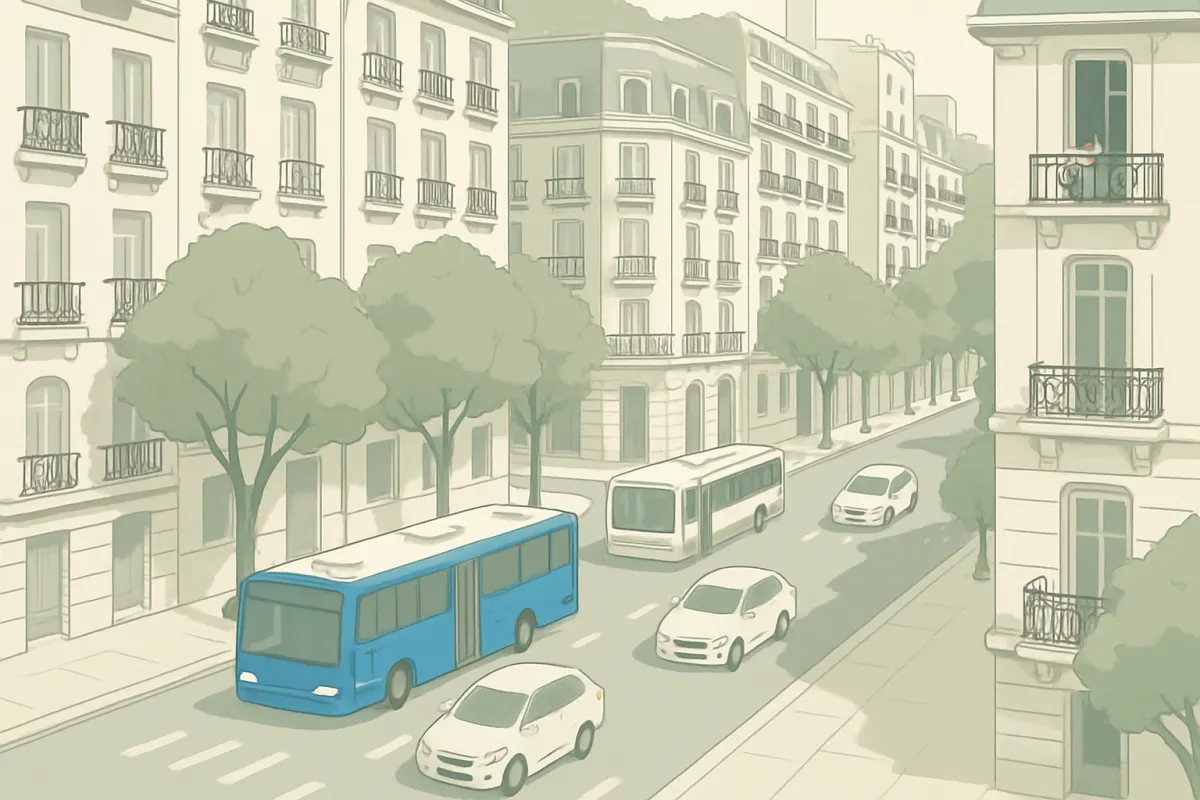
That is what listings say, and on the map it is true: forty metres from the entrance to the shelter. But if there is an avenue with a crash barrier down the middle in between, and the nearest crossing is two hundred metres away, in the morning you will walk not forty metres but four hundred and forty. And wait at the lights as well.
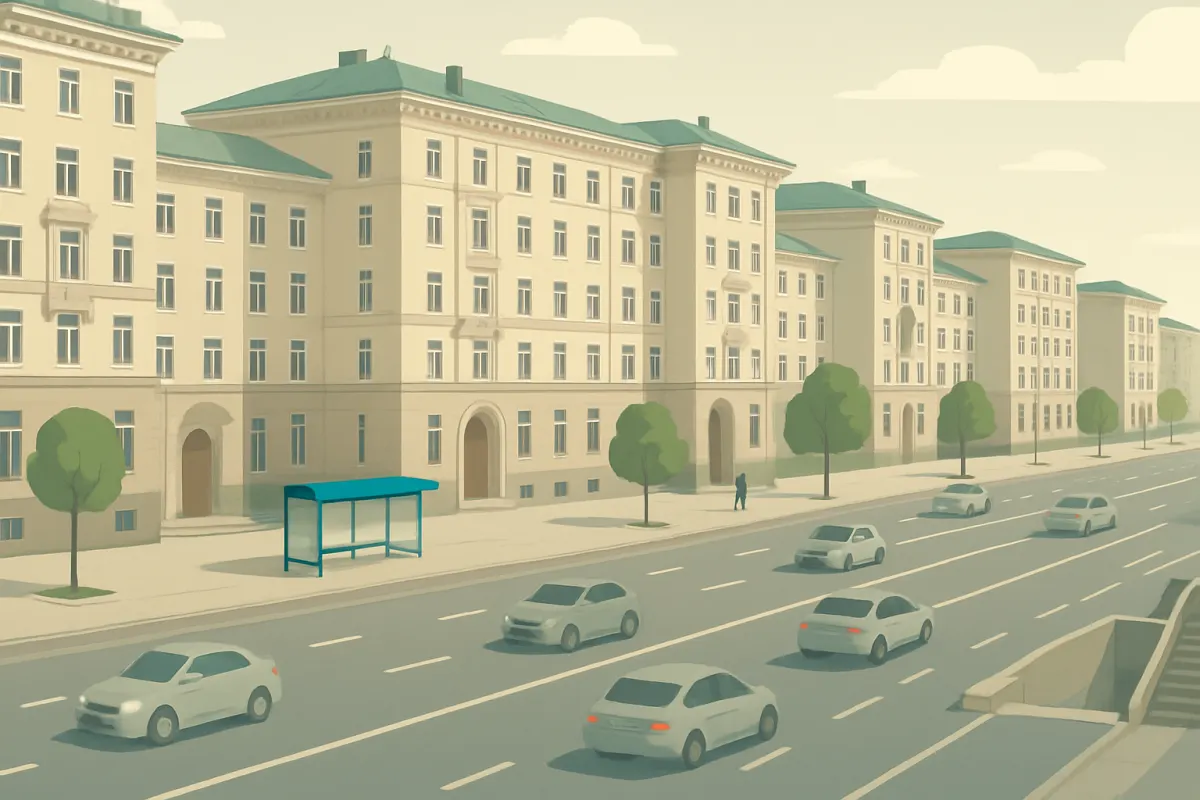
Let us see how the score handles this with one made-up but typical example and one real address: 13 Tverskaya Street in Moscow, report of 4 October 2026.
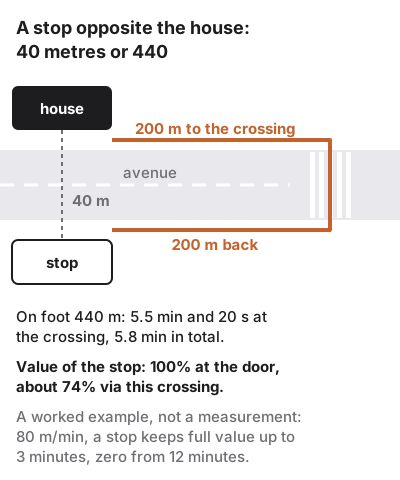
How a crossing changes the minutes
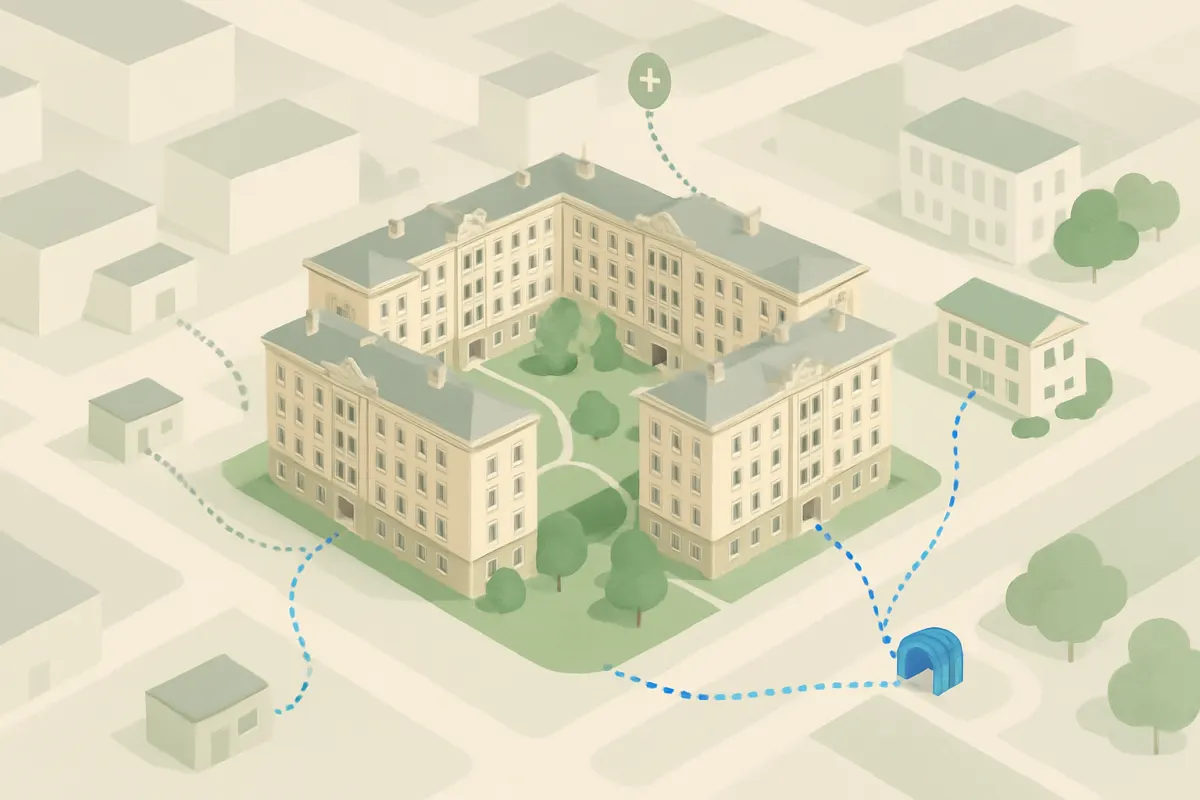
The score does not count the straight-line distance but the walking route along streets and crossings. In our example that is 200 metres to the crossing, 40 metres across the avenue and 200 metres back, 440 metres in all. At 80 metres a minute that makes 5.5 minutes. Then comes the wait at the crossing. In the report for 13 Tverskaya it is most often 20 seconds; take the same and you get 5.8 minutes.
For a bus or tram stop that is a lot. Its full value lasts up to three minutes on foot and fades to nothing by twelve. A stop right at the door is worth 100%, the same stop via a crossing 200 metres away about 74%. At the pace of a family with a child, 3.9 km/h, with a wait 20% longer, it comes to 7.2 minutes and 52%.
So a quarter of the stop's value, and for a family half, goes on one road that cannot be crossed where you would like. The map in the listing does not show this.
An underpass: shorter, but with stairs
Sometimes the crossing is right opposite the house, but it is an underpass. The route is shorter, but it has two flights of stairs, down and up. In the General profile steps count as one and a half times their length, for a family with a pram or an older person three times.
For an adult with a rucksack such a crossing is hardly different from one at street level. For a pram or a shopping trolley it may cost as much as the detour to the lights, sometimes more. So the same stop will be further away in a report with the Family with a child profile than with General, and that is not a mistake but how you will actually walk.
13 Tverskaya: crossings on real routes
At 13 Tverskaya the nearest stop, Tverskaya Ploshchad, is 168 metres away. There is no crossing on the way, and it counts as 2.1 minutes, within full value. The nearest bank, a VTB, is even closer, 156 metres, but there is a crossing on the way, and it counts as 2.3 minutes: 1.95 of walking and 20 seconds of waiting.
The longer the route, the more likely it has a crossing. A post office 762 metres away counts as 9.9 minutes instead of 9.5. The TsUM department store is 1075 metres and 28 seconds of waiting away, 13.9 minutes in all. Separately these are half-minutes, but they sit on the roads you will walk every day.
There are 4.14 kilometres of major roads around the address, and the map knows 255 crossings on the walking network. In the centre of a big city there is nearly always a crossing; the question is where it stands relative to your door.
Metro versus bus: different yardsticks
Transport in the score is counted by lines, not stops, and different kinds have different yardsticks. A metro line weighs three times a bus line, a tram line one and a half times. The metro counts in full up to five minutes on foot and loses its value by 18, later in a big city. A bus or tram counts in full only up to three minutes and is zero from twelve.
That is why five extra minutes to a bus hit the score harder than the same five minutes to the metro. If a listing promises a stop nearby, check what kind of transport it is and how long the walk really is.
The flip side: a stop under the window
A stop at the entrance usually means a big street by the building. And the score takes points off for the street: the noise penalty starts at 55 decibels at the building's spot, half a point per decibel, at most ten points.
Tverskaya Street runs 86 metres from the point of 13 Tverskaya. The estimated level is 54 decibels, so there is no penalty. Suppose another building stands right on the avenue at 65 decibels: that is minus five points. A nearby stop will not save such a building.
The best option is a flat one block from the big street, with a crossing or a stop on your own side. The noise is already lower, and transport is a couple of minutes away.
How to check a stop before a viewing
- Open the report and find the nearest stop in the transport category. If "counts as" is noticeably more than the metres divided by 80, there is a crossing or a climb on the way.
- Look at the route on the report's map. A loop to the lights and back shows at once.
- Check which lines leave from the stop and where they go. One line in the right direction is more useful than five going elsewhere.
- Look at the noise penalty. If it is above five points, the stop is probably on the same street as the windows.
- Walk the route yourself at rush hour. In the morning the wait at the lights can be longer than in the calculation.
How minutes, waiting at crossings and the weight of each line are counted is described on How it is calculated. Moscow addresses with minutes to the station and noise penalties are on the Moscow page.
Questions
Does the score take road crossings into account?
Yes. The route follows streets and crossings, and the wait at a crossing over a major road is added to the minutes. At 13 Tverskaya that is usually 20 seconds per crossing.
Which is better: a bus by the house or the metro ten minutes away?
A metro line weighs three times a bus line, and its value lasts longer: full up to five minutes, zero only from 18, and later still in a big city. A bus starts losing value after three minutes.
Why can a nearby stop lower the score?
The stop itself does not. The noise of the big street it usually stands on does: a penalty of up to 10 points if it is louder than 55 decibels at the building.