How to pick a quiet walking route: crossings and big roads
Why 600 metres along a quiet street can be closer than 400 metres along an avenue. How the score counts crossings and big roads, using Buenos Aires.
Score your own address
Everything this article covers, you can check on your own address: free, in a minute.
Free. The score at once, the full report after an e-mail sign-in.
Contents 7 sections
Why the short way is not always closer
The map says the pharmacy is 400 metres away. But those 400 metres run along a six-lane avenue, with a crossing at a light where you stand for a minute. Another pharmacy is 600 metres away, but the way there is a quiet street with no lights. Which of them is really closer?
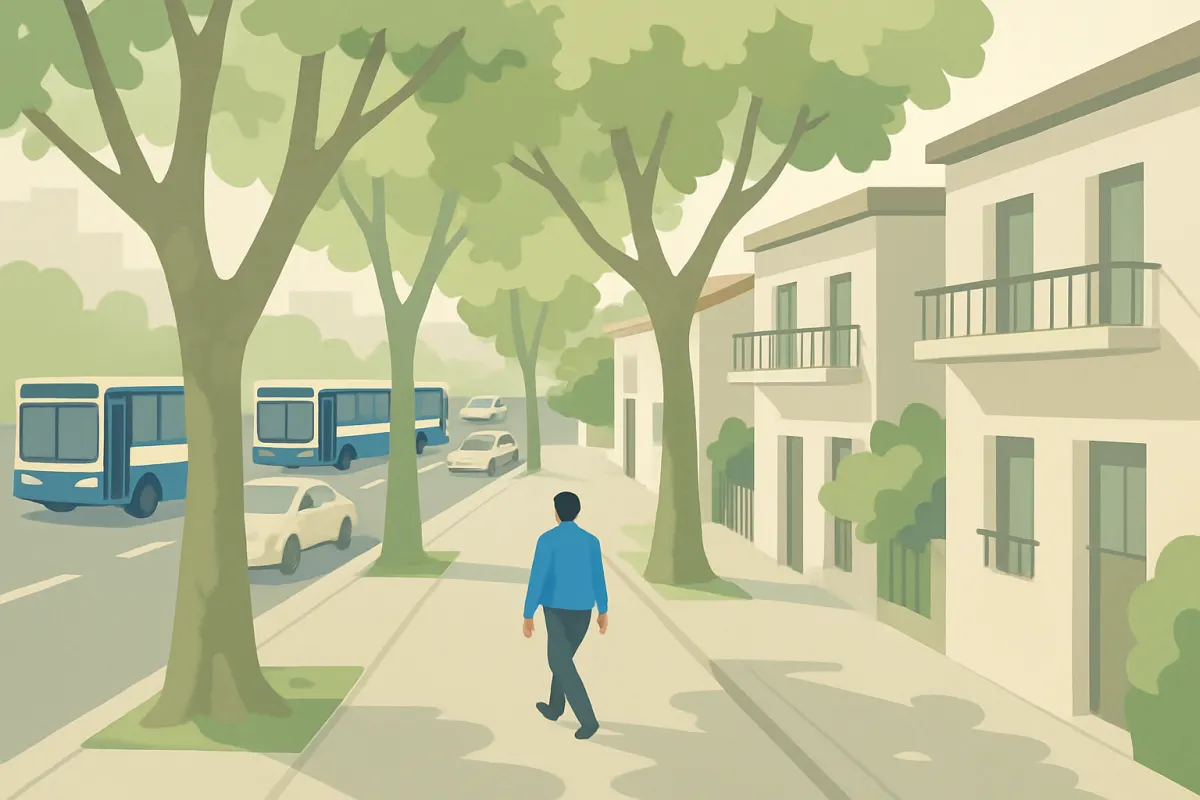
Living Score answers this directly: a pharmacy 400 metres away across six lanes and uphill is further than one 600 metres away along a quiet street. The score measures a route not in metres but in minutes, and those minutes include everything that makes the walk harder: the climb, the wait at crossings and the stretches along big roads.
What the minutes on foot are made of
The base is the route through streets and crossings, not a straight line. In the General profile the pace is 80 metres a minute. Three things are added to that time.
- Waiting at crossings. Crossing a big street at a light takes longer than crossing a quiet one.
- Walking along big roads. The cost of such a stretch depends on the class of the road, the number of lanes and the speed limit.
- Climbing. The steeper the street, the more each metre of it costs, and steps cost more still.
Let us count on a made-up example. Say the route along the avenue is 400 metres: 5 minutes of walking. Add half a minute for the noisy stretch and 40 seconds at the light, and it comes to about 6.2 minutes. The quiet route is 480 metres, exactly 6 minutes, with nothing to add. The quiet route is 80 metres longer but counts as closer.
The report shows both numbers: minutes by the clock and the minutes a place is counted as. If the second is noticeably larger than the first, there is an avenue, a long crossing or a climb on the way.
An example: Avenida de Mayo 825
Take the sample report for Buenos Aires, Avenida de Mayo 825, computed on 4 October 2026. This is the city centre: big avenues, squares and lots of traffic lights. For every place it counts, the report shows how many seconds big roads added and how many the waits at crossings added.
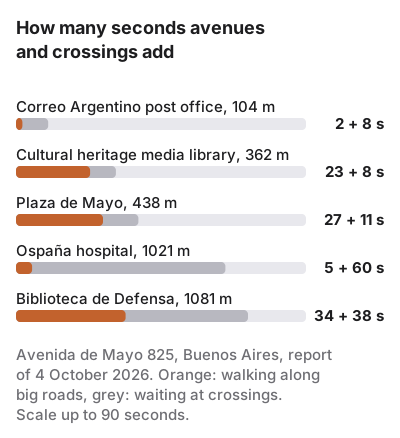
The Correo Argentino post office is 104 metres away, and the route is almost clean: 10 seconds in all. Plaza de Mayo is 438 metres and 6 minutes by the clock away, but 27 seconds of that are along big roads and another 11 at crossings. The square is counted as 6.2 minutes.
The furthest places show the difference more clearly. The Biblioteca de Defensa library is 1081 metres away, with 34 seconds along big roads and 38 at crossings on the way. The Ospaña hospital is 1021 metres away; big roads hardly get in the way, 5 seconds, but the waits at crossings add up to a whole minute.
Seconds seem trivial, but they add up. In the Comfort of the walks line this address has 6.6 minutes of waiting at crossings, 1.1 minutes along big roads and 1.7 on climbs. In the end, ordinary walking on the level is only 94.3% of the trip time.
Comfort of the walks: a line of its own in the score
That share enters the score twice. First, through the minutes to every place: the longer the route, the fewer points the place gives. Second, through a separate Comfort of the walks line in the Street network category. It gets 100 points when all the trip time is ordinary walking, and 0 when such walking is 70% or less.
At Avenida de Mayo 825 this line scores 81 out of 100. The other two lines of the street network are stronger: intersection density gives 100, and the ratio of the walking route to a straight line 97.6. Central Buenos Aires is dense and direct, but waiting at crossings and big roads cost it almost a fifth of its comfort.
| Street network line | Weight | Value | Points |
|---|---|---|---|
| Intersection density | 35% | 233 | 100 |
| Directness of routes | 25% | 1.27 | 97.6 |
| Comfort of the walks | 40% | 94.3% | 81 |
With a child or in old age the avenue costs more
In the Family with a child and Older person profiles a noisy stretch of road costs 30% more than in General. Waiting at crossings costs 20% more for a family and 30% more for an older person. The pace is lower too: 65 metres a minute with a child and 60 in old age instead of 80.
So the same address on an avenue loses more in the family profile than in General. If you are moving with a pram, open the report in that profile: the quiet way to school will show up better there.
How to choose a quiet route in real life
The score counts the route to every place, but you are the one who will walk it. When you view a flat, walk to the shop and the school yourself two ways: along the main street and along a parallel one. Often the second is a block longer but calmer to walk, and with a child faster too: there is no light across six lanes.
Look at the building itself as well. A flat on a quiet street a block from the avenue keeps almost all its minutes to the shops and pays no noise penalty. How much that penalty takes from a building right on the avenue is covered in the article about a loud street under the window.
What the calculation does not know
The map knows the class of a road, but not the traffic on it. A main road that is quiet at night and jammed by day gets the same cost. The calculation does not know where the pavement has shade, where the asphalt is broken and where cars are parked on it. That can only be checked on foot.
All the thresholds and weights of the street network are listed on the page How it is calculated. Buenos Aires addresses by neighbourhood are on the city page, and the best addresses in the country in the rating for Argentina.
Questions
Why can a place 600 metres away count as closer than one 400 metres away?
The score counts minutes, not metres. Waiting at crossings and walking along big roads add time, and a short route along an avenue can come out longer than a long one along a quiet street.
What is the comfort of the walks?
The share of the trip time spent on ordinary walking on the level. 100% gives 100 points, 70% or less gives zero.
Does the score take traffic lights into account?
Yes, as waiting at crossings. At Avenida de Mayo 825 it accounts for 6.6 minutes in the Comfort of the walks line.