How many hours a month the walk to the metro takes
24 minutes to the metro is almost 17 hours a month just to the station and back. We count on Moscow addresses and see what it does to the score.
Score your own address
Everything this article covers, you can check on your own address: free, in a minute.
Free. The score at once, the full report after an e-mail sign-in.
Contents 6 sections
Minutes to the metro in a listing and in real life
“Ten minutes to the metro” in a listing sounds like nothing. But you will walk those ten minutes morning and evening, every working day, for years. Let us count what they add up to and see how the score of an address treats them.

The arithmetic is simple. Say you take the metro to work 21 days a month. You walk to the station and back twice a day. Then every minute from your door to the metro entrance costs 42 minutes a month, or 0.7 hours. Five minutes is three and a half hours, ten minutes seven hours, twenty minutes fourteen.
Nine Moscow addresses: from one minute to twenty-four
We took addresses in three Moscow districts measured on 3 October 2026: Khamovniki, Presnensky and Ramenki. Their minutes to the station range from one to twenty-four. Here is what that comes to in hours.
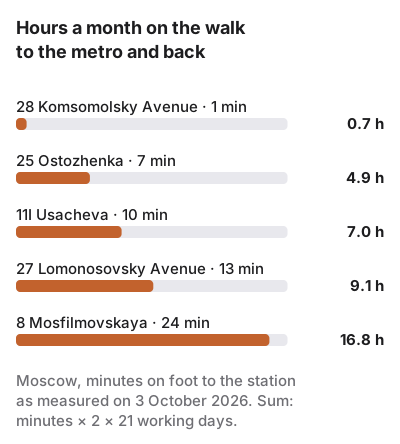
| Address | Station | Minutes on foot | Hours a month | Score |
|---|---|---|---|---|
| 28 Komsomolsky Avenue | Frunzenskaya | 1 | 0.7 | 80.3 |
| 12 Presnenskaya Embankment | Delovoy Tsentr | 1 | 0.7 | 76.4 |
| 29 Michurinsky Avenue | Ramenki | 1 | 0.7 | 80.5 |
| 25 Ostozhenka Street | Park Kultury | 7 | 4.9 | 79.5 |
| 24 Krasnaya Presnya Street | Krasnopresnenskaya | 7 | 4.9 | 84.0 |
| 1 bldg 5 Bolshaya Gruzinskaya Street | Krasnopresnenskaya | 7 | 4.9 | 86.6 |
| 11I Usacheva Street | Frunzenskaya | 10 | 7.0 | 79.0 |
| 27 Lomonosovsky Avenue | Universitet | 13 | 9.1 | 66.7 |
| 8 Mosfilmovskaya Street | Park Pobedy | 24 | 16.8 | 60.0 |
At 8 Mosfilmovskaya Street the walk to Park Pobedy station takes 24 minutes. Over a month that is 16.8 hours, over a year about two hundred. Two hundred hours is five working weeks spent on foot just getting to the turnstile and back.
At 28 Komsomolsky Avenue the same sum gives 0.7 hours a month: Frunzenskaya station is a minute from the door.
How the minutes to the station get into the score
In a big city with a metro, the public transport category has two parts. 60% comes from the nearest metro or commuter rail station, 40% from buses and trams near home. A station within 15 minutes counts in full; beyond that its value falls gradually and reaches nothing at 30 minutes.
So addresses one and seven minutes from the metro are equal in the station part: both stations count in full. There is a difference in hours of your life, but none in the score. The calculation assumes that fifteen minutes to the metro is normal in a big city, and it penalises what lies beyond.
If all 24 minutes are walked, the station is worth about a third of its full value. That is why 8 Mosfilmovskaya scores 60: transport is not the only reason, but a noticeable one. The nearest food shop is 8 minutes away, the school also 8, and all these minutes add up.
Close to the metro does not mean the best address
The table also shows the opposite. 12 Presnenskaya Embankment is a minute from Delovoy Tsentr station and scores 76.4. 1 bldg 5 Bolshaya Gruzinskaya Street, seven minutes from Krasnopresnenskaya, scores 86.6, ten points more.
The rest makes the difference. From Presnenskaya Embankment the school is 12 minutes away, the park 9. The business district was built for offices, not for everyday life, and the minutes show it. On Bolshaya Gruzinskaya the school is 9 minutes away, the park 4, a shop 6.
Six extra minutes to the metro cost 4.2 hours a month. A park four minutes away instead of nine you may well walk past more often than the station. Which of these trades pays off depends on you; the score only offers a hint.
When the minutes to the metro matter most
- You go to the office every day. Then each minute costs 0.7 hours a month, and the gap between 3 and 13 minutes is seven hours.
- You do not have a car. In the Without a car profile, transport weighs 28 points out of 100 instead of 18, and weak transport cuts the whole score by up to a quarter.
- You are moving in winter. Twenty minutes through snow and darkness feel longer than twenty minutes in May, even if the clock says the same.
- You have children and the school is not next door. Then the walk to the metro becomes part of the whole family's morning route.
If you work from home, it is the other way round. A station fifteen minutes away will be needed once a week, while the shop, café and park every day. That is what the Remote worker profile is for, where transport weighs 13 points.
How to count your own commute
Take the minutes to the station from the report, multiply by two and by the number of days a month you take the metro. Divide by 60. You get an honest number of hours that you can weigh against a difference in rent or another advantage of the flat.
If you need a specific station rather than the nearest one, add your office to My places. The report will show the minutes on foot to it or a direct transport line. Two addresses are easy to put side by side on the comparison page.
How the station and bus parts of transport work is explained on the page How the score is calculated. All measured Moscow addresses are on the city page, and the best addresses in the country in the rating for Russia.
Questions
How much time a month goes on the walk to the metro?
Multiply the minutes to the station by 2 and by the number of trips a month. With 21 working days, every minute gives 0.7 hours: 10 minutes is 7 hours, 24 minutes 16.8 hours.
How many minutes to the metro count as normal?
In our calculation, a station within 15 minutes in a big city counts in full. Beyond that its value falls and reaches zero at 30 minutes.
Is a flat right by the metro always better?
No. 12 Presnenskaya Embankment, a minute from the station, scores 76.4, while 1 bldg 5 Bolshaya Gruzinskaya Street, seven minutes away, scores 86.6: the second has the school, the park and daily errands closer.