Serbian cities compared: best and weakest districts
Six Serbian cities, 28 districts, one scale: Belgrade averages 80.6, Kragujevac 59.6. Best and weakest district are 13.3 to 39.4 points apart.
Score your own address
Everything this article covers, you can check on your own address: free, in a minute.
Free. The score at once, the full report after an e-mail sign-in.
Contents 7 sections
Two groups of cities
We have scored three addresses in every district of six Serbian cities: 84 addresses in 28 districts, all in the General profile in October 2026. Each city has its own page with climate, air and natural hazards: Belgrade, Novi Sad, Niš, Kragujevac, Subotica and Pančevo. Here they stand side by side on one scale, each with its best and its weakest district.
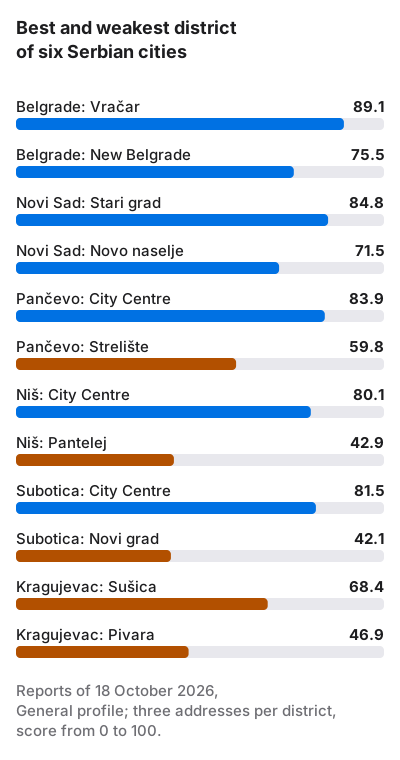
Belgrade and Novi Sad form one group. Their addresses average 80.6 and 79.3, and even their weakest districts, New Belgrade at 75.5 and Novo naselje at 71.5, score above 70. The other four cities average 59.6 to 66.7, and their weakest districts fall to 59.8 or lower, down to 42.1 in Subotica.
The centre leads almost everywhere
In five of the six cities the best district is the central one: Vračar in Belgrade at 89.1, Stari grad in Novi Sad at 84.8, the City Centre in Pančevo at 83.9, the City Centre in Subotica at 81.5 and the City Centre in Niš at 80.1. Kragujevac has no central district on our list; Sušica leads there on 68.4, ahead of Palilule on 66.5.
A strong centre does not make a strong city. The centre of Niš, 80.1, scores higher than Belgrade's weakest district, 75.5, and the centre of Subotica, 81.5, higher than Novo naselje in Novi Sad, 71.5. What differs from city to city is what lies outside the centre.
The best address of each city tells a different story from the averages. They score 89.5 in Belgrade (Sokolska 17), 87.7 in Pančevo (Generala Petra Aračića 2), 86.8 in Novi Sad (Svetozara Miletića 2), 83.6 in Subotica (Vase Stajića 6) and 82.6 in Niš (Obrenovićeva 32), within seven points of each other. The difference between the cities is how many addresses reach that level: 80 or more at seven of 15 in Novi Sad and six of 15 in Belgrade, at two each in Niš, Subotica and Pančevo, at none in Kragujevac, where the best address is Gružanska 24 at 73.0. At the other end, below 60 are none of the addresses in Belgrade and Novi Sad, four of 12 in Pančevo, six of 12 in Kragujevac, seven of 15 in Niš and eight of 15 in Subotica.
How far the weakest district falls
The gap between the best and the weakest district is 13.3 points in Novi Sad and 13.6 in Belgrade, 21.5 in Kragujevac, 24.1 in Pančevo, 37.2 in Niš and 39.4 in Subotica. In Subotica the City Centre scores 81.5 and Novi grad 42.1; in Niš the City Centre scores 80.1 and Pantelej 42.9. In these two cities the range between districts alone is wider than the range between the averages of all six cities, 59.6 to 80.6, which is 21.0 points.
What drags the lowest addresses down
The three lowest of the 84 addresses are all far from the things they need. Frederika Šopena 6 in Subotica scores 27.9: a grocery eight minutes away, a stop twelve, a school eight, a park twelve. Bulevar Svetog Pantelejmona 91b in Niš scores 33.2, with a school ten minutes away and a park twelve. Teslina 35a in Kragujevac scores 36.0, with a grocery and a school thirteen minutes away each. Noise explains little here: it takes 1.51, 3.23 and nothing from them.
Air and noise differ by city
Air differs little inside a city, so it moves whole cities. It takes 2.01 points in Subotica, 2.55 to 2.82 in Pančevo, 3.0 in Kragujevac, 3.1 to 3.44 in Novi Sad, 3.5 in Niš and 3.52 to 3.96 in Belgrade. Noise moves single addresses. The largest road-noise penalty in each city is 8.56 in Niš, 5.22 in Belgrade, 4.03 in Kragujevac, 3.91 in Subotica, 2.7 in Pančevo and 2.13 in Novi Sad.
| City | Districts | Best district | Weakest district | Gap | All addresses |
|---|---|---|---|---|---|
| Belgrade | 5 | Vračar 89.1 | New Belgrade 75.5 | 13.6 | 80.6 |
| Novi Sad | 5 | Stari grad 84.8 | Novo naselje 71.5 | 13.3 | 79.3 |
| Pančevo | 4 | City Centre 83.9 | Strelište 59.8 | 24.1 | 66.7 |
| Niš | 5 | City Centre 80.1 | Pantelej 42.9 | 37.2 | 63.2 |
| Subotica | 5 | City Centre 81.5 | Novi grad 42.1 | 39.4 | 59.8 |
| Kragujevac | 4 | Sušica 68.4 | Pivara 46.9 | 21.5 | 59.6 |
Which city for which kind of address
- The widest choice of good addresses: Belgrade and Novi Sad, where even the weakest district scores above 70.
- A strong centre and a mixed outskirts: Niš, Subotica and Pančevo, where the centre scores 80.1 to 83.9. Outside it the picture varies: Prozivka in Subotica at 73.9 and Medijana in Niš at 73.0 hold up, Pantelej at 42.9 and Novi grad at 42.1 do not.
- Kragujevac: no district above 68.4, so the address matters more than the district; its best address scores 73.0 and its weakest 36.0.
We do not measure safety, so ask the people who live on the same street.
How to read these numbers
Each district figure is the average of three addresses, so it is a sample, not a verdict: inside Novi grad the addresses run from 27.9 to 50.5, a spread of 22.6 points. Use the district as a place to start, and open the report for the address in the listing.
The closer comparisons are Belgrade districts compared, Novi Sad districts compared and Niš districts compared. The rating of Serbia lists the cities, all measured districts are on the districts page, and How it is calculated explains how minutes and penalties turn into a score.
Questions
Which Serbian city has the best-scoring districts?
Belgrade: its 15 addresses average 80.6, and its best district, Vračar, 89.1. Novi Sad follows on 79.3, with Stari grad on 84.8.
In which Serbian city are the districts most alike?
In Novi Sad and Belgrade: the best and the weakest district are 13.3 and 13.6 points apart. In Niš and Subotica the gap is 37.2 and 39.4.
Is it better to live in the centre of a Serbian city?
In five of the six cities the central district scores highest, from 80.1 in Niš to 89.1 in Belgrade. In Niš the price is traffic noise: 8.34 to 8.56 points at all three centre addresses.
How many addresses are behind these numbers?
Eighty-four addresses in 28 districts, three per district, scored on 18 October 2026 in the General profile. Kragujevac is counted with four of its five districts.