Vračar, Belgrade: living in the dense centre
Living in Vračar, Belgrade: a small, dense central district around the Church of Saint Sava and Kalenić market. Three scored addresses.
Score your own address
Everything this article covers, you can check on your own address: free, in a minute.
Free. The score at once, the full report after an e-mail sign-in.
Contents 9 sections
What the district is like
Vračar is a small, dense municipality in the middle of Belgrade, centred on the Church of Saint Sava and the Kalenić market, with the Krunska and Njegoševa streets close by. Most buildings are apartment blocks from before the war and the socialist era.
Cafés fill the ground floors. Young professionals, families and expats live here.
On foot
From each of the three addresses the shop, the stop, the school and the park are a short walk away. The nearest stops in our data are Mačvanska, Karađorđev park and the Kalenić market, so try the route from your own address.
What we measured
The addresses are on Sokolska, Internacionalnih brigada and Mutapova, in the Čubura and Neimar neighbourhoods.
| Address | Score | Groceries | Station or stop | School | Park | Noise and air |
|---|---|---|---|---|---|---|
| Sokolska, 17, Vracar Urban Municipality | 89.5 | 5 min | 3 minMačvanska | 7 min | 3 min | −3.5 |
| Internacionalnih brigada, 19, Vracar Urban Municipality | 88.5 | 2 min | 6 minKarađorđev park | 7 min | 2 min | −3.5 |
| Mutapova, 46, Vracar Urban Municipality | 89.4 | 4 min | 3 minPijaca „Kalenić” | 6 min | 5 min | −3.5 |
Map numbers match the table rows. Use the plus button to zoom in.
The air takes a little off these addresses, noise and industry nothing. Details: How the score works.
Who it suits
- Young professionals and expats who want to live in the middle of the city.
- Families who want a market, a school and a park within a short walk.
- People who prefer cafés and streets on foot to a car.
What it costs you
Rents are among the highest in the city, parking is scarce and older buildings often have no lift. There is no metro yet, so public transport means buses and trolleybuses.
The housing
The buildings are apartment blocks from before the war and from the socialist era, with cafés and shops on the ground floors. Older ones often have no lift. Rents are among the highest in the city, so compare several streets and buildings before you decide.
What to check
Check the building for a lift and ask where residents park. Walk from the door to the nearest stop and time it. Visit on a weekday evening and listen to the street near the cafés.
Without a car
Parking is scarce, and the shop, the stop, the school and the park are all close. For most days a car is more hassle than help.
Neighbours
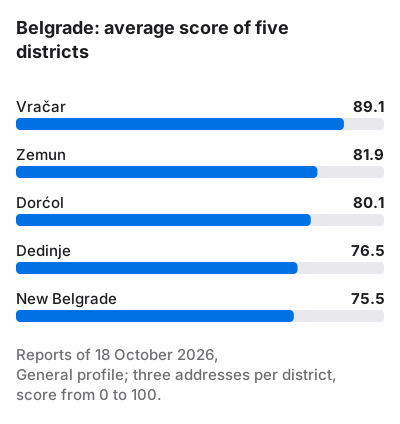
Close to the north, towards the Danube, is Dorćol, the old-town quarter. Further south is Dedinje, the green villa district.
Questions
Is Vračar a good place to live?
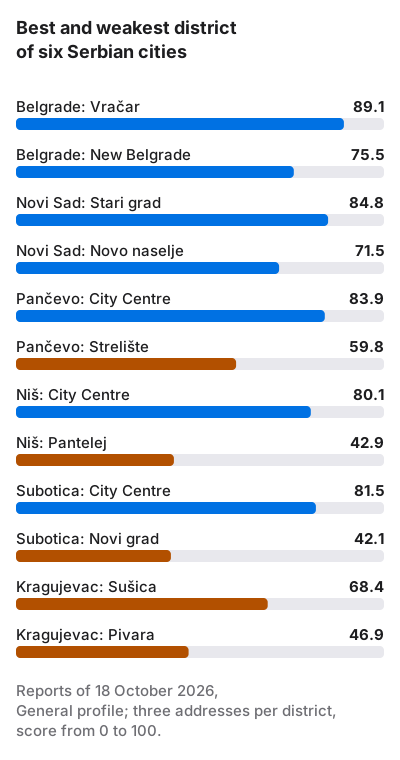
For life on foot in the centre, yes: a market, cafés, schools and a park are a short walk from the streets we measured. The trade-offs are high rents, scarce parking and older buildings that often lack a lift.
Is Vračar expensive?
It is among the most expensive districts of Belgrade for renting. You pay for a central address, pre-war and socialist-era buildings and streets full of cafés. Compare a few streets before you choose.
Is there a metro in Vračar?
Not yet: the district relies on buses and trolleybuses. Check the stop nearest to your address and how often the lines run.