What is a 15-minute city and who it does not suit
The 15-minute city in Yekaterinburg: in Akademichesky the shop is two minutes away and the metro 34. Who such a district suits and who it does not.
Score your own address
Everything this article covers, you can check on your own address: free, in a minute.
Free. The score at once, the full report after an e-mail sign-in.
Contents 6 sections
What the 15-minute city promises
The idea of the fifteen-minute city is simple: everything you need every day should be within a quarter of an hour's walk from home. A shop, a school, a doctor, a park, a cafe. Then a car becomes optional and the district turns into a small town. Fifteen minutes at an ordinary pace is about 1,200 metres, and that is along the streets, not as the crow flies: courtyards, fences and crossings make the real radius smaller.

Our score works in a similar way. A place within five minutes counts in full; beyond that its value falls and fades out by fifteen to twenty minutes. In a city with a metro the limit is 1.25 times farther, but no more than 25 minutes. The curve is described in detail on the page How it is calculated.
But the idea has a weak spot. It answers the question of what is nearby and says nothing about where you need to travel. For some people that does not matter; for others it decides everything. Yekaterinburg is a good example.
Akademichesky: everything close except the metro
The Akademichesky district was built to stand on its own, with shops, schools and parks inside the blocks. The three measured addresses confirm it. By the reports of 3 October 2026, at 37 Wilhelm de Gennin Street the shop is three minutes away and the school six. At 133 Krasnolesya Street the shop is two minutes away and the park five. At 53 Akademika Sakharova Avenue the park is a minute away.
Yet the scores are middling: 78, 76.9 and 75.5. What eats up the difference with the centre is transport. The nearest metro station, Chkalovskaya, is 34 minutes on foot from the first two addresses. From the third no station was found within walking distance at all. For anyone who commutes to the centre, that is the number that matters.
The result is a district that passes the fifteen-minute test almost perfectly and is still poorly connected to the rest of the city. Whether that is good or bad depends on who lives there.
The centre: the metro close, the school farther
In the centre the picture is the reverse. 51 Lenin Avenue scores 90.7 and 9 Vainera Street 90.3: both in the band "Everything on foot". The metro is four minutes from 9 Vainera and two from 46 8 Marta Street. Shops, cafes, theatres and stops are on every corner.
What is weaker in the centre is what a family needs. In the rating report for 46 8 Marta Street the Education and children category scores 57.8 out of 100: the school is nine minutes away. In Akademichesky, at 40 Wilhelm de Gennin Street, the same category scores 99. For an adult without children that difference means almost nothing.
Botanichesky lies in between. 17 Akademika Shvartsa Street scores 85.6: the shop two minutes away, Botanicheskaya metro four, a park two. The school, though, is 14 minutes away. And 46 Krestinskogo Street in the same district gets only 64.6: 16 minutes to the metro, plus 5.26 points of noise penalty and 2.43 for an industrial area.
One district for different people
We recalculated two addresses from the Yekaterinburg rating with the weights of three profiles: General, a family with a child and a person without a car. The categories and penalties stayed as in the report; only the weights changed.
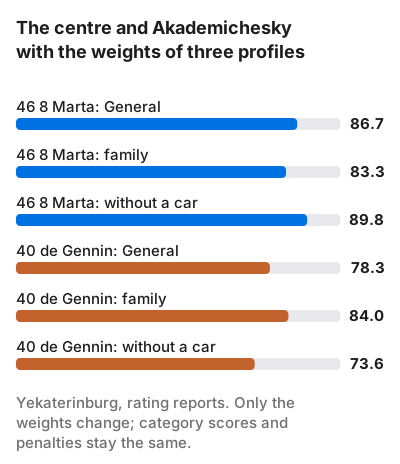
With General weights the centre leads by 8.4 points. With a family's weights it is the other way round: 40 de Gennin Street gets 84.0 and 46 8 Marta Street only 83.3. In Akademichesky education scores 99, parks 95, groceries 100, and the family profile gives them more weight than transport.
For a person without a car the gap is at its widest: 89.8 in the centre against 73.6 in Akademichesky, more than 16 points. A real report with that profile is stricter still: with weak transport it cuts the whole category sum by up to a quarter, and transport at 40 de Gennin scored 35.9.
Who the 15-minute city does not suit
This example shows the people for whom a self-sufficient district turns into a trap.
- Someone who travels every day to the same place at the other end of the city. A shop two minutes away does not make up for forty minutes to work each way.
- Someone who needs a particular doctor, university or club that the district does not have. The scale counts the nearest school, not the one you want.
- Someone who walks slowly. Fifteen minutes at 4.8 km/h is 1,200 metres; at 3.6 km/h it is 900. A circle with a 900-metre radius covers only 56% of the area of a 1,200-metre one.
- Someone who lives the city: theatres, exhibitions, meeting people in different districts. A fast way to the centre matters more to them than having everything under the window.
Conversely, a district like Akademichesky is good for a family where one adult works from home or drives, and the children go to school across the courtyard. For such people the centre, with its noise and weaker education category, would give less.
How to check your own version of 15 minutes
Open the report with the profile of whoever will live in the flat and look at two things. First, the categories that matter to you rather than to everyone. Second, the way to places that are not in the score. Add up to three addresses to the "My places" block: work, school, parents. The report will show the route on foot, by public transport, by car and by bike.
If all three places are within fifteen minutes, the district really is a fifteen-minute one for you. If even one is an hour away with a change, no score will fix that. The measured districts of Yekaterinburg are on the city page, and the comparison with other cities is in the rating for Russia.
Questions
What is the 15-minute city?
It is the idea that everything needed every day, from a shop to a doctor and a park, is within a quarter of an hour's walk from home. Then a car becomes optional.
Which district of Yekaterinburg comes closest to a 15-minute city?
Among our addresses, the centre: 51 Lenin Avenue and 9 Vainera Street score over 90. Akademichesky also keeps shops, schools and parks close, but the metro is 34 minutes away.
Why is the score lower in Akademichesky if everything is close?
Because of transport. Transport weighs 18 points out of 100, and the metro is more than half an hour on foot from the measured addresses.