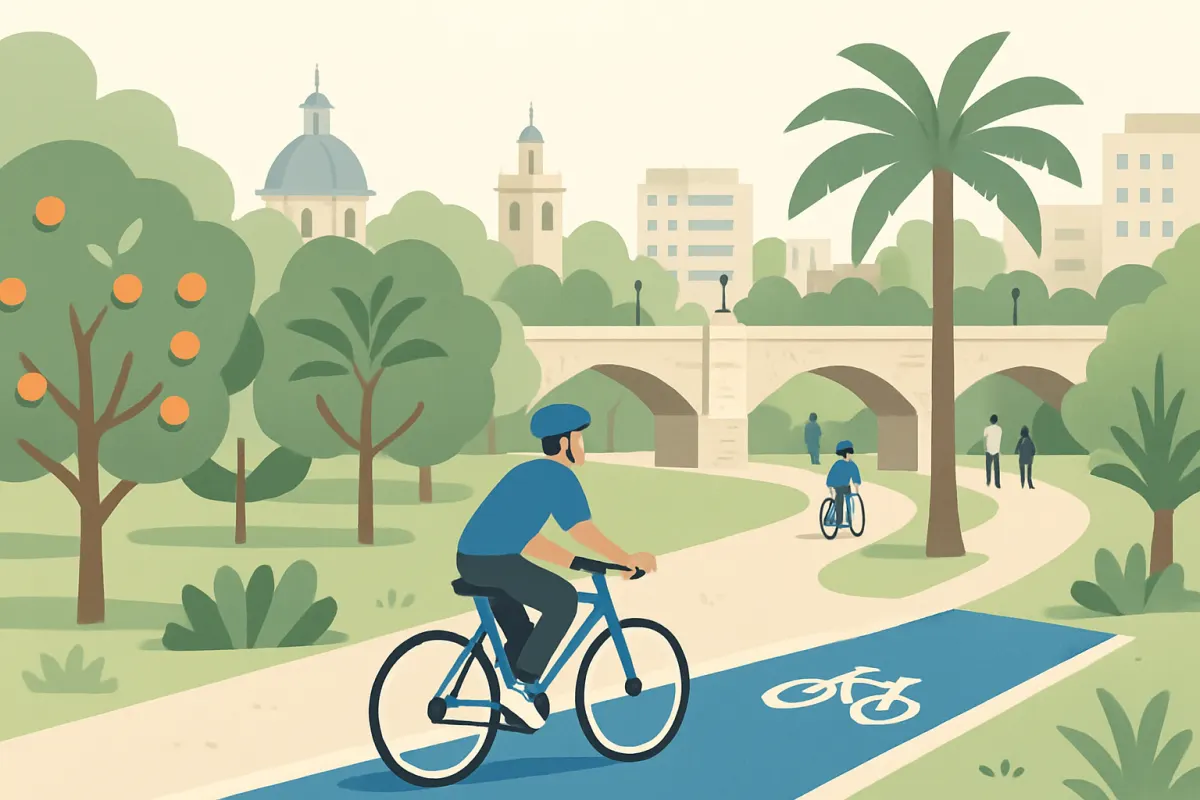
A bike instead of a car: what you need near home
Can a bike replace a car? Bike share 2 minutes away, parking, lanes within a kilometre and the ride to the centre, checked on addresses in Seville.
Score your own address
Everything this article covers, you can check on your own address: free, in a minute.
Free. The score at once, the full report after an e-mail sign-in.
Contents 7 sections
What a bike replaces and what it does not
People usually keep a car for three things: a job on the other side of town, the big shop, and trips with children or to the doctor. A bike covers the first almost completely if work is three to five kilometres away. It covers the second and third badly. So an address for life without a car gets checked in two layers: what is within a walk, and where a bike can take you.
Let us go through it in Seville. The city is flat, people cycle on a long network of bike lanes, and the heat sets the rules. The main example is Calle San Jacinto in Triana, the site's sample address for Seville, plus three rating addresses in other districts.
Layer one: a shop and a pharmacy on foot
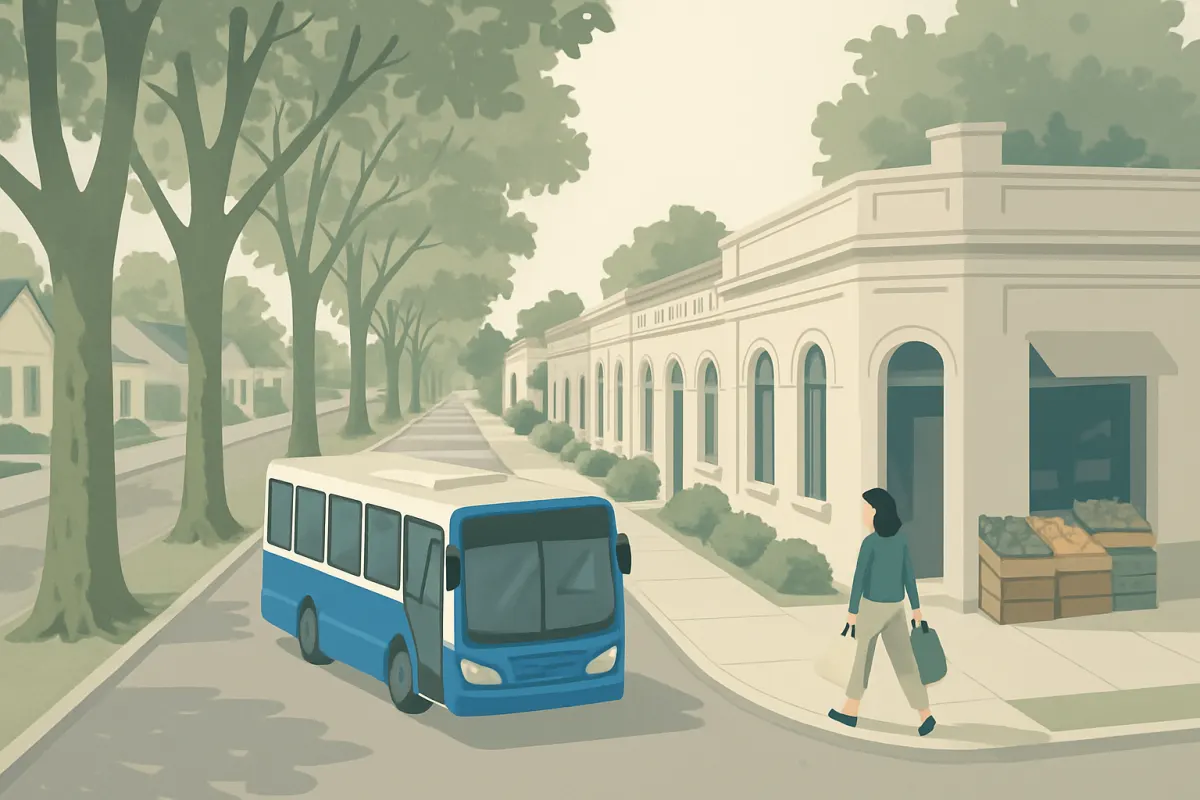
Nobody cycles for bread every morning, and a bag of groceries is easier to carry for five minutes than to ride with for twenty. From Calle San Jacinto the El Jamón grocery is 3 minutes away, a bakery 2, the Pagés del Corro stop 3, the Jardines de Chapina gardens 5 and the Guadalquivir riverside 3. Groceries score 100, and so does health.
This is the foundation. If groceries or a pharmacy are more than fifteen minutes' walk away, the bike stops being a choice and becomes a chore, and on a rainy day or in the summer heat taxis start doing the car's job.
Layer two: where to leave a bike and where to get one
In the report the bike lives in the category Bikes and shared cars. It has six needs, and half of the weight sits on two of them: the lane network nearby and the ride to the centre.
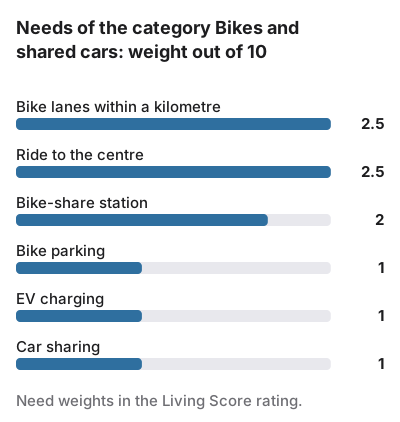
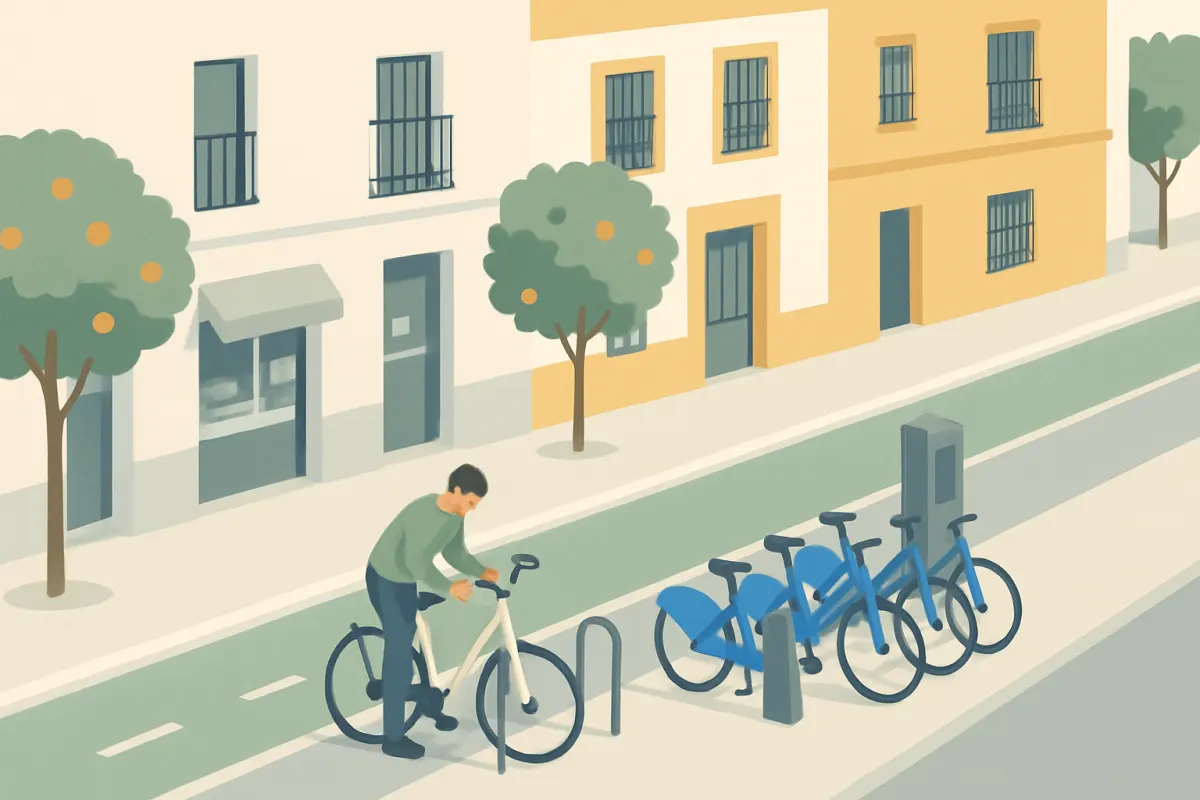
- Bike-share station: weight 2. Full marks up to 3 minutes, zero from 10. If you have no bike of your own this is the key item: people do not walk more than five or six minutes to a station.
- Bike parking: weight 1. Full marks up to 2 minutes, zero from 6. The shortest patience in the report: a bike is left at the door, not a block away from it.
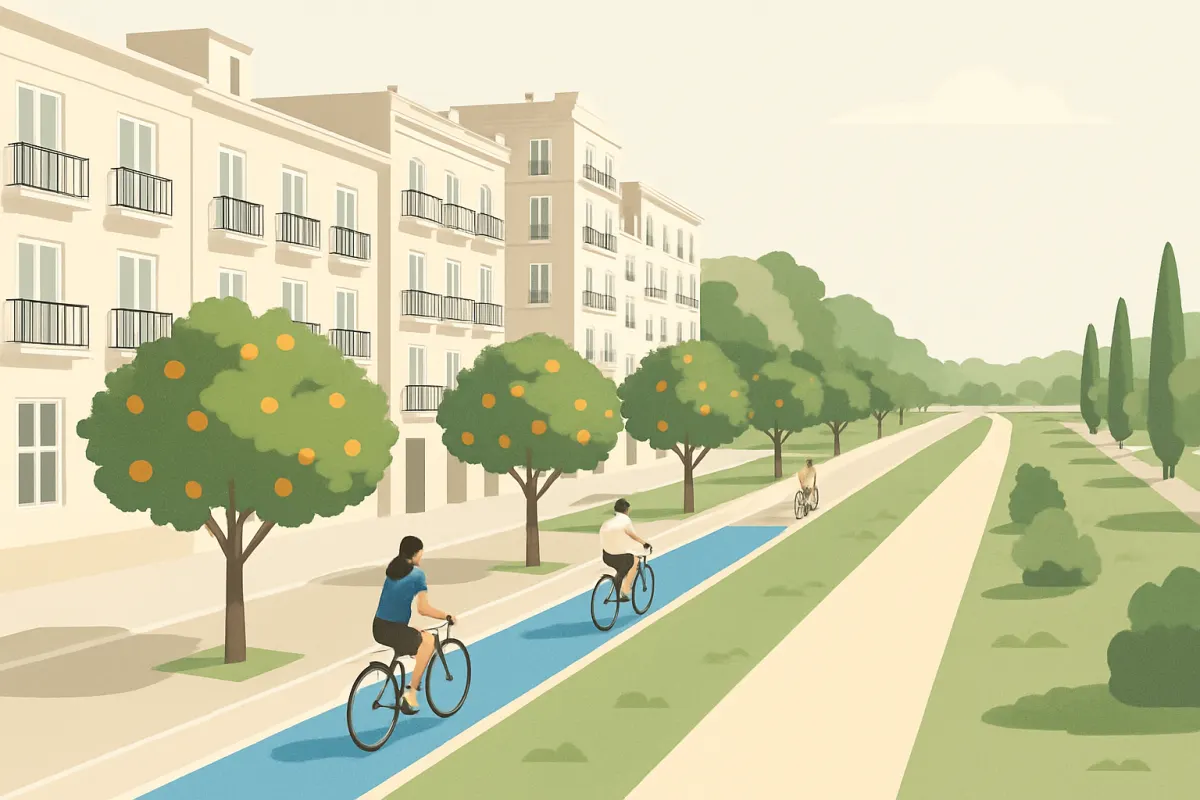
- Lanes within a kilometre of home: weight 2.5. Full marks when there are at least 8 kilometres of them and the longest connected stretch is at least 3.
- Ride to the centre: weight 2.5. Computed along the route at 15 km/h, plus a minute for every 10 metres of climb. Full marks up to 10 minutes, falling to zero at 60.
Calle San Jacinto passes this layer almost perfectly. The bike-share station "218 Plaza del Altozano" is 120 metres away, 2 minutes. Bike parking is 3 minutes away, and so is a charger for an electric car. The category scores 87.3.
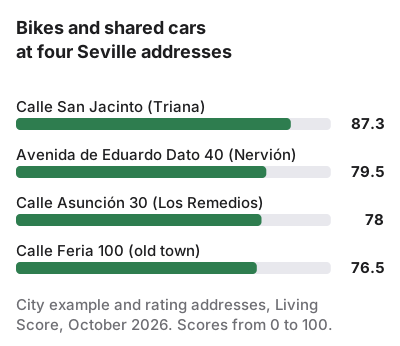
The three rating addresses are lower, but not by much: Avenida de Eduardo Dato 40 in Nervión gets 79.5, Calle Asunción 30 in Los Remedios 78, Calle Feria 100 in the old town 76.5. The spread is only 11 points. In a flat city with one shared lane network, a bike works from almost any central address, and the choice comes down to other lines of the report.
Layer three: how long the ride takes
Cycling minutes are easy to estimate yourself. 15 km/h is 250 metres a minute. Say work is 5 kilometres away: 20 minutes on level ground. If the route climbs 30 metres, add 3 minutes. Seville has hardly any hills, so cycling minutes here are close to plain distance divided by speed.
The report adds how calm the route is. A route on bike lanes counts in full, on quiet residential streets by half, on a main road worst of all. An address less than a kilometre from the centre gets 100 for the ride without any calculation. For a daily commute this matters more than the minutes: 20 minutes on a riverside lane and 20 minutes among buses feel very different.
The price of a convenient address: noise
Being handy for walking and cycling often comes with a busy street. In the Triana district measurements of 3 October 2026, Calle San Jacinto 50 loses 8.68 points to noise and scores 80.5; Calle Betis 30 and Calle Pureza 50 lose 5.13 each and score 81.4 and 82.3. Plaza de Cuba metro station is 9 minutes from all three. If you are happy without a car but sleep badly, move one block off the main street: bike share and shops stay the same number of minutes away, and the noise penalty may shrink.
How much it weighs in the final score
Not much. In the General profile the bikes category weighs 3 points out of 100, in the profile "Without a car" 2: there the main weight goes to public transport, 28 points, and to the street network, 15. This is deliberate. The score answers the question of what you can do on foot from your door; a bike widens that circle but does not replace it.
If the bike is your main way of getting around, raise the category's weight in the report's weights panel and the score is recomputed on the spot. But check the first layer first. A great cycling address without a shop five minutes away will still need a car on Saturdays.
A checklist before you move
- Groceries and a pharmacy no more than 5–7 minutes on foot.
- Bike parking by the entrance or room for a bike in the flat: in the report parking loses its value by 6 minutes.
- A bike-share station within 3 minutes if you have no bike of your own.
- The lanes nearby join up into one network rather than lying about in pieces.
- No more than 20–25 minutes by bike to work or study, preferably on lanes.
- In a hot city, a shaded route in summer: the report does not know this, so check it yourself.
All thresholds and factors of the cycling needs are published on the page How it is calculated. Seville addresses, from Triana to Nervión, are gathered on the Seville page, and the other Spanish addresses are in the rating.
Questions
Can I live without a car if I have a bike?
Yes, if groceries and a pharmacy are five to seven minutes' walk away and work is no more than 20–25 minutes by bike. A bike replaces trips, not the shop round the corner.
How far can you realistically cycle every day?
In the calculation the ride to the centre counts in full up to 10 minutes and loses its value by 60. At 15 km/h, 20 minutes is about 5 kilometres on level ground.
How much does cycling weigh in an address's score?
The category Bikes and shared cars weighs 3 points out of 100 in the General profile. You can raise its weight in the report's weights panel.
Which matters more: bike share or parking for my own bike?
If the bike is yours, parking: in the calculation it loses its value by 6 minutes. If you have none, a bike-share station within 3 minutes.