Map errors in an address score: how to spot them
Which map errors reach a neighbourhood score: the wrong kind of place, empty rows, missing hours. Examples from six Russian cities and how to spot them.
Score your own address
Everything this article covers, you can check on your own address: free, in a minute.
Free. The score at once, the full report after an e-mail sign-in.
Contents 7 sections
The score sees a neighbourhood through the map
Every place that goes into the score comes from OpenStreetMap. It is an open map of the world drawn by volunteers: someone added the pharmacy next to their building, someone outlined a park, someone entered a bakery's opening hours. It has mistakes, and some of them end up in the score.
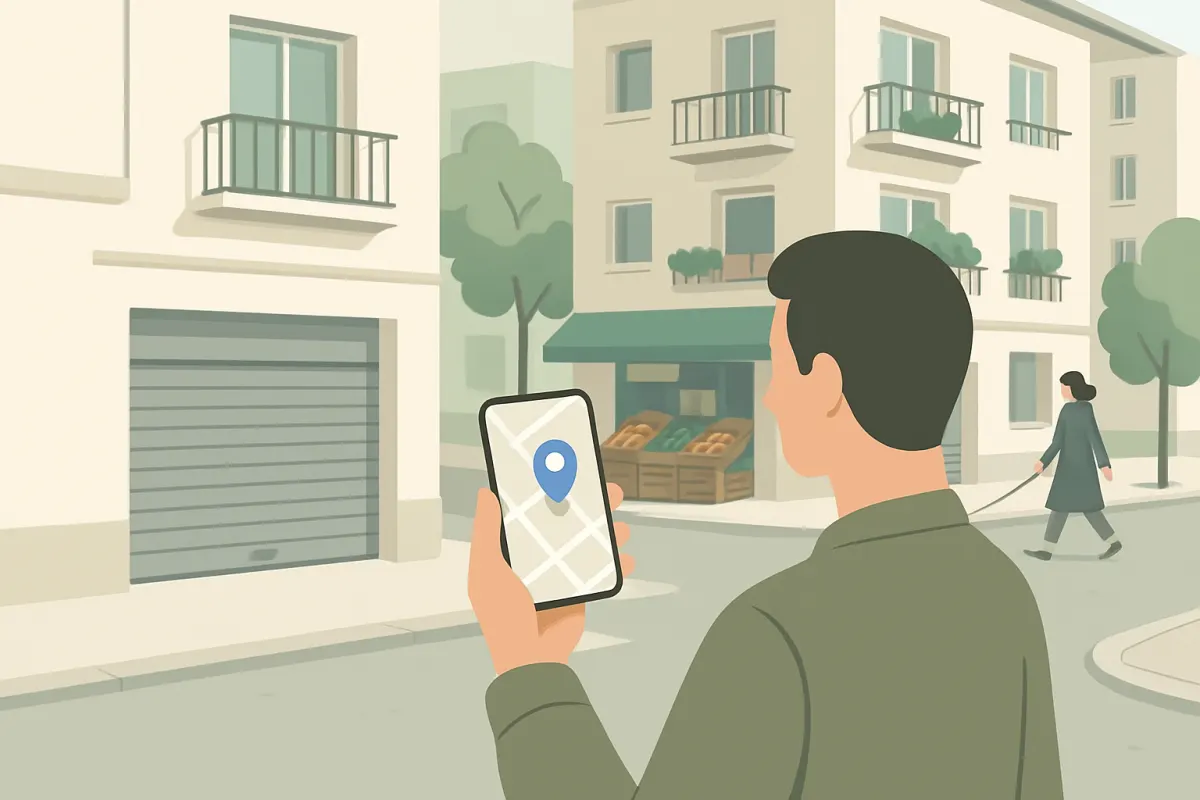
Below are three kinds of such mistakes, with examples from reports in six Russian cities, and how the score copes with them. They are worth knowing: an odd row in a report will not throw you, and a real weakness of an address will not hide behind a map error.
How a place gets into the calculation
Every object on the map carries a tag for its kind: supermarket, pharmacy, school, coworking space. The calculation reads the tag, not the name. The tag decides which need a place serves and what quality it gets: a supermarket 1, a corner shop 0.75, a greengrocer 0.5, a childcare centre 0.8 instead of the 1 a kindergarten gets.
That is where the mistakes come from. If a volunteer chose the wrong tag, the place lands in the wrong need. If they chose none, the score does not see the place at all. If they left out the details, part of the report stays empty.
Mistake one: the wrong kind of place
This one is the most visible. Here is what comes first in some rows of the examples on our city pages.
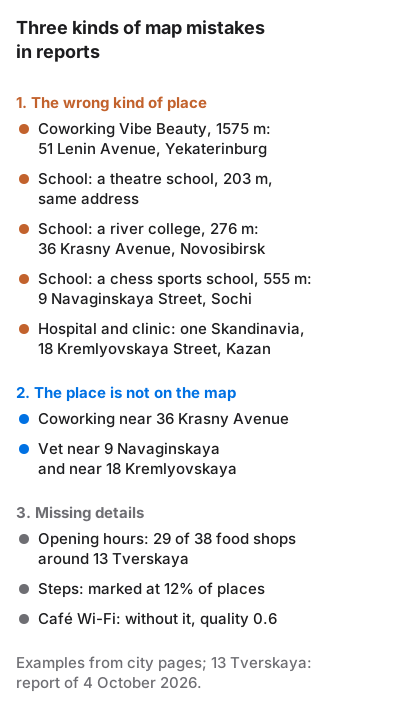
- 51 Lenin Avenue, Yekaterinburg: the nearest coworking space on the map is called Vibe Beauty, 1575 metres away. Judging by the name, it is a beauty salon.
- At the same address the nearest school is the Yekaterinburg children's theatre school, 203 metres away. For a child who needs an ordinary school, it is no substitute.
- 36 Krasny Avenue, Novosibirsk: the place tagged as the nearest school is the Novosibirsk Command River School, a college for river crews, 276 metres away.
- 9 Navaginskaya Street, Sochi: the nearest school is a chess sports school 555 metres away, and the nearest hospital is a first-aid post 1203 metres away.
- 18 Kremlyovskaya Street, Kazan: one and the same Skandinavia clinic, 204 metres away, stands in both the outpatient clinic row and the hospital row.
How to read this. The name is always shown in the report next to the minutes. If the first row of a need looks odd, look at the second: it tells you where the nearest real place is.
Mistake two: the place is not on the map
The opposite mistake is harder to spot. At 36 Krasny Avenue in Novosibirsk the coworking row is empty; at 9 Navaginskaya in Sochi and 18 Kremlyovskaya in Kazan the vet row is empty. It may mean there really is none nearby. Or it may mean nobody has mapped one.
The confidence figure next to the score helps to tell the two apart. It has four parts: how precise the address is weighs 0.15, how much around it is mapped 0.35, how detailed the pavements and crossings are 0.25, and the share of routes along real streets 0.25. From 0.75 the number can be trusted; from 0.45 the map is only partly detailed; below that, read the score as a minimum and draw no conclusions.
At 13 Tverskaya Street in Moscow the confidence is 0.985 (report of 4 October 2026). In a place like that, an empty row most likely means the place really is not there. At a confidence of about one half, an empty row only tells you about the map.
Some needs are not counted at all when the map is empty, so that an address is not punished for a gap in the data. Car sharing in Moscow, Saint Petersburg and Madrid works through apps rather than stations that could be mapped. So there the car sharing need is left out of the score: it is missing from the map, but it is there in real life.
Mistake three: missing details
The place is mapped correctly, but without details. Three are missing most often.
- Opening hours. Of the 38 food shops within a kilometre of 13 Tverskaya, 29 have them. That is good for the block “What is open in the evening”; in other cities it can be a third as many.
- Steps. Only 12% of the places around 13 Tverskaya say whether you can get in without steps. The rest are silent, and silence does not mean “no”.
- Wi-Fi in cafés. A café without that mark counts as a “Cafe to work from” with a quality of 0.6. At 13 Tverskaya that is how the Pims café 166 metres away is counted, while Tsiferblat, 324 metres away, gets full value.
How much map mistakes move the score
Less than an odd row suggests. Each need counts only the two or three nearest places: a wrong place shifts one need, not a whole category. And the categories carry different weights.
Take Vibe Beauty. Even if it is not a coworking space, 1575 metres is close to the limit for it: in a city with a metro, a coworking space counts up to 25 minutes away, and this one is 21 minutes. The remote work category weighs 1 point out of 100 in the general profile, so the whole coworking story moves the score of 51 Lenin Avenue by less than a point.
Schools are more serious. Education and children weighs 10 points, and 22 in the family with a child profile. If the nearest real school is much farther than the one in the report, the family score of the address is too high. So for schools and kindergartens, always read the name.
What to do about a map mistake
- Read the names in rows where the first place looks too close or too strange.
- Check empty rows against the confidence: when it is high, an empty row is more likely true.
- If you know the place you need, add it to My places: the report will work out the way there and include it in your version of the score.
- Anyone can fix the map, it is an open project. A corrected tag reaches our calculations after the next map update.
The quality table for every kind of place and the confidence formula are on the page How the score is calculated. Example addresses in Yekaterinburg are on the Yekaterinburg page, and all six cities are in the rating for Russia.
Questions
Where does the data for a neighbourhood score come from?
Places, streets and roads come from OpenStreetMap; terrain, climate and air from Open-Meteo. The place names in a report are the ones on the map.
What if a report shows the wrong kind of place?
Look at the next row of the same need and add the real place to My places. The mistake can also be fixed on the map itself.
Does an empty row in a report mean there is no such place?
With high confidence, most likely yes. With a confidence of about one half, it may just mean the place has not been mapped.