Which noise near home is worst: tram, highway or bar
Which noise near home is worst: a tram, a highway, a railway or a bar. How many points each source takes off and at what distance the penalty disappears.
Score your own address
Everything this article covers, you can check on your own address: free, in a minute.
Free. The score at once, the full report after an e-mail sign-in.
Contents 6 sections
Which noise is worse to live with
Under your window a tram may clang, a highway may roar, a train may rumble past, or a bar may play music until two in the morning. All four are a nuisance, but in different ways: some are louder, some carry further, some only happen at night. When you are choosing a flat, it helps to know which of them is the bigger threat to your sleep.
Living Score computes the noise at a building with one formula for every city. It knows roads, railways, tram lines and runways. It does not know bars. Below we go through how much each source takes off, at what distance it stops mattering, and why a bar is something you will have to check for yourself.
How many decibels each source produces
For each source the formula has a level at 10 metres. A motorway gives 78 decibels, a highway 75, a railway 74, a main city street 71, a light rail line 66 and an ordinary tram 62. A wide road of four lanes or more gets 2 decibels extra, a road with a speed limit of 70 km/h or higher another 2, and a street limited to 30 km/h loses 2.
From there the level falls by 15 decibels with every tenfold increase in distance. Distances under 15 metres are not counted: that is already the facade. From 40 metres on, in a densely built area, another 5 decibels come off for the first row of buildings. The penalty is half a point for every decibel above 55, at most 10.
A tram under the window: loud, but not for long
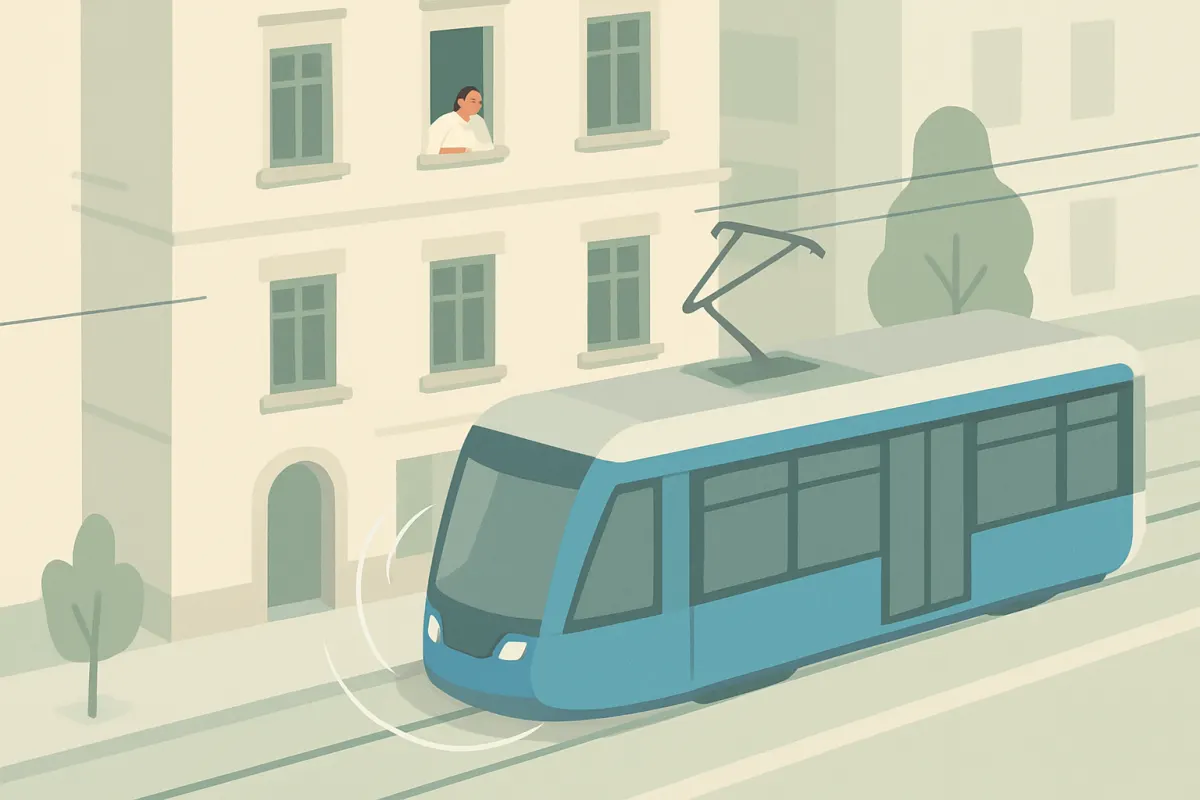
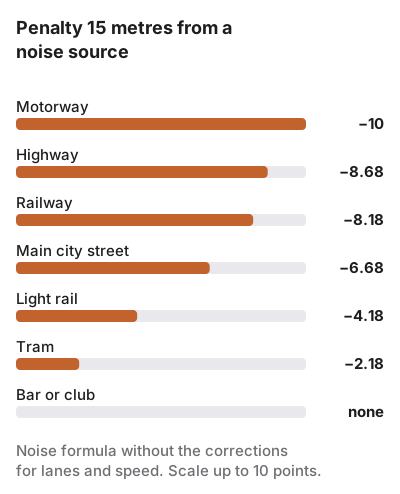
A tram 15 metres away takes off 2.18 points, a third of what a main street costs at the same distance. It does not carry far either: 29 metres from the line the formula's penalty is already zero. A light rail line is louder, 4.18 points at the facade, and fades out by 54 metres in the open or by 40 behind the first row of buildings.
One important detail: a tram usually runs along the same street as the cars. The formula takes the loudest road and the loudest rail or tram line and adds up their energy, not their decibels. A main street and a tram, both 15 metres away, give 68.9 decibels together, while the street without the tram gives 68.4. The tram adds only 0.26 points.
The formula ignores tunnels. It also ignores service tracks, depots and sidings. The squeal of a tram on a curve and its bell at five in the morning are not in the formula either: it counts the average level, not individual events.
Highways and railways: heard from far away
A highway by the building takes off 8.68 points, and a motorway hits the cap of 10. The main difference from a tram is reach. In the open the highway penalty only disappears at 215 metres, the motorway one at 341. In a densely built area, behind a row of buildings, that becomes 100 and 158 metres.
A railway 15 metres away costs 8.18 points and fades out by 185 metres in the open. If a big road and a railway are both nearby, their levels add up. That is how an address between a motorway and a railway easily reaches the cap.
| Source | Level at 10 m | Penalty at 15 m | Zero beyond, in the open | Zero beyond, dense area |
|---|---|---|---|---|
| Motorway | 78 dB | 10 | 341 m | 158 m |
| Highway | 75 dB | 8.68 | 215 m | 100 m |
| Railway | 74 dB | 8.18 | 185 m | 86 m |
| Main street | 71 dB | 6.68 | 117 m | 54 m |
| Light rail | 66 dB | 4.18 | 54 m | 40 m |
| Tram | 62 dB | 2.18 | 29 m | 29 m |
An example: Adler and central Sochi
The difference between loud and quiet places shows clearly in Sochi, on addresses computed on 3 October 2026. In Adler three addresses lost more than nine points to noise. 84 Ulyanova Street hit the cap of 10 points: that means 75 decibels or more at the building. 58 Kirova Street lost 9.49 and 38 Demokraticheskaya Street 9.21: by the formula that is 73 to 74 decibels.
Only the loudest sources produce figures like these: a highway or railway close by, a wide street with fast traffic, or a runway. Adler sits next to the airport, and for runways the formula has a rule of its own: under the take-off and landing path, up to 10 kilometres from the end of the runway, the noise goes up, and 8 decibels are added because an aircraft is more annoying than a car. The report names the source behind each building's penalty.
Central Sochi looks different. 7 Navaginskaya Street lost nothing and scored 88.1. 22 Moskovskaya Street lost 1.74 and scored 81.8. The noisy Adler addresses ended up with 58.4 to 62.9.
A bar under the window: what the calculation leaves out
The formula cannot see bars, clubs, summer terraces or concert venues. Open data has no night-time noise from venues, and we chose not to invent it. So a street full of bars can get a zero for noise if the cars on it move slowly or do not drive there at all.
Yet for sleep a bar can be worse than a highway. A highway hums steadily and predictably, while a bar comes in loud bursts, at night, at weekends and in summer. If the report shows many cafes and bars near the building under "Cafes and culture", visit the flat on a Friday evening rather than on a Tuesday afternoon.
- Tram: check how many metres your windows are from the line. Beyond 30 metres the formula no longer hears it.
- Highway and railway: check whether there are other buildings between them and yours. A row of buildings takes off 5 decibels.
- Bar: find the venues on the map near the building and go and see them in the evening. The number in the report will not tell you about them.
The full table of levels, the corrections for lanes and speed and the airport rule are listed on the page How it is calculated. The Adler and central addresses are collected on the Sochi page, and all the Russian addresses are in the rating.
Questions
How loud is a tram under the window?
By the formula a tram line 15 metres away gives about 59 decibels and takes off 2.18 points. At 29 metres the penalty is already zero.
How far from a highway does the noise stop counting?
By the formula the highway penalty disappears at 215 metres in the open and at 100 metres behind a row of buildings in a dense area.
Does the score include noise from bars and clubs?
No. Open data has no night-time noise from venues, so a street with bars is something to check yourself in the evening.
How do road and railway noise add up?
The loudest road and the loudest line are taken, and their sound energy is added. A quiet source next to a loud one adds little.