Living in Marbella old town: Plaza de los Naranjos
Living in Marbella old town and centre: Plaza de los Naranjos, Avenida Ricardo Soriano, the Alameda and the beach. Who it suits and what to look at first.
Score your own address
Everything this article covers, you can check on your own address: free, in a minute.
Free. The score at once, the full report after an e-mail sign-in.
Contents 9 sections
Two halves of one centre
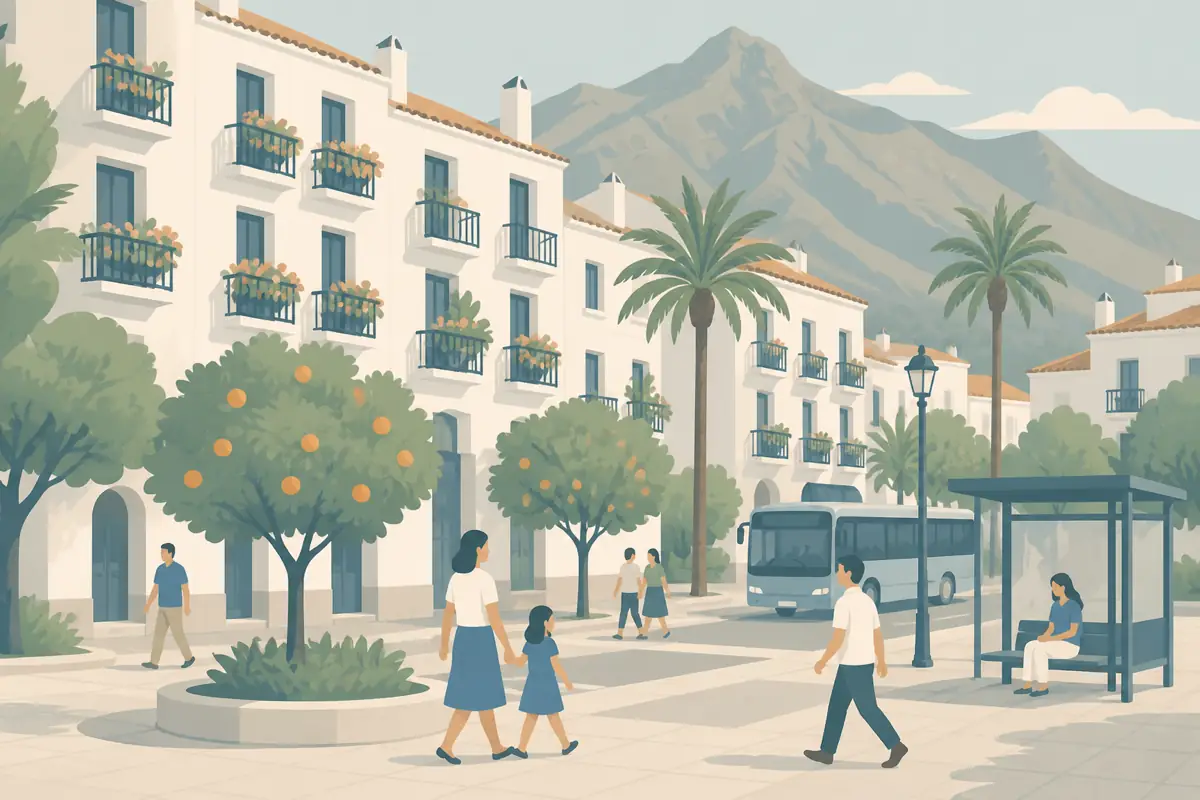
Living in Marbella old town means choosing between two quite different streetscapes. Up the slope is the Casco Antiguo: whitewashed houses, lanes hung with flowerpots, and Plaza de los Naranjos with the town hall. Below it runs Avenida Ricardo Soriano, a busy avenue of shops and banks, and from there the Alameda park and Avenida del Mar with its Dalí sculptures lead down to the sea.
This is the part of Marbella that works all year. The courts, the town hall, schools, clinics and the market are here, so the centre is full of ordinary Spanish households as well as newcomers.
Daily life on foot
Bread, a pharmacy, the post office and a bar for coffee and toast are a couple of blocks from almost any door. The beach promenade is a short walk downhill and runs both ways along the coast.
Marbella has no train. The bus station sits above the bypass, north of the centre, with coaches to Málaga airport, Málaga and Estepona; local buses run along Ricardo Soriano. Plenty of people still keep a car, but parking near a flat in the old lanes is close to impossible.
The three addresses
We picked a block on Avenida Ricardo Soriano, one on Avenida Ramón y Cajal in Barrio Nuevo by the park, and a quieter one on Calle Notario Luis Oliver between the old town and the avenue.
| Address | Score | Groceries | Station or stop | School | Park | Noise and air |
|---|---|---|---|---|---|---|
| Avenida Ricardo Soriano, 30, Marbella | 77.9 | 2 min | 2 minEdificio El Cisne | 7 min | 3 min | −7.1 |
| Avenida de Ramón y Cajal, 10, Marbella | 74.6 | 2 min | 1 minEdificio Berrocal - Casco Antiguo | 6 min | 2 min | −7.0 |
| Calle Notario Luis Oliver, 10, Marbella | 82.4 | 3 min | 4 minEdificio AMI | 4 min | 4 min | −0.5 |
Map numbers match the table rows. The plus button zooms in.
An avenue flat and a lane flat can feel like different towns, which is why the three points are spread out. More on How the score works.
Who it suits
- People moving without a car who want everything close.
- Retirees who value doctors, shops and a flat seafront walk.
- Remote workers who like street life in winter.
What you give up
In summer the old town fills with day visitors, and a share of the flats are holiday lets. Houses in the lanes are old, thin-walled and rarely have a lift. Rents are high for this stretch of coast, and a good long-term contract takes patience. Is the centre a good place to live? It is if you trade some noise for convenience.
Housing stock
The old town is mostly two- and three-storey houses around patios, often split into small flats. Along Ricardo Soriano and near the park you find apartment blocks from the sixties and seventies with balconies, a few with sea views over the rooftops. Newer buildings with a pool and underground parking are rare and priced accordingly.
Before you sign
Visit on a Friday night: the bars around Plaza de los Naranjos stay open late. Ask whether a parking space or a garage nearby comes with the flat. In an old house look for damp on the ground floor and check the bedroom air conditioning. A flat facing the avenue is louder than one facing a courtyard.
Is it safe?
We do not measure crime. The centre is busy in the evening, which usually helps; for a specific street, ask the neighbours and the landlord.
Next door
West of the centre the Golden Mile begins, with villas and hotels, then Nueva Andalucía and Puerto Banús. East lie the residential areas of Marbella Este, such as Río Real and Los Monteros, and beyond them Las Chapas.
Questions
Is Marbella old town a good place to live?
Yes, if you want to do everything on foot and can live with some noise. Schools, clinics, the market and the town hall are close by, but summer brings crowds to the old lanes and the bars near Plaza de los Naranjos stay open late.
Do you need a car in central Marbella?
Not really. Shops, the beach promenade and the local buses on Ricardo Soriano are all within reach, and coaches leave the bus station for Málaga and its airport. A car is more of a burden here, since parking in the old lanes is almost impossible.
What kind of housing is there in the centre of Marbella?
In the Casco Antiguo, old two- and three-storey houses around patios, usually split into small flats without a lift. Near the Alameda and Ricardo Soriano stand balconied blocks from the sixties and seventies. New buildings with a pool and a garage are scarce and expensive.