Living in El Palmar, Murcia: by the Arrixaca
Living in El Palmar, Murcia: the largest pedanía, south of the city by the Arrixaca hospital, with its own high street and lower rents. Pros and cons.
Score your own address
Everything this article covers, you can check on your own address: free, in a minute.
Free. The score at once, the full report after an e-mail sign-in.
Contents 8 sections
A town of its own inside Murcia
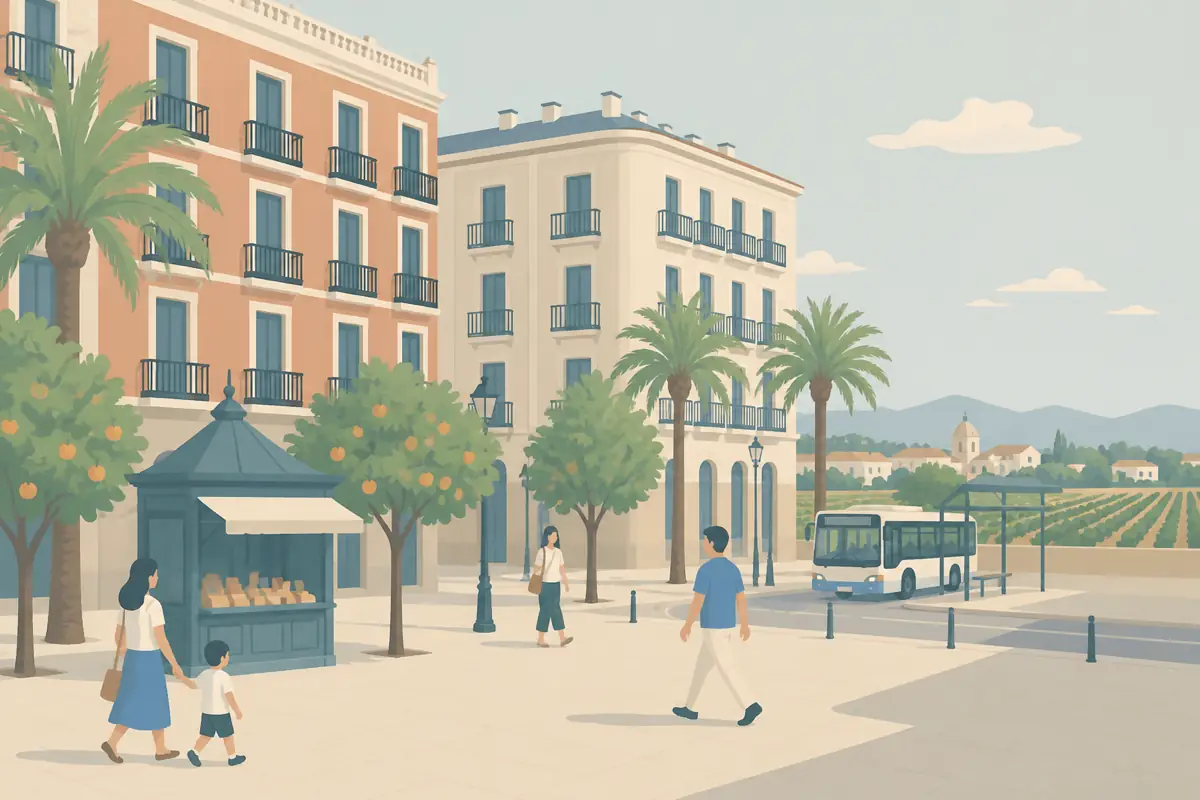
On paper El Palmar belongs to the municipality of Murcia. In practice it feels like a separate town a few kilometres south of the centre. Murcians call such places pedanías, and El Palmar is the largest of them.
Everyone in the region knows it for the Virgen de la Arrixaca, Murcia's main hospital, and the health sciences campus next to it. Many doctors, nurses and students live here to avoid crossing the whole city every day.
Its own daily life
El Palmar has a high street with shops, a market, schools, a church and bars where everyone knows everyone. Buses run into Murcia, and the trip takes a while, especially at rush hour, through other pedanías.
Flats and rents are usually cheaper than in the city barrios to the north, which is the main reason families on a budget move here.
What we measured
The three addresses, on Calle Isabel la Católica, Calle del Pilar and Calle Floridablanca, sit in the old core of the town, a few hundred metres apart.
| Address | Score | Groceries | Station or stop | School | Park | Noise and air |
|---|---|---|---|---|---|---|
| Calle de Isabel "La Católica", 5, Murcia | 76.9 | 7 min | 4 minClub 3° Edad (Impar) | 7 min | 7 min | −1.0 |
| Calle del Pilar, 10, Murcia | 74.2 | 7 min | 5 minPlaza Capitán García | 8 min | 8 min | −1.0 |
| Calle Floridablanca, 30, Murcia | 80.1 | 6 min | 3 minClub 3° Edad (Impar) | 7 min | 6 min | −1.0 |
Dot and table row share a number.
The results describe central El Palmar, not its newer edges or the area right by the hospital.
Who it suits
- Arrixaca staff and students of the health campus.
- Families who need a rent below city level.
- People who like small-town life close to the regional capital.
The trade-offs
It is not a city barrio, and without a car trips into Murcia depend on the bus timetable. Parts of the town are old and run-down, the streets narrow, and the main road is noisy.
Is El Palmar a good place to live? If you work at the hospital or on the campus, it is a sensible choice. If your job is in the centre, compare the journey with the barrios on the north bank.
Pedanía or city
The difference matters. A pedanía has its own fiestas, its own market and neighbours who know your name. Some people love that; others miss the anonymity of the city and the choice of restaurants.
What to check
See how far the flat is from a bus stop and how often buses run in the evening. Ask about parking by the building. If the windows face the main road, judge the noise at night.
We do not measure crime, so ask neighbours and people who work locally about a particular street.
Neighbours
None of our measured barrios border El Palmar. The nearest, the city centre, is a drive north across the Ronda Sur and the river. Closer to the Segura, still on the south bank, lies Infante Juan Manuel.
Questions
Is El Palmar a good place to live?
If you work at the Arrixaca hospital or study on the health campus, it is a sensible choice: work is close and housing usually costs less than in the city. If your job is in central Murcia, think about the daily bus ride first.
How do you get from El Palmar to Murcia city centre?
By bus or by car, north through other pedanías, over the Ronda Sur and the river. At rush hour the trip drags. Bike paths exist, but riding in the summer heat is hard going.
Is El Palmar a good option for families on a budget?
Yes, lower rents are exactly why many families move here. The town has schools, a market, a church and a high street with shops. Without a car you will plan around the bus timetable, especially in the evening.
How is a pedanía different from a city barrio?
El Palmar lives like a small town: its own fiestas, its own market, shopkeepers and neighbours who know you by name. Some people love that; others miss city anonymity and a wider choice of restaurants.