Living in Torrevieja town centre: port and promenade
Living in Torrevieja town centre: a grid of flats behind the port and promenade, the market, two town beaches and buses. Who it suits, and the snags.
Score your own address
Everything this article covers, you can check on your own address: free, in a minute.
Free. The score at once, the full report after an e-mail sign-in.
Contents 8 sections
A town built behind its seafront
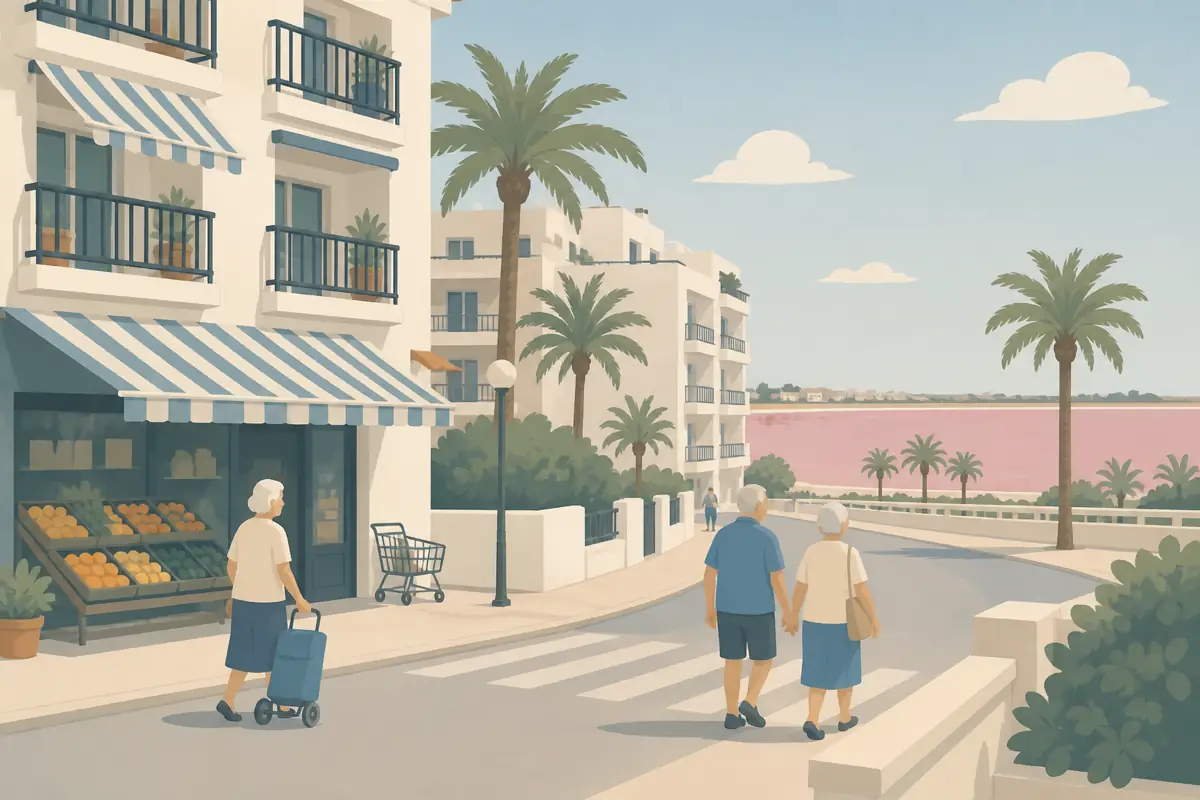
Living in Torrevieja town centre means living in the grid of straight streets between the port, the seafront promenade and the Plaza de la Constitución. Torrevieja grew out of a salt-workers' and fishermen's village, so there is little old architecture: most buildings are blocks of flats from the seventies to the nineties, with shops at street level.
Is Torrevieja a good place to live? The centre is the part of town where the answer is easiest, because it is the one area that does not empty out in winter. Spanish families live here alongside Northern European retirees and a large Russian-speaking community.
Day to day
The market, chemists, banks, a health centre, schools and plenty of cafés are a few blocks apart. Playa del Cura and the cove of Los Locos reach right up to the streets, and in the evening people stroll along the breakwater by the port. In summer the town hosts its habaneras song contest, a tradition that goes back decades.
There is no railway. Town buses loop out to the urbanizaciones, and coaches from the bus station in the centre go to Alicante, Murcia and the airport. The public hospital is on the western edge of town, so getting there takes a bus or a car.
What we measured
We scored addresses on Calle Pedro Lorca and Calle Ramón Gallud, both a couple of blocks from the sea, and on Calle del Tomillo in the Europa area on the northern edge of the centre.
| Address | Score | Groceries | Station or stop | School | Park | Noise and air |
|---|---|---|---|---|---|---|
| Calle Pedro Lorca, 20, Torrevieja | 84.4 | 3 min | 2 minHotel Fontana | 6 min | 6 min | −0.7 |
| Calle Ramón Gallud, 50, Torrevieja | 84.6 | 2 min | 3 minHotel Fontana | 4 min | 8 min | −0.7 |
| Calle del Tomillo, 12, Torrevieja | 77.9 | 2 min | 2 minGasolinera BP | 6 min | 3 min | −2.0 |
Each dot carries the number of its row in the table, and the plus button zooms in.
Who it suits
- Retirees who want to do everything on foot.
- People without a car.
- Anyone working in town all year, in shops, cafés or services.
The trade-offs
Buildings are mostly older, often without a lift or a garage, and finding a street space in summer is a chore. In July and August the town fills with holidaymakers and the noise lasts late. In winter it swings the other way: many flats stand empty and some streets feel deserted.
The housing
A typical flat in the centre sits in a block of five to ten floors with a balcony over the street. Many are small, with one or two bedrooms, because they were built as holiday homes, so kitchens are tight and storage is scarce. New builds are rare; refurbished older blocks are more common. Flats with a sea view cost noticeably more than those facing a courtyard.
What to check
Ask about the lift and the air conditioning, and stand on the balcony on a Friday evening: there may be a bar below. Find out how many flats in the block are holiday lets. Is the centre safe? We do not measure crime, so ask neighbours about the specific street and walk it after dark.
Neighbours
North of the centre, towards the pink salt lagoon, is the urbanización of El Chaparral. Further up the coast are Aguas Nuevas and La Mata.
Questions
Can you live in central Torrevieja without a car?
Yes, more easily than anywhere else in town. The market, chemists, banks, a health centre and schools are a few blocks apart, and coaches leave the central bus station for Alicante, Murcia and the airport. Only the public hospital, on the western edge, needs a bus or a car.
What are flats like in the centre of Torrevieja?
Mostly flats in blocks from the seventies to the nineties, many of them small, with one or two bedrooms, because they were built as holiday homes. A lift and a garage are not a given, and a sea view adds noticeably to the price.
Is the centre of Torrevieja lively in winter?
It is the one part of town that does not empty out: Spanish families, Northern European retirees and a large Russian-speaking community live here all year. Still, some holiday flats stand dark in winter, so look at your street out of season too.