Living in El Born, Barcelona: medieval streets and bars
Living in El Born, Barcelona: medieval streets around Santa Maria del Mar, designer shops, cocktail bars and the Ciutadella park. Three addresses on foot.
Score your own address
Everything this article covers, you can check on your own address: free, in a minute.
Free. The score at once, the full report after an e-mail sign-in.
Contents 11 sections
What the district is like
El Born is the part of the old town between Via Laietana and the Ciutadella park. Its streets keep their medieval layout, and at the centre stands Santa Maria del Mar, the church the quarter's own residents built.
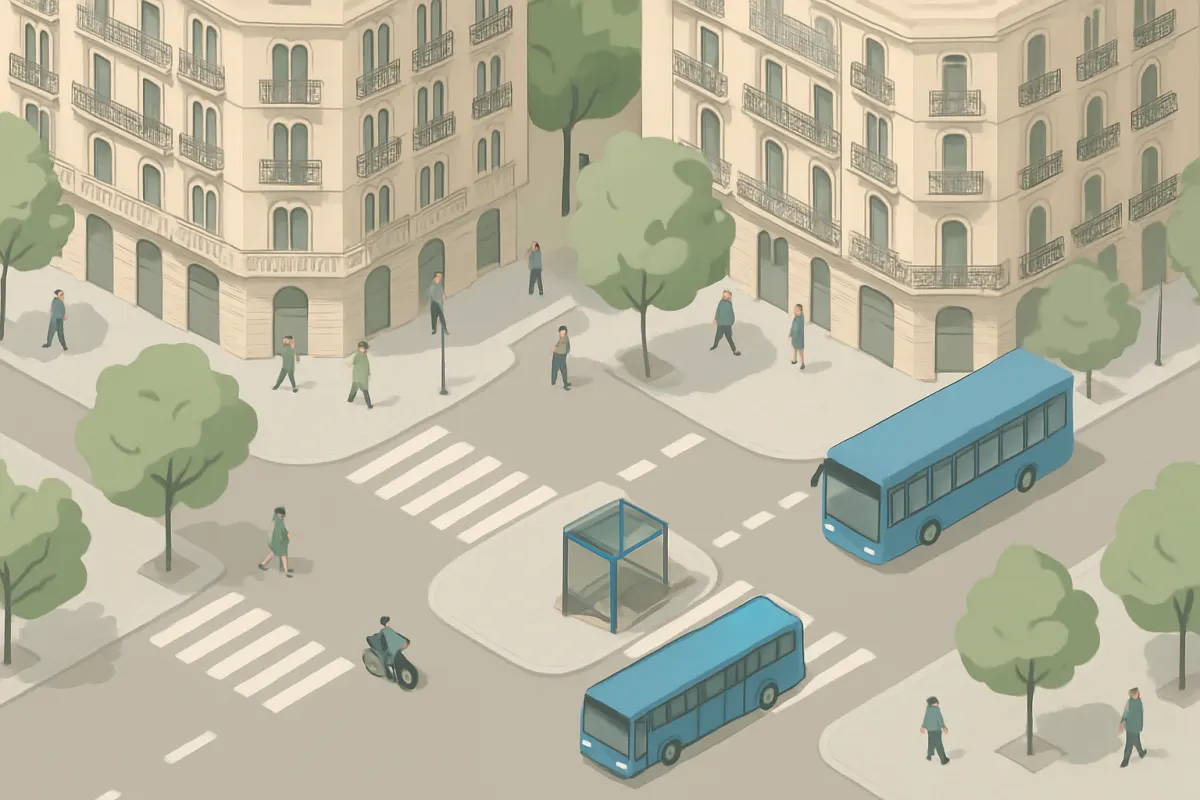
Today the El Born area means designer shops, cocktail bars, the Picasso museum and a former market hall turned cultural centre.
On foot
Daily errands are minutes away: the Santa Caterina market, shops, cafes, a gym. The sea, the port and the Gothic Quarter are a walk. Metro and railway station are at the edges.
The big green space is the Ciutadella, with a lake and lawns, starting just across Carrer del Comerç. The streets themselves are narrow, stone and almost treeless.
What we measured
We chose Passeig del Born, Carrer de la Princesa and Carrer del Comerç on the park side.
| Address | Score | Groceries | Station or stop | School | Park | Noise and air |
|---|---|---|---|---|---|---|
| Passeig del Born, 20, Barcelona | 94.1 | 2 min | 5 minJaume I | 6 min | 5 min | −2.0 |
| Carrer de la Princesa, 30, Barcelona | 94.3 | 2 min | 4 minJaume I | 6 min | 4 min | −2.0 |
| Carrer del Comerç, 36, Barcelona | 94.2 | 2 min | 7 minJaume I | 6 min | 4 min | −2.0 |
Map numbers match the table rows. Use the plus button to zoom in.
The third address is nearest the park, and the table shows it. Bar noise at night is not measured; what is measured is on How the score works.
Who it suits
- Young expats.
- Remote workers who want to live in the old town.
- People renting for a few months.
The trade-offs
There are tourists and noise at night. The narrow streets get an hour of sun a day, the flats are old, and pickpockets work the crowds. After a couple of years many residents move further uphill.
The housing
Houses from the Middle Ages to the nineteenth century, narrow and with steep stairs. Small flats with beams and stone walls. A lift is not a given.
What to check
Check the light: go up at midday and see whether the sun reaches the windows. Ask what is on the ground floor. Come back on a Saturday night.
With children
There are fewer families than elsewhere, but there are some. The Ciutadella makes up for a lot, with playgrounds, the zoo and rowing boats on the lake.
Without a car
A car makes no sense: access is restricted and there is nowhere to leave it.
Summer and winter
Stone streets stay cool in summer, but the quarter is full of people. In winter the old houses are damp and the lanes are quiet by ten.
Neighbours
Across Via Laietana is the Gothic Quarter. Uphill the Eixample begins. Past the park, by the sea, is Poblenou.
Questions
Is El Born a good place to live?
If you want the old town within walking distance of the sea, the port and Ciutadella park, yes. Santa Caterina market and cafés are close. But tourists, night noise and pickpockets come with it, and the sun reaches the narrow streets only briefly.
Can you live in El Born with children?
You can, though there are fewer families than elsewhere. Ciutadella park saves the day with playgrounds, the zoo and boats on the pond, and there are schools in and around the quarter. Pushchairs on narrow pavements and naps during walking tours are the hard part.
What are El Born flats like?
Small, with beams and stone walls, in narrow buildings with steep stairs, and not every one has a lift. Visit at noon to see whether sunlight reaches the windows, and come back on a Saturday night to hear what runs on the ground floor.