Living in Sant Andreu, Barcelona: a village up north
Living in Sant Andreu, Barcelona: an old core around Carrer Gran de Sant Andreu, its own market, L1 and Rodalies. Pros, cons and addresses.
Score your own address
Everything this article covers, you can check on your own address: free, in a minute.
Free. The score at once, the full report after an e-mail sign-in.
Contents 11 sections
A town within the city
Sant Andreu de Palomar was a town of its own north of Barcelona until the late nineteenth century. It was annexed, yet older residents still say they are going to Barcelona when they head downtown. It has its own high street, its own church and its own festa major.
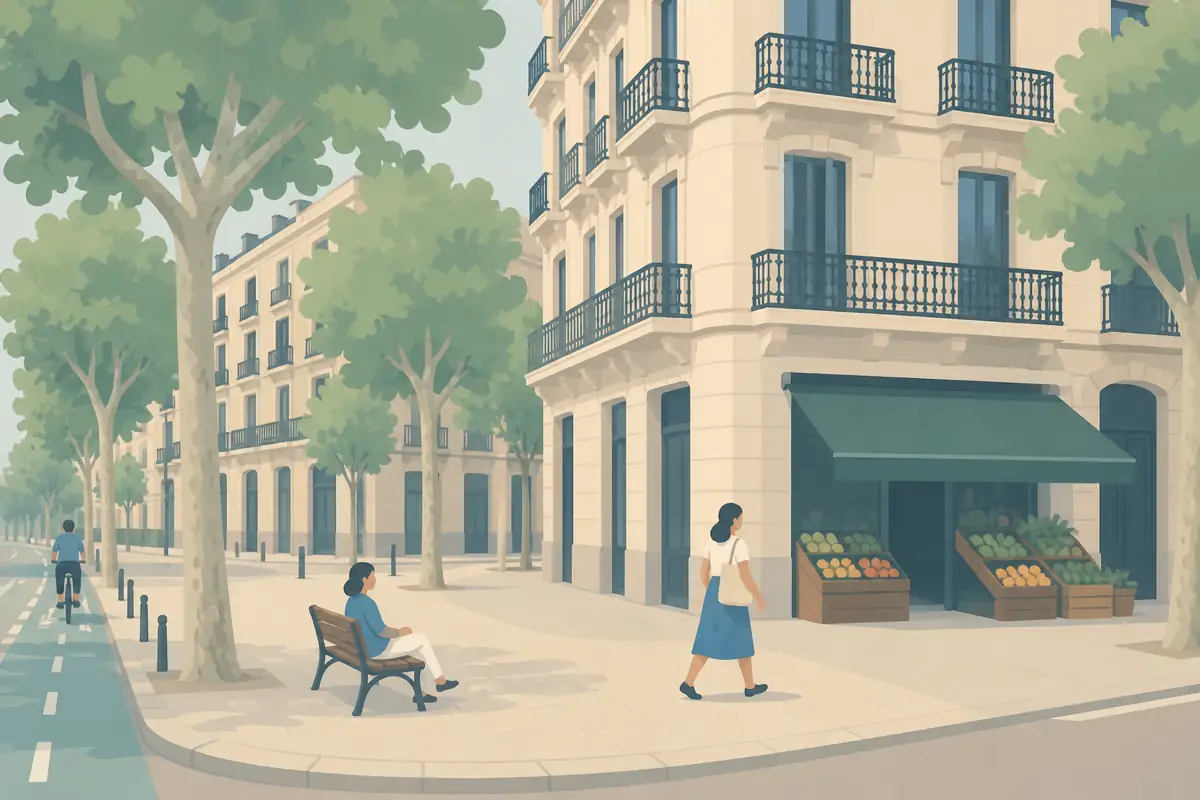
The heart is Carrer Gran de Sant Andreu, long and traffic-calmed. Around it sit Plaça d'Orfila with the church and the Sant Andreu market. Tourists rarely make it here, and neighbours know each other by name.
Day to day
Bakeries, greengrocers, cafés and nurseries line the main street and the lanes beside it. A large park is being laid out to the south on old railway land near La Sagrera, together with the new station.
L1 crosses the area with stops at Sant Andreu, Torras i Bages and Fabra i Puig. Rodalies trains call at Sant Andreu station, and the centre is a single ride away.
The addresses
We took a building on Passeig de Torras i Bages in the north, one on Carrer de Joan Torras toward the eastern edge, and one on Carrer de Pons i Gallarza close to the old core.
| Address | Score | Groceries | Station or stop | School | Park | Noise and air |
|---|---|---|---|---|---|---|
| Passeig de Torras i Bages, 50, Barcelona | 89.3 | 5 min | 3 minSant Andreu | 4 min | 4 min | −4.0 |
| Carrer de Joan Torras, 40, Barcelona | 89.6 | 2 min | 3 minSant Andreu | 3 min | 6 min | −2.1 |
| Carrer de Pons i Gallarza, 20, Barcelona | 92.4 | 3 min | 4 minSant Andreu | 6 min | 6 min | −2.0 |
Dot numbers and row numbers are the same, and the plus button zooms the map.
Outer districts like this often do well on daily errands and worse on the trip to the sea. More on How the score works.
Who it suits
- Families who want a calm street with everything close.
- People priced out of the centre.
- Young couples happy to chat with neighbours in Catalan.
The trade-offs
The beach and the centre are further away than from most districts. English-language services and international schools are thin on the ground. Life along the tracks is noisy, and the huge La Sagrera station works have gone on for years.
The housing
The old core has houses of two or three floors, some with a courtyard behind. The wider avenues have mid-century blocks, and newer developments sit on the edges.
What to check
Find out how close the rails are and whether trains rumble under the window. Check which metro stop is nearer. Walk Carrer Gran on a Saturday morning to get the feel of the place.
Safety
We do not measure crime. Walk from the station to the door on a weekday evening and judge for yourself.
For families
Schools and playgrounds are plentiful, the streets of the core carry little traffic, and many children walk to school on their own.
Festivals and language
In late November, around Saint Andrew's Day, the district holds its own festa major with fire runs and concerts in the squares. You hear more Catalan on the street than in the centre, and notices in building entrances are usually written in it. Spanish is enough to get by, but a few phrases of Catalan help you get on with the neighbours.
Neighbours
Nou Barris starts to the north, La Sagrera and Sant Martí, with Poblenou by the sea, to the south. Line L1 takes you from here to the Eixample without changing.
Questions
Is Sant Andreu a good place to live?
If you want a quiet street, neighbours who know each other and everything you need nearby, yes. It has its own main street with limited traffic, a market and a church square, and almost no tourists. The trade-off is a longer trip to the sea and the centre, and noise along the railway.
How do you get from Sant Andreu to central Barcelona?
On metro line L1 from Sant Andreu, Torras i Bages or Fabra i Puig without changing, or on Rodalies trains from Sant Andreu station. Before choosing a flat, check which station is closer to the door.
Do you need Catalan in Sant Andreu?
Spanish is enough to get by, but Catalan is heard on the street more than in the centre, and notices in building entrances are usually written in it. A few phrases of Catalan help you make friends with the neighbours.