Living in Zaragoza city centre: arcades and tram
Living in Zaragoza city centre: the arcades of Independencia, the tram and big old flats. Who it suits, what it costs and what to check in a building.
Score your own address
Everything this article covers, you can check on your own address: free, in a minute.
Free. The score at once, the full report after an e-mail sign-in.
Contents 9 sections
The centre is not the old town
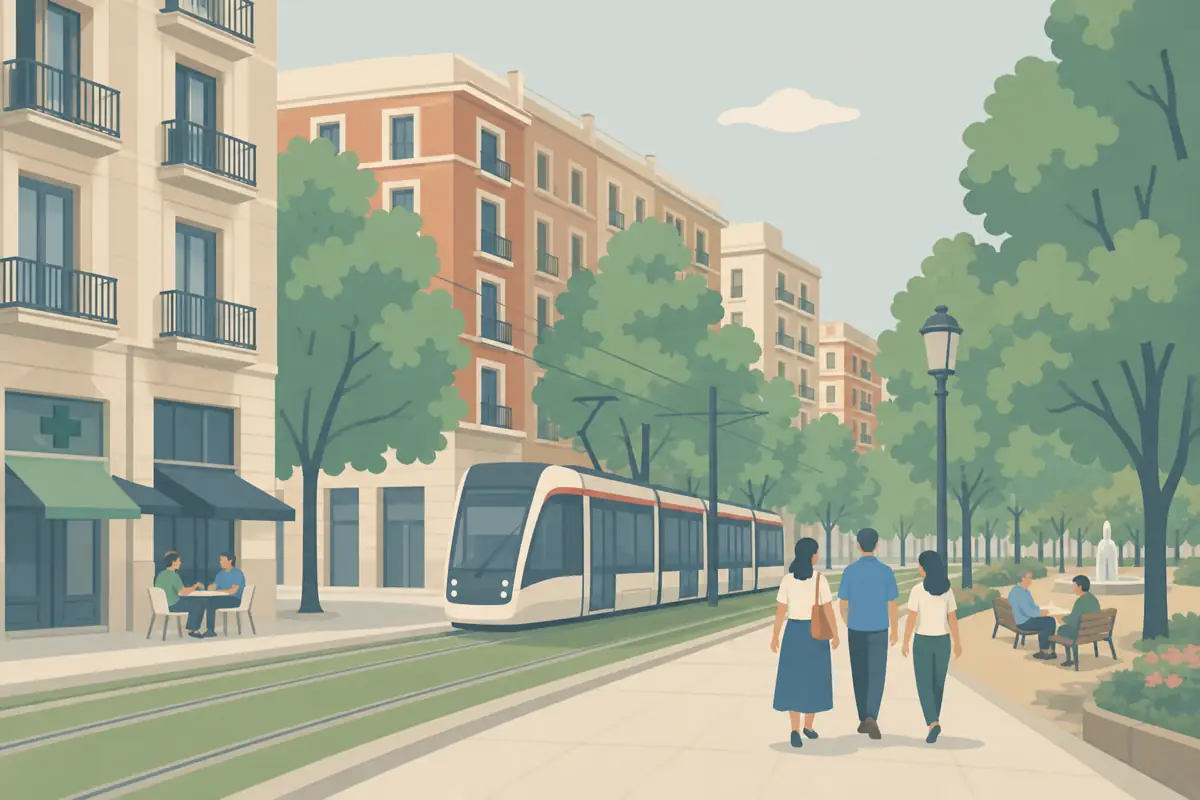
Zaragoza city centre, the official Centro district, sits just south of the old town around the Basílica del Pilar. It is the city of the late 1800s and 1900s: the arcaded Paseo de la Independencia, Plaza Aragón, and the two boulevards Paseo Sagasta and Gran Vía. Expect handsome apartment buildings with tall ceilings, banks, offices and the El Corte Inglés department store.
The medieval lanes, the Mercado Central and the Pilar belong to the next district over. From most streets of Centro they are a short walk, so people here use both.
Day to day
Tram line 1 runs down Independencia and Gran Vía. Southbound it heads past La Romareda to the new estates; northbound it crosses the Ebro to Actur. Shops, pharmacies, cafés, schools and health centres are never far.
The climate shapes daily life. Summers are fierce, and in winter the cierzo, a cold north-westerly wind, can blow for days. Locals duck under the arcades of Independencia; on open Plaza Aragón you feel it full in the face.
What we measured
Our three addresses are on Paseo Sagasta, on Calle Cádiz and at the northern end of Paseo de la Independencia; that last building stands near Plaza de España, on the district’s northern edge.
| Address | Score | Groceries | Station or stop | School | Park | Noise and air |
|---|---|---|---|---|---|---|
| Paseo de Sagasta, 20, Zaragoza | 91.6 | 5 min | 2 minPaseo de Sagasta 14 | 2 min | 2 min | −5.3 |
| Paseo de la Independencia, 10, Zaragoza | 93.9 | 2 min | 2 minPlaza de España | 3 min | 5 min | −2.3 |
| Calle Cádiz, 10, Zaragoza | 95.6 | 3 min | 4 minPlaza de España | 2 min | 6 min | −0.4 |
Each map number is a table row.
The housing
Buildings from the late 1800s and early 1900s stand next to 1960s blocks. Flats are often large, with three or four bedrooms, a long corridor and windows on two sides. Lifts were frequently added later in the courtyard, and the cabin can be tiny. Studios are scarce, so a single person has less choice here than a family.
Who it suits
- People working in the offices and banks around Plaza Aragón.
- Retirees who want everything within a few blocks.
- Couples without a car who like to walk.
Pros and cons
Distance is the big win: apart from Delicias station, which needs a bus or a taxi, nearly everything is close. The costs are clear too. This is the priciest district in Zaragoza, buses and cars make Independencia and Gran Vía loud, and kerbside parking is close to hopeless.
Flats in older buildings tend to be large but tired: wiring, windows and heating often need work. Newer blocks on Sagasta come with lifts and garages, and with prices to match.
Is the city centre a good place to live?
If you want the city outside your window and never want to drive for bread, yes. A family after a courtyard and quiet nights should weigh Centro against Universidad or Actur.
Is Zaragoza city centre safe? We do not measure crime. Evenings here are busy with people; still, walk from the flat to the tram stop after ten at night before you sign.
Checking a flat
Find out whether the windows face the avenue and the tram or an inner courtyard. Ask about air conditioning and how the building is heated, because shared central heating in old blocks can be costly. Locate the nearest underground car park.
Neighbouring districts
Paseo Sagasta leads south into Universidad and the Parque Grande. West lies Delicias; east, across the Huerva river, is San José.
Questions
Is Zaragoza city centre a good place to live?
It suits people who like to walk everywhere: shops, cafés, schools and the tram are close, and the old town is a stroll away. It is also the priciest district in the city, and the main avenues are loud with buses and cars.
What is the difference between Centro and the old town?
The old town around the Basílica del Pilar, with its medieval lanes and the Mercado Central, is a separate district. Centro lies just south of it and grew in the nineteenth and twentieth centuries around Independencia, Sagasta and Gran Vía.
Can you live in central Zaragoza without a car?
Easily. Tram line 1 runs down Independencia and Gran Vía, and nearly everything else is a walk away. A car is more of a burden here, since kerbside spaces are almost never free, so find out where the nearest underground car park is.
What are flats like in the centre of Zaragoza?
Many are large, with three or four bedrooms, a long corridor and windows on two sides. In older buildings the wiring, windows or heating often need work, and a lift added later can be tiny. Studios are hard to find.