Living in Recoleta, Buenos Aires: Alvear, Junín, Santa Fe
Living in Recoleta, Buenos Aires: Alvear, Junín by the cemetery and Santa Fe, walked to lines D and H and Plaza Francia with its rubber trees and fair.
Score your own address
Everything this article covers, you can check on your own address: free, in a minute.
Free. The score at once, the full report after an e-mail sign-in.
Contents 10 sections
What the district is like
Recoleta is the grandest barrio in Buenos Aires. In the early twentieth century wealthy families built here on Parisian models, and Avenida Alvear still looks like a piece of France.
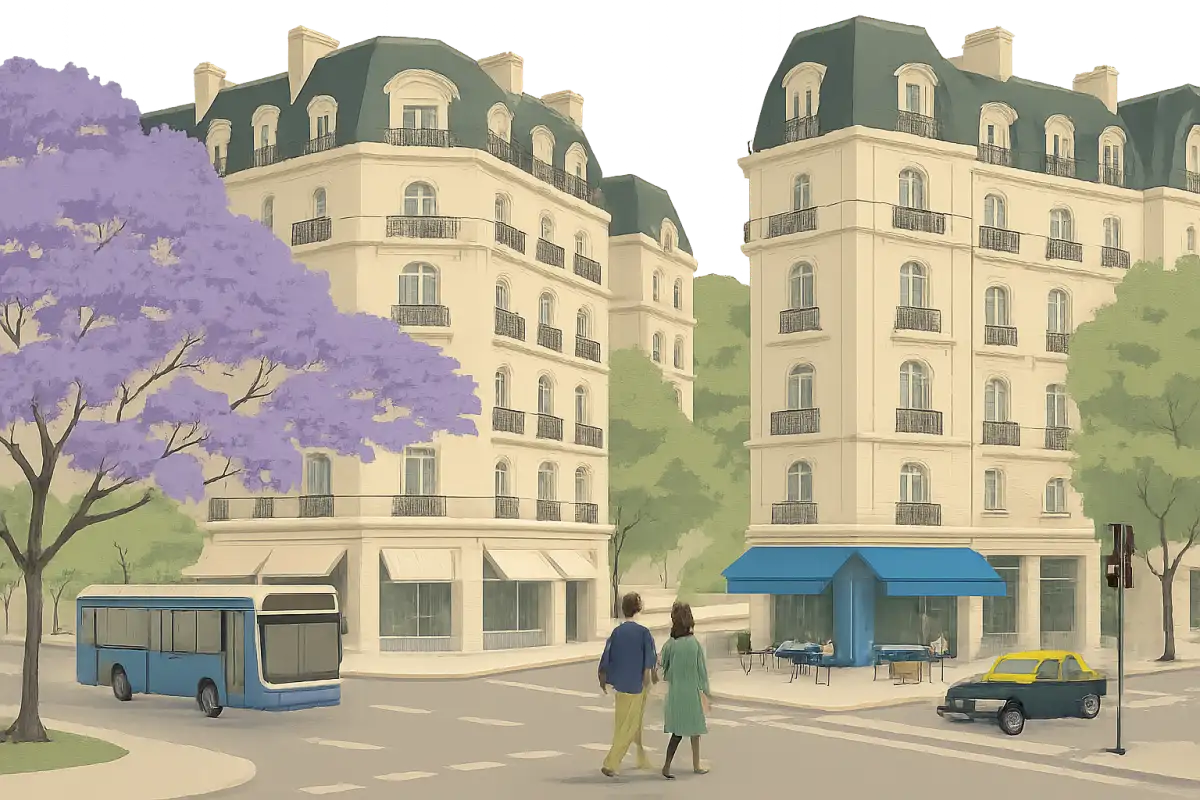
It is known for the cemetery with its vaults, the fine arts museum and the squares sloping down towards the river. Several university faculties are next door, so there are many students among the residents.
On foot
Recoleta is close to downtown and well connected. Subway line D runs under Santa Fe and line H crosses the barrio too. Buses use every avenue.
Shops, cafes, clinics, bookshops and cinemas are a few blocks away. Plaza Francia and Plaza Mitre, with their century-old rubber trees, are the barrio's park. At weekends there is a craft fair.
What we measured
The addresses are Avenida Alvear, Calle Junín by the cemetery and Avenida Santa Fe.
| Address | Score | Groceries | Station or stop | School | Park | Noise and air |
|---|---|---|---|---|---|---|
| Avenida Alvear, 1891, Buenos Aires | 83.8 | 4 min | 9 minFacultad de Derecho - Julieta Lanteri | 4 min | 2 min | −6.6 |
| Junín, Buenos Aires | 88.3 | 2 min | 8 minLas Heras | 2 min | 1 min | −6.0 |
| Avenida Santa Fe, 1860, Buenos Aires | 86.7 | 2 min | 6 minCallao (D) | 2 min | 3 min | −6.2 |
Map numbers match the table rows. Use the plus button to zoom in.
In this table Santa Fe should lose on noise and win on transport. How that is weighed is on How the score works.
Who it suits
- Retirees.
- High-income families.
- Expats who want classic Buenos Aires.
- Students at the nearby faculties.
The trade-offs
It is expensive, and the avenues carry heavy traffic. Residents are older than in Palermo and evenings are quieter; people describe the barrio as calm and a little formal.
The housing
Buildings from the first half of the twentieth century with high ceilings, oak floors and a caretaker, plus towers from the sixties and seventies. Flats are large. Recoleta real estate offers little that is brand new.
What to check
Ask about the monthly building charges: in old buildings with staff they are high. Check the lift and the heating, and see whether the flat faces the avenue.
Summer and winter
In January many residents leave for the coast and the barrio empties. In winter the old buildings with central heating are warm.
Without a car
From here it is easy to reach any part of the city. Buses run all night and taxis are everywhere.
The business district and Retiro station are a walk or a few stops away. Cycle lanes cross the barrio towards the parks of Palermo.
Neighbours
To the north-west, Santa Fe leads into Palermo. To the south, beyond the business district, lies old San Telmo.
Questions
Is Recoleta a good place to live?
It is if you want to live close to downtown in an old building with high ceilings and quiet evenings. The price is steep: it is one of the most expensive barrios, and its avenues carry heavy traffic all day.
How do you get from Recoleta to the centre?
Many people simply walk to the business district and Retiro station. Subway line D runs under Avenida Santa Fe, line H crosses the barrio too, and buses on the avenues keep going through the night.
What is housing like in Recoleta?
Large flats in early twentieth-century buildings with parquet, tall ceilings and a caretaker, plus towers from the sixties and seventies. New builds are rare. Before renting, ask what the building charges come to, because staff in old buildings cost a lot.
Is Recoleta good for families with children?
For well-off families, yes. Schools are close, the wide squares have playgrounds under old trees and museums run programmes for children. There are fewer kids around than in Belgrano, though, so playmates next door may be scarce.